Modal Interchange Chords & Borrowed Harmony
Understand modal interchange and borrowed chords with real C major/minor examples, guitar and piano exercises, note changes, and common pitfalls.
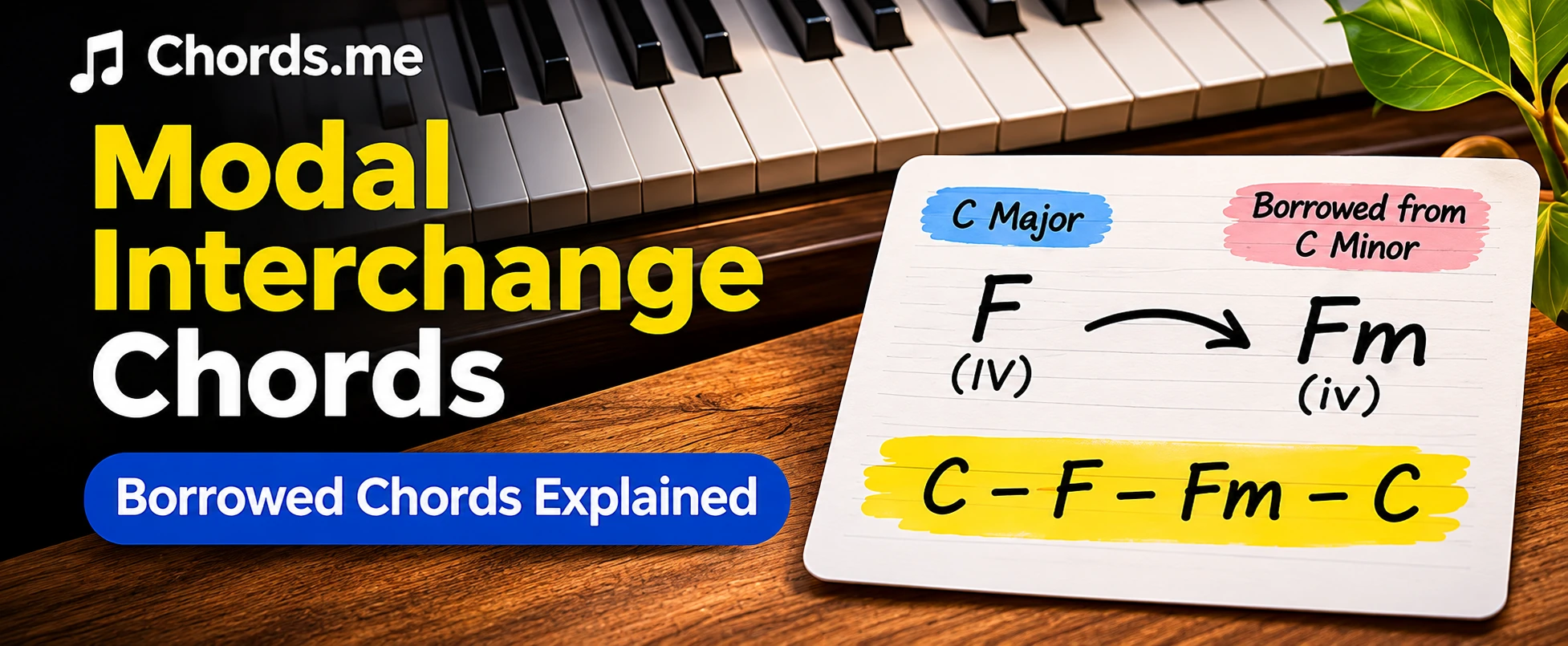
Modal interchange chords, also called borrowed chords, are chords taken from a parallel mode and used inside your main key. In C major, you might borrow F minor from C minor while the music still feels centered on C. The chord brings in a note outside the C-major scale, adding a new color without changing home.
Try this progression: C – F – Fm – C
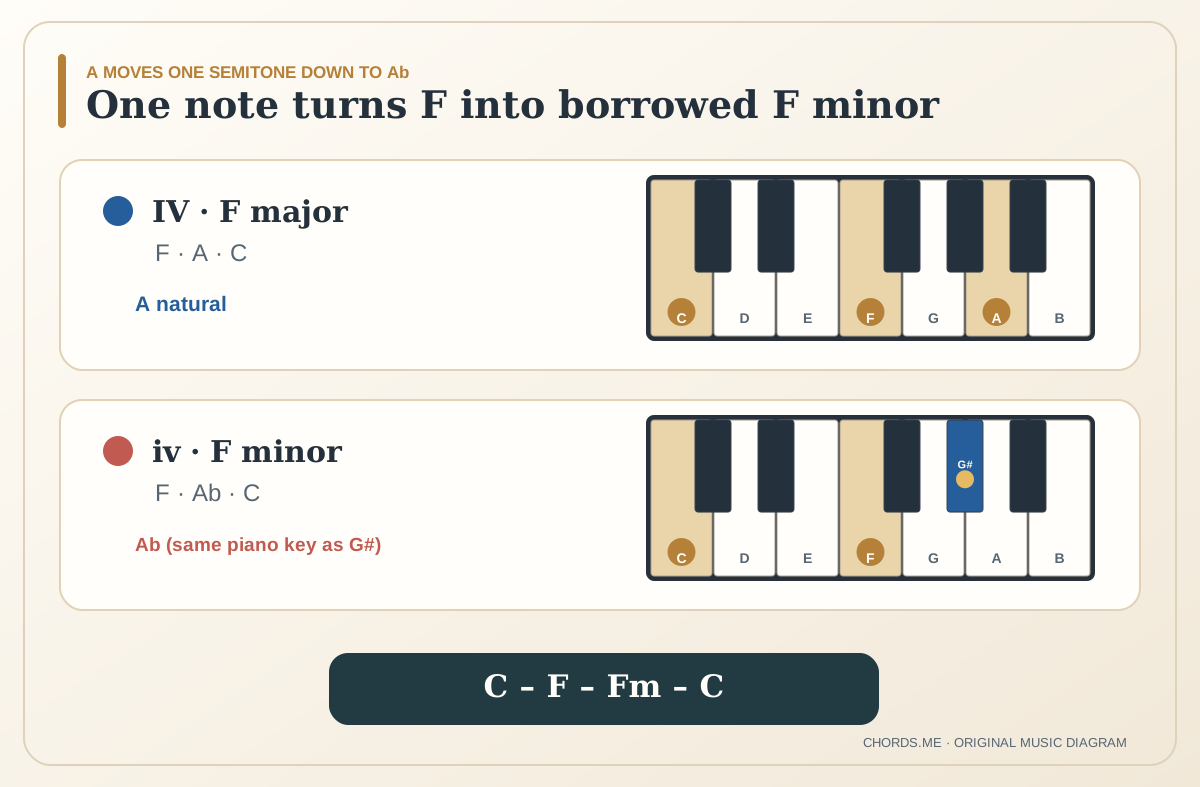
Play F major, then F minor. Only one note changes: A drops to A♭, so F–A–C becomes F–A♭–C. A♭ isn’t in the C-major scale. It comes from C minor, the parallel minor. But the progression lands back on C, so C still sounds like home. That is the classic borrowed-chord effect: a familiar key with one unexpected note.
First listen, then name it: Play C – F – Fm – C slowly, holding each chord for four beats. Repeat the loop, but use F both times: C – F – F – C. The difference you hear comes chiefly from a single altered note. This short before-and-after test is the easiest way to understand the idea before learning the terminology.
What Is Modal Interchange in Music?
Four ideas are worth keeping separate:
- Diatonic harmony uses chords built only from the key’s scale. In C major, that means C, Dm, Em, F, G, Am, and Bdim.
- Borrowed chords come from a parallel major, minor, or other mode with the same tonic. They often introduce notes that are outside the home scale.
- Tonal center is the chord or note that feels like home. Borrowing leaves it in place.
- A change of key or mode establishes a new tonal context for more than a passing chord. The tonic can move, or the music can shift between parallel major and minor.
For example, consider C – G – Fm – C. The G and C are ordinary C-major chords. The Fm is borrowed. In this short example, the C-major harmony remains the main point of reference; one Fm chord is not enough by itself to establish a different key.
How Borrowed Chords Work
Here is the process, using C major:
- Choose your key. C major: C D E F G A B.
- Identify a parallel mode. The simplest choice is C natural minor: C D E♭ F G A♭ B♭.
- Find a chord from that parallel collection. C minor has E♭, A♭, and B♭ where C major has E, A, and B. A chord is a borrowing candidate when its notes and musical role fit the chosen parallel mode—not merely because it contains one chromatic note.
- Replace or insert the chord. Swap F for Fm, or add A♭ before a chord you already have.
- Check the larger context. If C remains the convincing tonal center and major-key harmony returns, the altered chord is reasonably heard as a borrowing rather than a sustained shift into another key or mode.
The triads of C natural minor are Cm, Ddim, E♭, Fm, Gm, A♭, and B♭.
A note on notation: in this article, ♭III, ♭VI, and ♭VII are measured against the major scale, so B♭ in the key of C is ♭VII. Some textbooks number the same chords as III, VI, and VII of the minor scale. Neither is wrong, but check which system a source uses.
Parallel Major vs Relative Minor
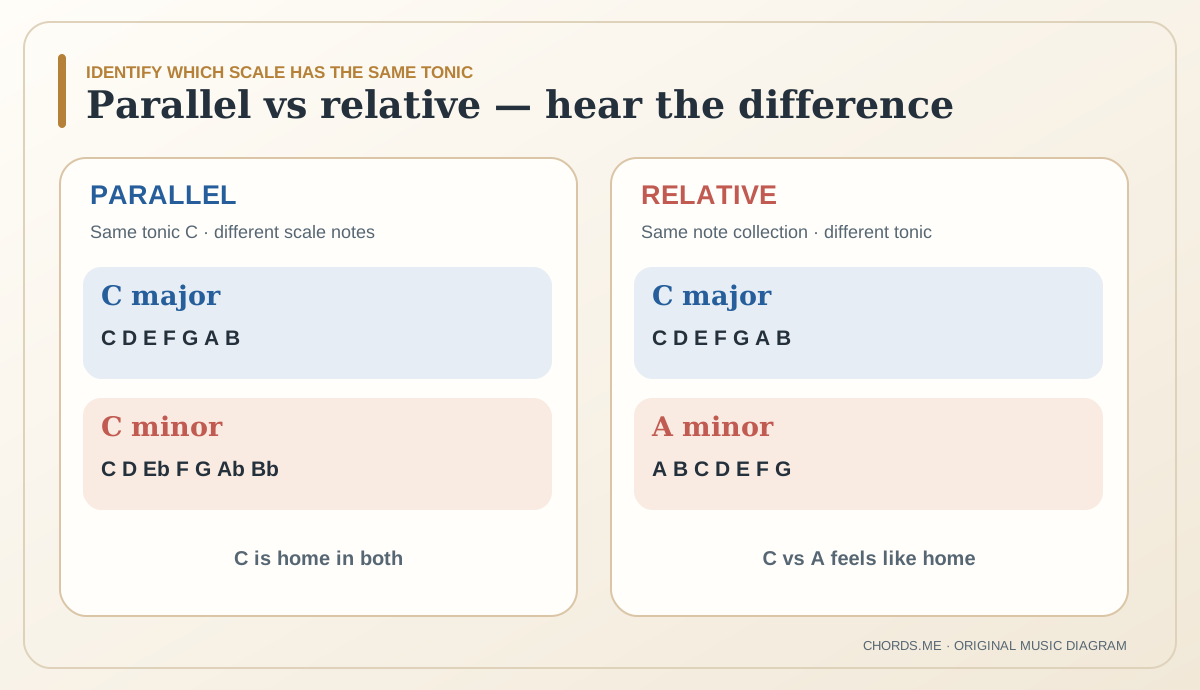
This distinction trips up many players.
| Key | Notes | Relationship to C major |
|---|---|---|
| C major | C D E F G A B | — |
| C minor | C D E♭ F G A♭ B♭ | Parallel: same tonic, but three notes differ |
| A minor | A B C D E F G | Relative: same notes, different tonic |
C minor is C major’s parallel minor because they share the tonic, C. A minor is the relative minor because it shares C major’s notes and key signature but centers on A.
This matters because simply choosing diatonic chords from A natural minor adds no new pitch classes to C major. Am, Dm, and Em are already diatonic in C major. The fresh colors come from C minor, whose E♭, A♭, and B♭ are not in C major. If you confuse the two, you will mislabel chords and miss the sound that makes borrowing work.
Common Modal Interchange Chords
These five are useful starting points. They are not a complete list, and a chord symbol alone does not prove which mode it came from.
- Fm (iv): F–A♭–C. From C natural minor. It replaces F as the subdominant, often just before a return to C.
- A♭ (♭VI): A♭–C–E♭. From C natural minor. It makes a wide, dramatic step away from the diatonic chords. Try A♭ – B♭ – C as one possible route back to the tonic.
- B♭ (♭VII): B♭–D–F. Available from C natural minor or C Mixolydian (C D E F G A B♭). It approaches C from a whole step below.
- E♭ (♭III): E♭–G–B♭. From C natural minor. It shares G with the C chord, so C to E♭ moves easily.
- Cm (i): C–E♭–G. The parallel-minor tonic. Use it for a single darker tonic chord. If an entire section sits on Cm, you have likely moved into the minor mode instead of borrowing one chord.
None of these has one fixed emotional effect. Rhythm, melody, and placement all change how a chord feels.
Five Practical Borrowed-Chord Progressions
These are original teaching arrangements, not a ranking of popular progressions.
1. The Minor iv
Chords: C – F – Fm – C
Roman numerals: I – IV – iv – I
Changing F to Fm swaps A for A♭. That one-note change makes a subtle but audible shift from bright to shaded harmony.
The voice leading is smooth. Moving from Fm to C, F falls to E, A♭ falls to G, and C stays put. Two semitone steps and one held note make a colorful chord resolve gracefully.
Play it: Give each chord two beats. On piano, keep C as the lowest note of your right-hand voicing throughout.
Try this: Hum A over the F chord, slide down to A♭ over Fm, then down to G over the final C. You have just sung the borrowed note’s path home.
2. Borrowed ♭VI
Chords: C – A♭ – F – G – C
Roman numerals: I – ♭VI – IV – V – I
A♭ major (A♭–C–E♭) comes from C minor. It lifts the progression away from the diatonic chords, but the ending is ordinary: F to G to C. G contains B, which can resolve upward to C. The wider C-centered progression makes A♭ sound like a temporary detour rather than evidence of a new tonic.
Play it: On guitar, A♭ can be a full barre at fret 4: 466544. On piano, hold the C between the A♭ and F chords.
Try this: Sustain a melody note of C across the A♭ and F bars. C belongs to both chords, so the harmony changes underneath a melody that doesn’t move.
3. The ♭VII Rock Progression
Chords: C – B♭ – F – C
Roman numerals: I – ♭VII – IV – I
B♭ replaces B with B♭. You can explain it as borrowed from C natural minor or as part of C Mixolydian vocabulary, and the chord alone can’t settle which. Don’t assume every ♭VII is borrowed from natural minor. Context decides.
Play it: With the guitar shapes B♭ x13331 and F xx3211, the F notes on the D string (fret 3) and high E string (fret 1) can stay in place. On piano, keep F as the common tone between the two chords.
Try this: Play C – B♭ – F – C, then swap B♭ for G: C – G – F – C. Compare how the two versions move away from home and return. G contains the leading tone B; B♭ offers a different, less conventionally dominant sound.
4. Borrowed ♭III
Chords: C – E♭ – F – G – C
Roman numerals: I – ♭III – IV – V – I
E♭ major (E♭–G–B♭) introduces two outside notes, E♭ and B♭, in place of E and B. The G stays common with C. From E♭ to F, all three notes step up: E♭ to F, G to A, B♭ to C. Then F to G to C finishes the cadence normally.
Play it: On piano, voice the change as C–E–G → B♭–E♭–G. C descends a whole step to B♭, E descends a semitone to E♭, and G stays in place. Then move into an F-major voicing.
Try this: Write a bass line of C, E♭, F, G. After a leap of a minor third, it climbs by step into the dominant.
5. Mixing Diatonic and Borrowed Chords
Chords: C – Am – F – Fm – C
Roman numerals: I – vi – IV – iv – I
Am and F are fully diatonic, so Fm arrives as the only outside chord. Your ear has just heard A in both the Am and F chords, which makes the drop to A♭ especially noticeable. Surrounding a borrowed chord with ordinary ones makes it stand out.
Play it: Strum slowly and let Fm ring a little longer than the other chords.
Try this: Write a two-line lyric. Let the first line sit on Am and F, and make the second line, on Fm, change direction.
Try the Same Idea in Other Keys
You do not have to play in C major to use modal interchange. A simple way to transfer the minor iv sound is to find the normal IV chord in your major key, then lower that chord's third by one semitone.
| Home key | Regular IV | Borrowed iv | Note that changes | Play this progression |
|---|---|---|---|---|
| C major | F (F–A–C) | Fm (F–A♭–C) | A → A♭ | C – F – Fm – C |
| G major | C (C–E–G) | Cm (C–E♭–G) | E → E♭ | G – C – Cm – G |
| D major | G (G–B–D) | Gm (G–B♭–D) | B → B♭ | D – G – Gm – D |
| A major | D (D–F♯–A) | Dm (D–F–A) | F♯ → F | A – D – Dm – A |
Each example follows I – IV – iv – I. The chord roots and fingerings change, but the harmonic idea stays the same. Start with the key that has the easiest shapes for your instrument, and play slowly enough to hear the one-note change.
To hear the change clearly, compare I – IV – IV – I with I – IV – iv – I at the same tempo.
Can You Borrow Chords in a Minor Key?
Yes. Modal interchange also works in a minor-key setting. For example, A natural minor normally uses Dm (D–F–A), but A Dorian has F♯, allowing a D-major chord (D–F♯–A). Try Am – D – Am, then compare Am – Dm – Am. The tonic remains A minor in both short examples, while the IV chord changes color.
One useful distinction: E7 in A minor is a conventional dominant made possible by raising G to G♯, as in A harmonic minor. It is not usually labeled a borrowed chord from a parallel mode. The same unexpected note can have different theoretical explanations depending on musical context.
How to Play Borrowed Chords on Guitar
In standard EADGBE tuning, these voicings work for the examples above:
- C: x32010 (C E G C E)
- F: xx3211 (F A C F)
- Fm: xx3111 (F A♭ C F)
- B♭: x13331 (B♭ F B♭ D F)
From F to Fm, only one note changes. On the G string, fret 2 (A) becomes fret 1 (A♭). The D-string fret 3, B-string fret 1, and high-E fret 1 stay put.
In F, only the B and high E strings are pressed at fret 1. In Fm, fret 1 covers the G, B, and high E strings at once, so the fretting finger on fret 1 has to flatten across three strings. This partial barre takes practice. Press close to the fret and check that every string rings, and expect some buzzing while you build strength. For both chords, start strumming from the D string.
Practice exercise: Play C – F – Fm – C, one chord per bar, at a slow tempo.
- Play C, then switch to F and let it ring.
- Before changing, lift the finger on fret 2 and flatten the fret-1 finger across the G string. Pluck the strings one at a time to confirm each rings.
- Play Fm, then return to C.
Repeat until the F-to-Fm move feels steady, then gradually speed up. If you want alternative shapes, the Guitar Chord Finder can help you check them.
How to Use Borrowed Chords on Piano
Here are the chord tones:
- C: C E G
- F: F A C
- Fm: F A♭ C
- A♭: A♭ C E♭
- B♭: B♭ D F
- E♭: E♭ G B♭
From F to Fm, the A moves down one semitone, from the white key to the black key just below it. The F and C stay.
Voice-leading exercise: Play the root of each chord in your left hand (C, F, F, C) and these right-hand voicings:
- C: C–E–G
- F: C–F–A (E up to F, G up to A)
- Fm: C–F–A♭ (A down to A♭)
- C: C–E–G (F down to E, A♭ down to G)
The lowest right-hand note, C, never moves. Only the upper two notes shift, so you can hear exactly how the borrowed chord bends the line. To see other inversions of the chords above, try the Piano Chord Finder.
What If the Melody Clashes With a Borrowed Chord?
A chord can be theoretically valid and still rub against an existing melody. This is not always bad—dissonance can be deliberate—but it is worth hearing rather than overlooking.
Suppose the melody holds A over F major in C – F – Fm – C. That A belongs to F (F–A–C), but when F changes to Fm (F–A♭–C), the held A and new A♭ sit a semitone apart. Played in the same register, they can create a strong clash.
Try three versions:
- Follow the chord: Sing or play A over F, move to A♭ over Fm, then land on G over C.
- Keep a common tone: Hold C across F and Fm. Both chords contain C, so the melody stays steady while the harmony changes.
- Use tension on purpose: Hold A briefly over Fm, then resolve to A♭ or G. Listen to the tension rather than assuming it is automatically wrong.
This is why a songwriter should check both the chord notes and the melody notes when swapping in a borrowed chord. Sometimes one small melodic adjustment is more effective than adding another chord.
Borrowed Chords vs Secondary Dominants
Not every chromatic chord is modal interchange. Compare these two progressions:
- C – Fm – C: Fm is a borrowed minor iv. Its A♭ comes from the parallel minor.
- C – A7 – Dm – G7 – C: A7 (A–C♯–E–G) is V7/ii, a secondary dominant that leads to Dm.
In the first example, Fm is a borrowed iv chord whose A♭ and F can resolve smoothly into G and E over C. It is not acting as an applied dominant of another chord. In the second, A7 contains C♯, which isn’t in C major or C minor. That note is a leading tone that wants to step up to D, so A7 sounds like it is setting up the next chord.
In short, a borrowed chord changes the color of the key. A secondary dominant points toward a chord within the key. Analysis can depend on context, so use your ear alongside the labels.
Modal Interchange vs Modulation
Borrowed harmony does not by itself set up a new tonic. Take a song in C major whose chorus uses C – F – Fm – C. Even with the borrowed Fm, every phrase returns to C.
Now imagine the next section uses D – G – A7 – D, and melodic phrases repeatedly settle on D. That provides strong evidence for a new D-major center: F♯ and C♯ appear in its harmony, and A7 resolves toward D. A longer passage centered on C minor could likewise establish a shift to the parallel minor mode even though the tonic note C remains the same.
There is no fixed number of bars that separates a borrowed chord from a change of key or mode. Listen for sustained harmonic and melodic emphasis, not just the appearance of an accidental.
How to Write Your Own Borrowed-Chord Progression
Try this six-step method with C – Am – F – G (I – vi – IV – V):
- Start with a simple progression you already like.
- Pick one chord to color. The F is a good choice because it is a subdominant that can be darkened.
- List borrowed options from C minor: Fm, A♭, B♭, E♭, Cm.
- Match function. Fm can replace F because both are subdominant chords.
- Check the notes. F–A–C becomes F–A♭–C. The A in Am just before also falls to A♭, a chromatic step. Then Fm moves to G, with A♭ falling to G and C falling to B.
- Test the return. G still leads to C because B is a leading tone, so C still sounds like home.
The result is C – Am – Fm – G (I – vi – iv – V). Compare the two versions. The original is bright and open at the third chord, while the revision turns shaded exactly when A drops to A♭. Try borrowing only once, perhaps in the last pass of a chorus.
You can compare original and revised progressions in the Chord Progression Generator. If you produce music, Chord to MIDI can help you carry a favorite progression into your production workflow.
A Short Practice Routine
Use guitar or piano at a comfortable slow tempo (around 60–80 BPM, or slower if needed):
- Play C – F – F – C in 4/4, one chord per bar.
- Repeat with C – F – Fm – C, keeping the rhythm identical. Hear A become A♭.
- Sing or play A – A♭ – G over F – Fm – C.
- Add Fm to one of your own C-major progressions. Check the melody against its A♭ and listen for the return to C.
The aim is to hear and control the altered note, not to memorize a long list of scales.
For a practical minor-key comparison, E minor chord progressions shows how Bm and B7 change the return to Em.
Common Mistakes
- Confusing parallel and relative minor. C minor (parallel) supplies E♭, A♭, and B♭. A minor (relative) supplies nothing new to C major.
- Assuming every outside chord is borrowed. A7 in C is a secondary dominant, not a borrowed chord. Check where it leads.
- Confusing a borrowed chord with a larger key or mode change. A single Fm in C major may be borrowed; a whole section establishing C minor calls for a broader analysis.
- Labeling ♭VII incorrectly. In C, ♭VII is B♭ major. The diatonic vii° is Bdim, which is a different chord entirely.
- Skipping the chord notes. Playing A major when you meant A♭, or F when the chart says Fm, hides the very change you are trying to hear. Spell out the notes first.
Frequently Asked Questions
What are borrowed chords in music theory?
They are chords taken from a parallel mode, most often the parallel minor, and used in a major key. The term modal mixture is often used for this specific idea, while modal interchange can also include other modes such as Mixolydian.
What is an example of modal interchange?
C – F – Fm – C is the simplest example. F is diatonic to C major, and Fm borrows its A♭ from C minor, but the progression still returns to C.
Is F minor borrowed in C major?
Yes, as iv. The diatonic IV in C major is F major (F–A–C). Fm replaces A with A♭, a note from C natural minor.
Can you use borrowed chords on guitar?
Yes. Any chord shape works as long as it has the right notes. A practical start is moving between F xx3211 and Fm xx3111, where only the G-string note changes.
What is the difference between modal interchange and modulation?
Modal interchange borrows a chord while the tonic stays the same. A modulation establishes a different key over a longer passage; a sustained shift to a parallel major or minor mode can also change the music’s governing tonality without changing its tonic note.
Takeaway
Pick a progression you already know, choose one chord, and swap in a borrowed alternative from the parallel minor. Check the notes, listen to where each one moves, and confirm that your tonic still sounds like home. Start with C – F – Fm – C, and borrowed chords will start to make sense in your ears and under your fingers.