How to Tell What Key a Song Is In (5 Steps)
Learn five practical steps to find a song's key using chords, melody, cadences, sheet music, and your ear, with worked major/minor examples.

To tell what key a song is in, list its main chords, find the keys that could contain them, and listen for the chord or note that feels like home. Then check the melody, bass, and resolutions, and confirm by playing. You don’t need perfect pitch to hear a tonal center, though naming its exact pitch by ear usually requires a reference note or instrument.
Quick Answer: Five Steps to Find a Song’s Key
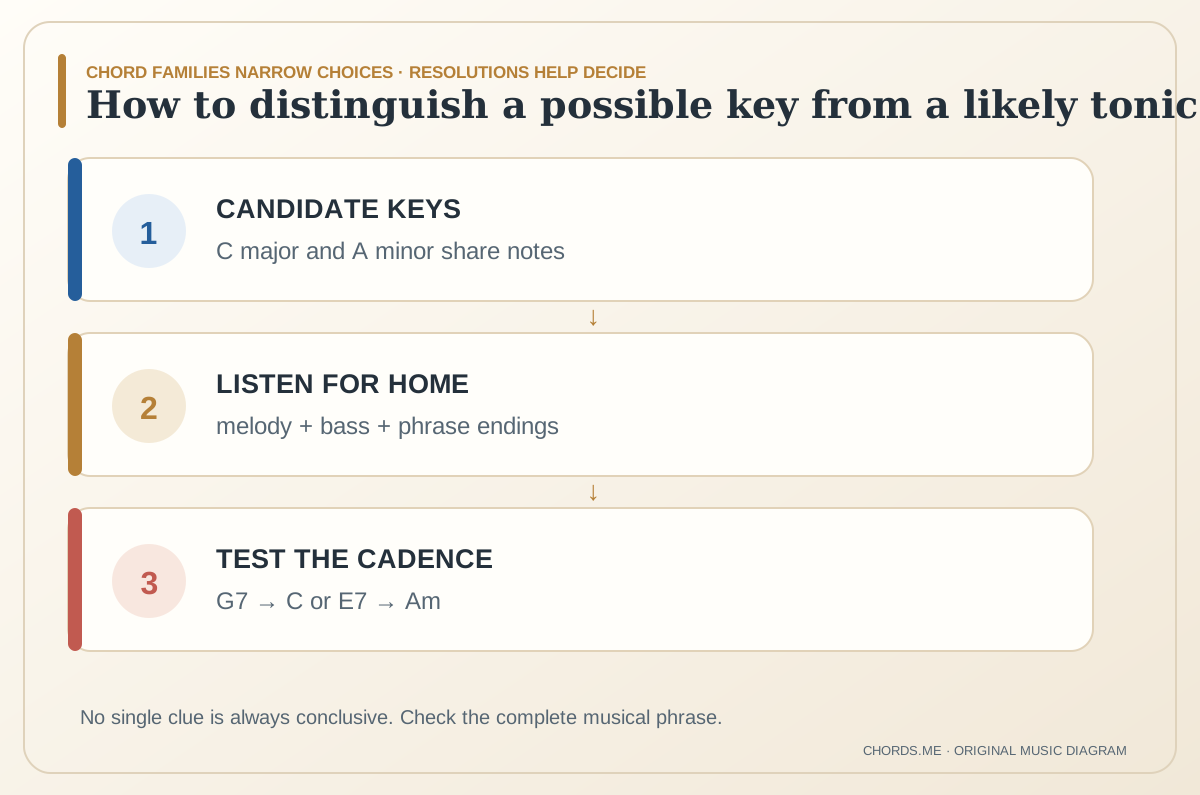
- Write down the song’s main chords.
- Find the major and minor keys that could contain them.
- Listen for the tonic, or home chord.
- Check melody notes, bass movement, and harmonic resolutions.
- Test your answer on guitar or piano.
Treat these as clues to weigh together, not five infallible rules. Sometimes the evidence points clearly to one key. Sometimes two keys are both reasonable, and that ambiguity is part of how music works.
Step 1: Write Down the Song’s Chords
Start by identifying the repeating chord progression, usually from the verse or chorus. Write the chords in order, such as:
A – E – F♯m – D
Chord quality matters because small differences change which keys fit:
- C is not Cm. C major contains E; C minor contains E♭.
- G is not G7. The 7th adds F, which points toward C in many contexts.
- E is not Em. E major contains G♯; E minor contains G.
If you’re working from a guitar chart, check for a capo. A capo changes the sounding pitch without changing the chord shapes. For example, the shapes G – D – Em – C with a capo on the 3rd fret sound as B♭ – F – Gm – E♭. Those sounding chords, not the shapes, tell you the key of the recording. The Capo Calculator helps you convert between shapes and sounding chords.
Step 2: Find the Possible Keys
Once you have the chords, ask: which major and minor keys contain all of them?
Take C – G – Am – F. C major and A natural minor share the same seven notes:
C – D – E – F – G – A – B
Each chord is built only from those notes:
| Chord | Notes | In C major | In A natural minor |
|---|---|---|---|
| C | C E G | I | III |
| G | G B D | V | VII |
| Am | A C E | vi | i |
| F | F A C | IV | VI |
Every chord fits both keys, so both are plausible keys. Neither is yet a confirmed tonal center. The chords narrow the field, but the music’s context chooses between the candidates.
If you want to see a key’s notes laid out, the Guitar Scale Finder shows scale notes on the fretboard. It can help you compare candidate keys, but it can’t tell you which note a particular song treats as home.
Step 3: Listen for the Home Chord
The tonic is the chord or note that feels like the center of the music, the place that sounds settled or finished. In C major, that’s C. In A minor, it’s A.
Here’s a simple listening exercise:
- Play a short progression, such as C – F – G, and stop before it resolves.
- Try ending on different candidate chords: C, then Am, then F.
- Notice which ending sounds most settled in this particular context.
Most players find that C feels like arriving home after C – F – G.
This method is helpful but not perfectly reliable on its own. Songs don’t have to end on the tonic, and some deliberately avoid it. Many loops circle without ever clearly landing. If you’re still developing your ear, hum or sing the note that feels like home, then find it on an instrument. Do this with several parts of the song, not just one spot.
Step 4: Examine Melody, Bass, and Cadences
The melody often leans toward the tonic, especially at the end of phrases. Notes that a singer holds, lands on, or returns to often hint at the tonal center. The bass is another clue, since bass notes often emphasize the home chord at phrase endings.
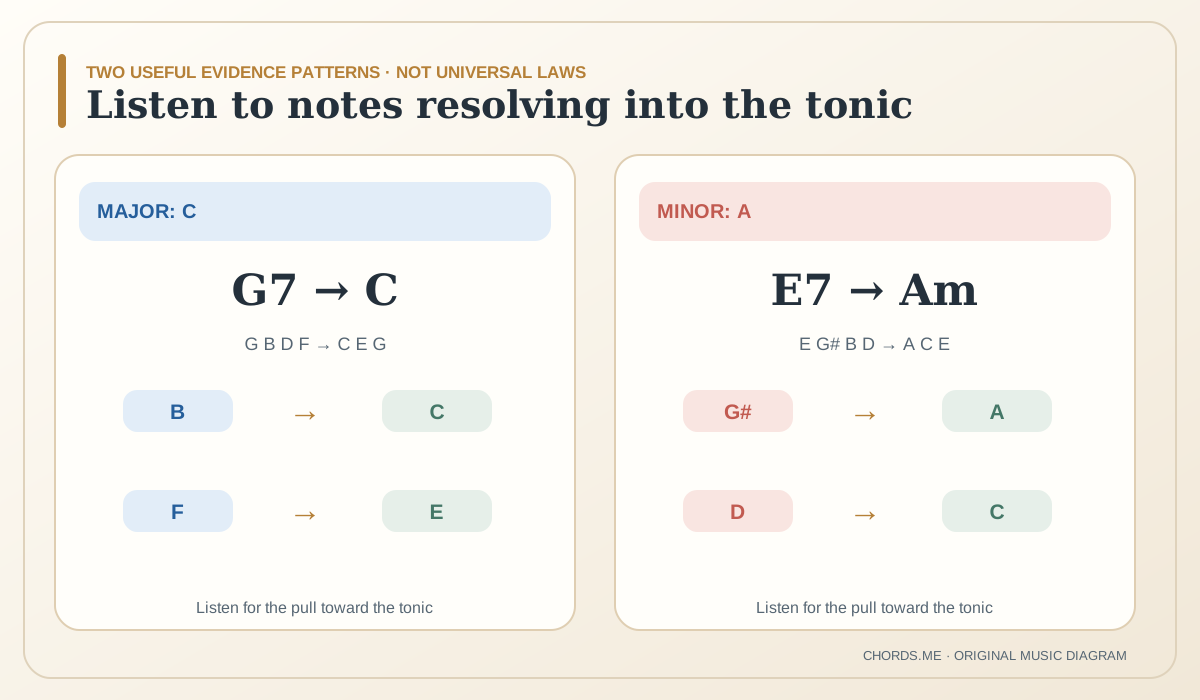
Cadences, the chord movements that close phrases, give some of the strongest evidence. Two examples:
C – F – G7 – C In C major: I – IV – V7 – I.
Am – Dm – E7 – Am In A minor: i – iv – V7 – i.
In the first, G7 → C supports C as tonic. G7 contains B and F (G B D F). The B can step up to C, and the F can step down to E. In the second, E7 → Am supports A minor. E7 contains G♯ and D (E G♯ B D). The G♯ can step up to A, and the D can step down to C.
These are common voice-leading possibilities, not mandatory movements in every arrangement.
Note that E7 contains G♯, which isn’t in A natural minor. That doesn’t mean E7 is “wrong” in A minor. Raising the 7th degree to G♯ is standard in minor keys because it creates a leading tone pulling toward A. If you want to see the notes of each chord on a keyboard, the Piano Chord Finder is useful.
Try this: Play G7, then C, on guitar or keyboard, and listen for the pull. Then play E7, then Am. Both resolutions should sound settled, in a major and a minor flavor.
Step 5: Confirm the Key by Playing
Now test your hypothesis:
- Play your suspected tonic chord against the song. Does it sound like home at the ends of phrases?
- Compare it with the ending of a phrase, not just the beginning of the song.
- Check the chord progression and the melody against your candidate.
- Try the relative major or minor. If you guessed C major, test A minor. If you guessed A minor, test C major.
- Decide whether the evidence supports one tonic.
If the song is a short loop, the evidence may be thin. Listen to the verse, chorus, bridge, or a longer passage, since a bridge often clarifies what the verse leaves open. Once you’ve settled on a key, a tool like the Chord Progression Generator can help you compare playable progressions in different keys.
Worked Example: C Major or A Minor?
Consider Am – F – C – G. These chords all belong to both C major and A natural minor, so the order alone doesn’t settle the key. Here are two ways the same chords can feel different.
Version 1: A minor emphasis. Play Am | F | C | G | Am, with this melody:
- Over Am: E, A
- Over F: C, A
- Over C: G, E
- Over G: D, B
- Final Am: hold A
The melody keeps returning to A and ends on it over Am. A feels like home, and the G → Am ending reads as a close in A minor.
Version 2: C major emphasis. Play Am | F | C | G | C, with this melody:
- Over Am: C, E
- Over F: F, A
- Over C: G, E
- Over G: D, B
- Final C: hold C
Here the melody climbs through D and B, and B steps up to C as the final chord arrives. The G → C ending supports C major as tonic.
The chords are almost the same in both versions. The tonal center is decided by where the melody and the phrase endings settle. This is also why many songs built on this progression can be heard either way.
Worked Example: G Major or E Minor?
Take the chord collection G – D – Em – C. These chords come from the same seven notes in G major (G A B C D E F♯) and E natural minor, so either key could be the home.
Now compare two strong harmonic clues.
D7 → G D7 = D F♯ A C. The F♯ is the leading tone of G major, and it can step up to G. The C can step down to B. This points toward G.
B7 → Em B7 = B D♯ F♯ A. The D♯ is a raised leading tone, one half step below E, and it can step up to E. The D♯ isn’t in G major or E natural minor, so it points toward E as the target. This points toward E minor.
If the progression repeatedly features D7 → G, G major is the more convincing tonic. If it features B7 → Em, E minor probably is. If it only ever loops G – D – Em – C with no strong resolution, treat both as plausible and let the melody decide.
How to Find a Song’s Key by Ear
There are two separate skills here:
- Hearing which note feels like home. Most people can learn to do this with practice.
- Identifying that note’s exact pitch name. Without perfect pitch, you usually need a reference note.
A beginner may hear a tonal center clearly without knowing it’s an A or a C until they check it against an instrument. Here’s an exercise:
- Play the song and hum the note that feels most like home, perhaps where the melody could comfortably end.
- Keep humming that note while you search for a match on guitar or piano, moving one note at a time.
- When a note sounds like the same pitch as your hum, name it.
- Play major and minor chords on that note and see which sounds more settled with the song.
Recordings can also be tuned slightly differently or played in an alternate tuning. If your note seems to fall between two notes on the instrument, you may be hearing a slightly detuned recording.
How to Tell a Key From Sheet Music
A key signature tells you which notes are sharped or flatted throughout the piece. For example:
- No sharps or flats: C major or A minor
- One sharp (F♯): G major or E minor
- Two sharps (F♯, C♯): D major or B minor
A key signature narrows the possibilities, but it can’t distinguish a major key from its relative minor. Relative keys share a signature and the same notes but have different tonics.
For sharp keys, a shortcut is that the last sharp in the signature is the leading tone of the major key, so the major key’s tonic is one half step above it. In a signature with one sharp, F♯, the major key is G. For flat keys, the major key is usually the second-to-last flat, except in the one-flat case (F major).
To decide between the major and its relative minor, look at the music itself: Where does the melody end? What chord does the bass land on? Is there a cadence?
Say a piece has one sharp in the signature. If the melody ends on G over a G chord and the harmony moves D7 → G, it points to G major. If the music centers on E and uses B7 → Em, it points to E minor. In E minor you’ll also often see D♯ appear as an accidental. That doesn’t mean the piece has changed key. It’s the raised leading tone appearing in the cadence, as in the B7 chord above.
If a chord uses notes outside the candidate scale, read our borrowed-chord and modal interchange guide to see why that does not automatically signal modulation.
What If the Song Uses Chords Outside the Key?
Many songs include chords that don’t fit the simplest diatonic collection. Common reasons include borrowed chords from the parallel key, secondary dominants, and modulation to a new key.
Take C – A7 – Dm – G7 – C. A7 contains C♯ (A C♯ E G), which isn’t in C major. But A7 here acts as a secondary dominant: it leads to Dm the way G7 leads to C. The overall context is still C major, and the progression ends on C.
One unexpected chord doesn’t automatically prove the song has changed key. A real modulation usually establishes a new tonic over time, often with its own cadences. So don’t abandon your analysis when you find a chromatic chord. Ask whether it pulls strongly toward another chord, and whether the home base is still the same.
Common Mistakes
Assuming the first chord is the key. Songs often start on a chord other than the tonic. Weigh the first chord as one clue, and check the phrase endings.
Confusing relative major and minor. C major and A minor share the same notes. Test both against the melody and the resolutions.
Treating the key signature as conclusive. It gives two candidates, not one. Check the cadences and where the melody settles.
Assuming every chord must belong to one scale. Borrowed chords and secondary dominants are common. One chromatic chord isn’t necessarily a key change.
Confusing capo shapes with the sounding key. Chord shapes on a capoed guitar can sound in a different key. Convert them to sounding chords before analyzing.
Ignoring melody and resolution. Chord collections alone leave ambiguity. The melody and the cadences are often what settle it.
FAQs
How do you know what key a song is in?
Combine several clues: the chords, which candidate keys contain them, which chord feels like home, the melody, and the cadences. No single clue is infallible, so check them against each other.
Can you find a song’s key from its chords?
You can find candidate keys from the chords, and often a likely answer. But the same chords can fit a major key and its relative minor, so you usually need melody and resolution to confirm.
How can I find a song’s key without perfect pitch?
You don’t need perfect pitch to hear which note feels like home. To name its exact pitch, use a reference note: hum the home note, then find it on a guitar or keyboard.
How do I know whether a song is in a major or minor key?
Find the tonic first, then listen to the chord built on it. If the home chord sounds bright and the cadences support it, the song likely leans major. If the home chord is minor and settled, it leans minor.
Can a song have more than one key?
Yes. Songs can modulate, moving the tonal center to a new key, for example in a final chorus. Some songs are also ambiguous between a major key and its relative minor. If you want to move a confirmed progression to a new key, the Chord Transposer can do that.
The Takeaway
Finding a song’s key is detective work: gather clues from the chords, the melody, the bass, and the cadences, then test your answer on an instrument. Start with candidate keys, listen for the home chord, and confirm by ear. When the evidence points two ways, that’s not a failure. It’s often just the nature of the song.