Chords in A Minor: 7 Guitar & Piano Chords
Discover all seven chords in A natural minor with verified guitar shapes, piano notes, seventh chords, and a clear Em versus E7 explanation.
The chords in A minor are Am, Bdim, C, Dm, Em, F and G. They come from the A natural minor scale (A B C D E F G), so none need a sharp or flat. In real songs you will also hear E or E7 in place of Em, because the raised note G♯ pulls more strongly back to Am.
One quick distinction before we start. "A minor" can mean a single chord (A–C–E, written Am) or the key built around that chord. This guide is about the key: the family of chords that work together around Am, what notes they contain, how to play them on guitar and piano, and how to use them.
Quick A Minor Chord Chart
Read each row left to right: the Roman numeral names the chord's place in the key, and the notes show exactly what to play.
| Degree | Roman numeral | Chord | Notes | Quality | |:--:|:--:|:--:|:--:|:--| | 1 | i | Am | A C E | minor | | 2 | ii° | Bdim | B D F | diminished | | 3 | III | C | C E G | major | | 4 | iv | Dm | D F A | minor | | 5 | v | Em | E G B | minor | | 6 | VI | F | F A C | major | | 7 | VII | G | G B D | major |
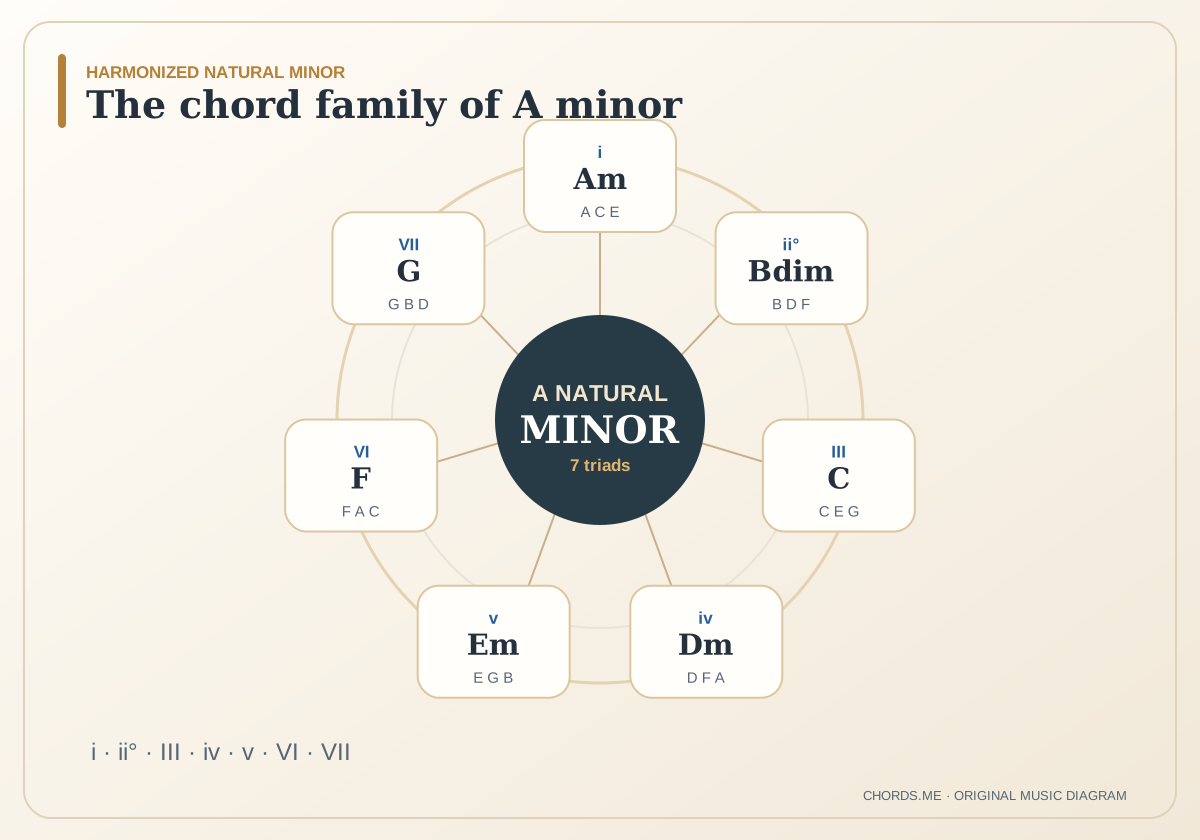
How to read the numerals: this article uses one convention throughout. Capital numerals are major chords, lowercase numerals are minor, and the ° sign means diminished. The numbers follow the notes of A natural minor, with one deliberate exception: a capital V means E major, which uses the raised note G♯ (more on that below).
The pattern (minor, diminished, major, minor, minor, major, major) is the same in every natural minor key. Only the note names change.
How the Chords Are Built
A natural minor has seven notes and no sharps or flats:
A – B – C – D – E – F – G
To build a chord, start on one of those notes and stack thirds by skipping every other note, using only notes from the scale. (You can see these seven notes laid out on a fretboard in Chords.me's Guitar Scale Finder.)
- A + C + E → Am. From A up to C is three half steps (a minor third), and C up to E is four (a major third). Minor third plus major third gives a minor chord.
- B + D + F → Bdim. B up to D is three half steps, and D up to F is also three. Two minor thirds in a row give a diminished chord.
- D + F + A → Dm. Same recipe as Am: a minor third, then a major third.
What separates a diminished chord from a minor one is the top note. Bdim has B to F as its outer interval (six half steps) instead of the usual B to F♯ (seven). That lowered fifth is why diminished chords are often described as tense or unsettled. Context and rhythm matter as much as the chord itself, though.
The seventh chords in A minor
Add one more third on top of each triad and you get the key's seventh chords:
| Degree | Triad | Seventh chord | Notes | Type | |:--:|:--:|:--:|:--:|:--| | i | Am | Am7 | A C E G | minor seventh | | ii° | Bdim | Bm7♭5 | B D F A | half-diminished (minor seventh flat five) | | III | C | Cmaj7 | C E G B | major seventh | | iv | Dm | Dm7 | D F A C | minor seventh | | v | Em | Em7 | E G B D | minor seventh | | VI | F | Fmaj7 | F A C E | major seventh | | VII | G | G7 | G B D F | dominant seventh |
G7 is spelled like a dominant seventh, but in A minor it is a color chord on the subtonic. The chord that normally creates a strong pull to Am is E7, which comes from outside the natural minor scale.
A Minor Chords on Guitar
These diagrams use standard tuning (E–A–D–G–B–E). Strings run low E to high e from left to right, an open circle means play the string open, and an X means leave it out.
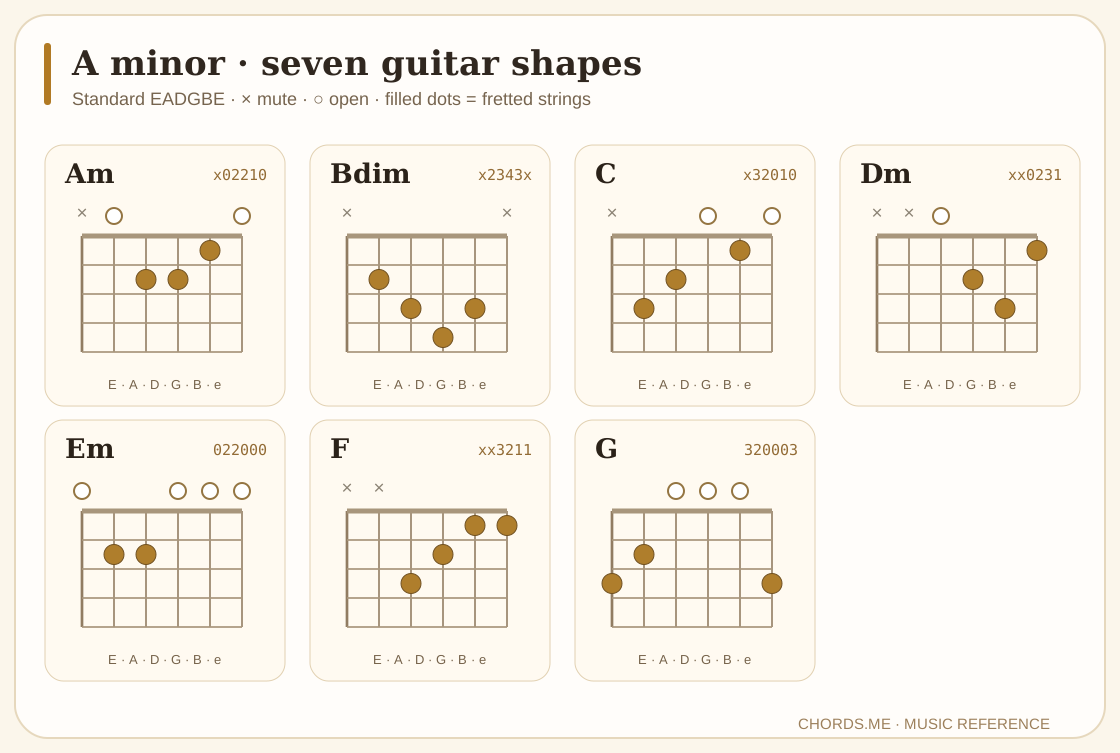
| Chord | Frets (low E to high e) | Notes you hear | Comment | |:--|:--|:--|:--| | Am | x02210 | A E A C E | Open shape | | Bdim | x2343x | B F B D | Four fretted notes across frets 2–4; the least familiar shape here | | C | x32010 | C E G C E | Open shape | | Dm | xx0231 | D A D F | Open shape on the top four strings | | Em | 022000 | E B E G B E | Open shape | | F | xx3211 | F A C F | Four-string version; the first finger covers two strings | | G | 320003 | G B D G B G | Open shape |
Bdim deserves a warning. It is a compact, four-string grip that most beginners have not met, and fingerings vary from player to player, so the diagrams do not prescribe finger numbers. Plenty of songs in A minor never use it, so learn it after the other six. If you want to compare other shapes for any of these chords, the Guitar Chord Finder is a handy second reference.
Practice exercise (5 minutes). Set a slow pulse and strum Am for four beats, Dm for four, Em for four, then back to Am. Notice that Am is close to Em: in Em you fret two adjacent strings at the 2nd fret, and the Am shape is that same pair of fingers shifted over by one string, with one extra finger on the B string. Once that feels smooth, play Am – F – G – Am.
A Minor Chords on Piano
Every one of the seven chords uses white keys only, which makes A minor one of the friendliest keys on the keyboard. Each chord below is shown as a root-position triad: the root at the bottom, then the third and fifth above it.
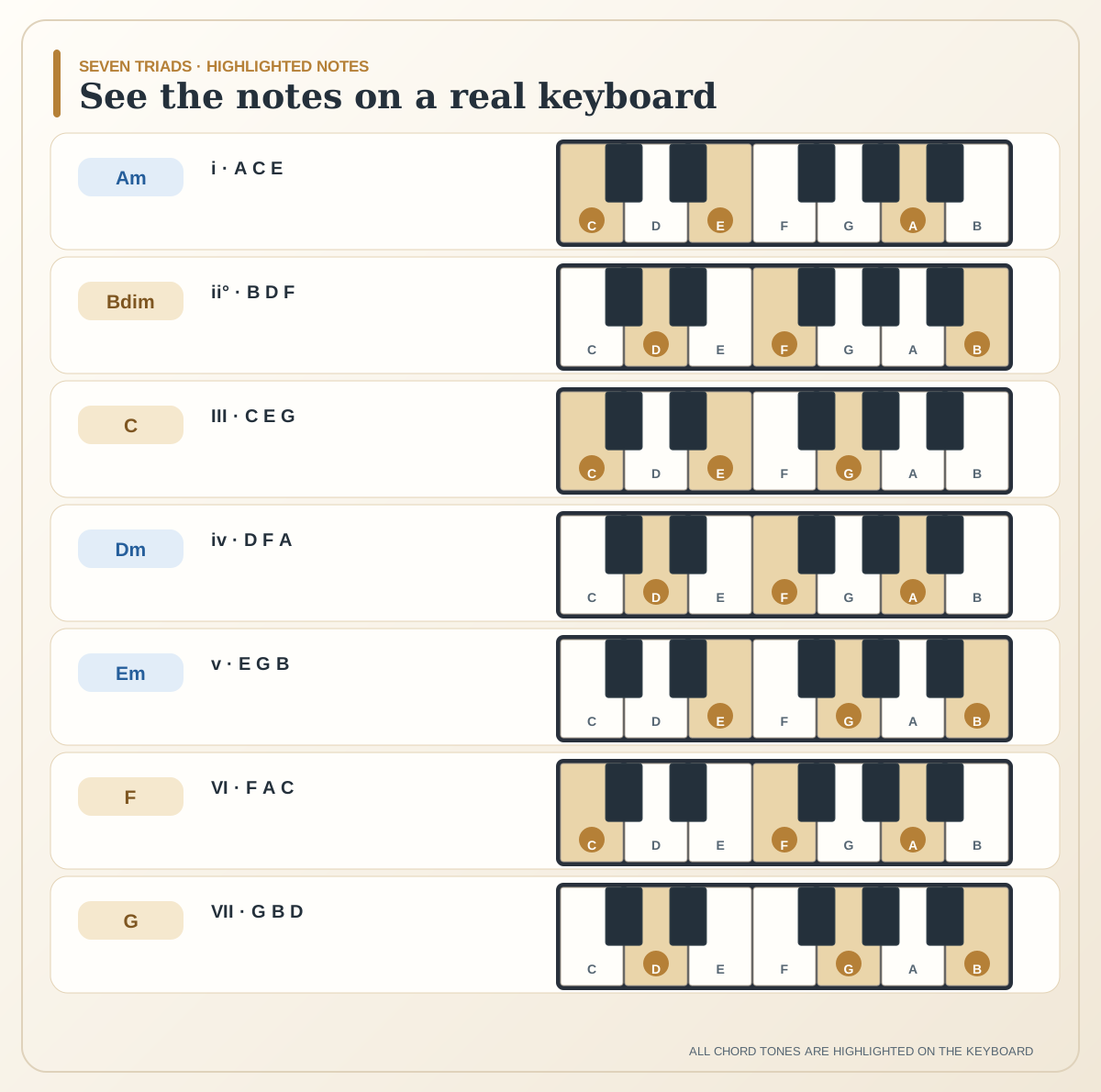
| Chord | Keys (root position) | |:--|:--| | Am | A – C – E | | Bdim | B – D – F | | C | C – E – G | | Dm | D – F – A | | Em | E – G – B | | F | F – A – C | | G | G – B – D |
Practice exercise. Play the root of each chord with your left hand and the triad with your right: Am, Dm, Em, Am. Then try a smoother version where the right hand moves as little as possible: Am (A–C–E), then Dm with A on the bottom (A–D–F), then E major with G♯ on the bottom (G♯–B–E), then back to Am (A–C–E). Notice that in the last step two notes move by a half step and the third stays put. Use whichever fingers feel natural for your hand size and the shape you are holding, because there is no single fingering that suits every inversion. To check the notes or inversions of any chord, the Piano Chord Finder is a quick reference.
Why E Major Appears in A Minor
If you have looked at a few A minor songs, you have probably seen E or E7 where the chart above says Em. That is not a mistake, and it does not mean the song has left the key. It comes from a small change to the scale.
Compare these two progressions:
- Am – Dm – Em – Am
- Am – Dm – E – Am
In natural minor, the fifth chord is built on E from the notes E, G and B. The G sits a whole step below A, which gives a softer, less directional approach to the home chord.
In harmonic minor, the seventh note is raised by a half step: A B C D E F G♯. Stack thirds on E now and you get E, G♯ and B, an E major chord. The G♯ is only a half step below A, so it works as a leading tone: a note that tends to lead up to the tonic.
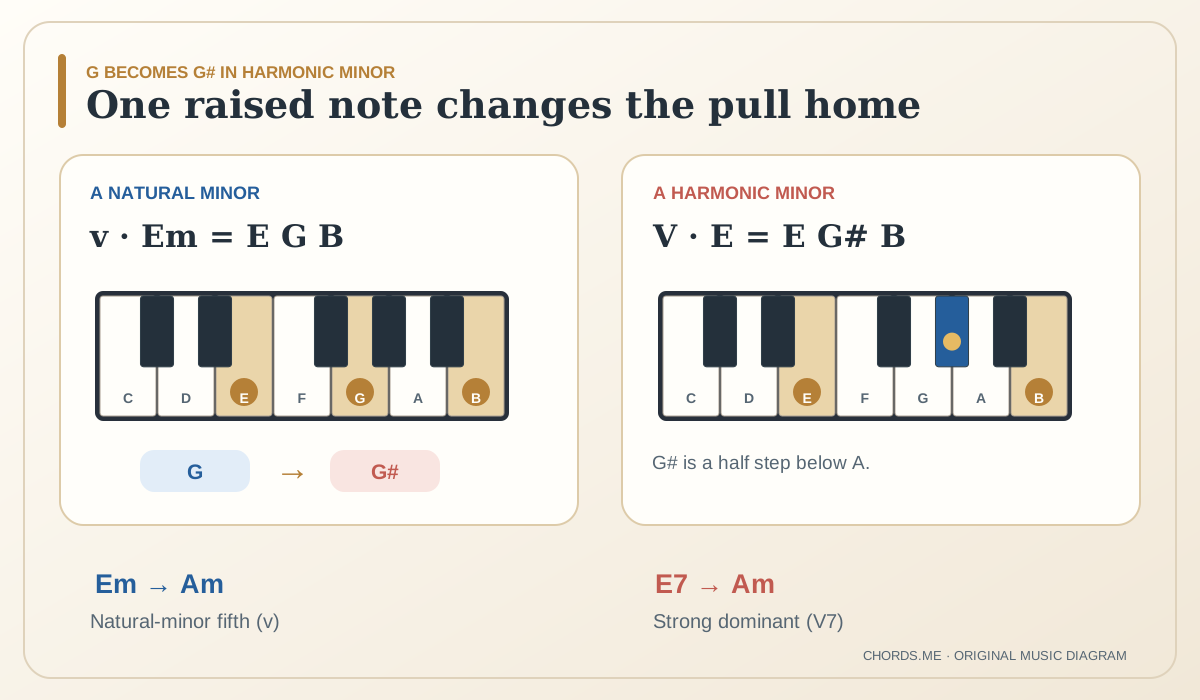
This raised note creates a few more chords you will see in minor-key music:
- E (V): E G♯ B
- E7 (V7): E G♯ B D, which is also a common way to approach Am
- G♯dim (vii°): G♯ B D
When E7 resolves to Am, G♯ rises to A while D falls to C. Both moves are small, which is part of why the arrival sounds so settled. Many listeners hear that as a stronger ending than Em to Am, but it is a tendency, not a law.
Natural, harmonic and melodic minor are not three separate keys. They are three forms of the same minor key, and composers move between them freely. A theory textbook from the University of Puget Sound counts thirteen possible triads once you consider all three forms, and lists E major and G♯ diminished among the most common in practice. The key signature of A minor stays empty. The G♯ appears as an accidental when the music needs it.
Listening exercise. [AUDIO 1: Em → Am vs E → Am, to be produced] Play Em and then Am. Now play E and then Am. Pay attention to what the top voice does on the way home.
Practical A Minor Chord Progressions
You rarely need all seven chords. Here are four short progressions, each with its Roman numerals.
1. Am – F – C – G (i – VI – III – VII). Every chord is from the natural minor scale. Listen to how G returns to Am without a leading tone.
2. Am – Dm – Em – Am (i – iv – v – i). All three chords are minor, and everything comes from natural minor. Listen for how softly Em settles into Am.
3. Am – Dm – E – Am (i – iv – V – i). The same shape, with one note changed in the third chord. Listen for G♯ leaning up into A.
4. Am – G – F – E (i – VII – VI – V). The roots walk down step by step, A–G–F–E, and finish on E major, which sets up a return to Am. This descending pattern is often called an Andalusian cadence.
Try this: play progression 2, then replace only the Em with E and play it again. Write down the difference you hear in the last two chords. Then swap the E in progression 4 for Em and listen again.
To hear these or build your own, choose A minor in Chords.me's Chord Progression Generator, where you can reorder chords and play them back. If you want a progression as a MIDI file, you can send the chord sequence to Chord to MIDI. And if you want to move any of these into another key, the Chord Transposer will do that.
If you are working out the tonic of an unfamiliar progression, our guide to identifying a song’s key shows how to weigh chords, melody, and cadences.
A Minor vs C Major
A minor and C major are relative keys. They use the same seven notes and the same key signature (none), so Am, Bdim, C, Dm, Em, F and G belong to both. What changes is which chord feels like home.
| Chord | Numeral in A minor | Numeral in C major | |:--|:--:|:--:| | Am | i | vi | | Bdim | ii° | vii° | | C | III | I | | Dm | iv | ii | | Em | v | iii | | F | VI | IV | | G | VII | V |
Because the chords are shared, seeing C, G, F and Am in a song does not prove which key it is in. Here is a small example. Play these two four-bar loops, one chord per bar:
- Loop A: | Am | Am | F | G |
- Loop B: | C | C | F | G |
Both finish on F and G. In Loop A that pair returns to Am (VI – VII – i). In Loop B the same pair returns to C (IV – V – I). The notes are identical. What changes is where the harmony rests and what the loop points toward.
Be careful with shortcuts. The first chord and the last chord are useful clues, but neither one settles the question alone. Melody, bass line, phrasing and cadences all count. The same applies to the raised G♯ clue: hearing it is a strong hint of A minor, but not every minor-key song uses it. Music theory textbooks advise combining several clues rather than trusting any single one.
Common Beginner Mistakes
- Mixing up an A minor chord with the key of A minor. Am is one chord. The key of A minor is the whole collection. If a chart says "key of A minor," you are not meant to play only Am.
- Treating E major as a theory error. E major is not one of the seven natural-minor triads, but it is a normal, widely used chord in minor keys. Think of it as a chord from the harmonic minor form of the same key.
- Playing the wrong notes in Bdim. It is B, D and F (F natural), not B, D and F♯. With F♯ you get B minor, which sounds quite different and is not in this key.
- Assuming a relative major and minor sound the same. C major and A minor share notes, but they do not share a home chord, so they do not feel the same.
- Thinking every A minor progression must use all seven chords. Many songs use three or four. You never have to include Bdim.
FAQs
What is the relative major of A minor? C major. It has the same notes and the same empty key signature. A minor and C major differ in which chord feels like home.
Is Bdim necessary in every A minor song? No. It is the least used of the seven, and plenty of songs avoid it entirely. If you do use it, it often leads toward E or E7 before returning to Am.
What are the main chords in A minor? Am, Dm and E (or Em) are often treated as the three main chords, because together they cover every note of the scale. Which one fills the fifth-chord role depends on the sound you want.
Can I use E7 instead of E? Yes. E7 adds a D to E major, and it still contains the G♯ leading tone. It is common when a stronger pull toward Am is wanted.
Does the key of A minor have any sharps or flats? Not in the key signature. A G♯ shows up only when the music borrows it from the harmonic minor form.
Your Next Step
Play Am – Dm – Em – Am, then Am – Dm – E – Am, and note which version feels more final to you. Then open the Chord Progression Generator, set the key to A minor, and listen to a few loops while you follow along with the chart at the top of this page.