E Minor Chord Progressions: 7 Playable Examples
Play seven E minor chord progressions on guitar and piano. Learn correct chord shapes, Bm versus B7, rhythm, voice leading, and songwriting.
An E minor chord progression is a sequence of chords that treats E minor as home. The simplest way to start is with these two:
Em – C – G – D Em – Am – B7 – Em
The first stays entirely inside the E natural minor scale. It sounds open and circular, so it loops easily under a verse or chorus. The second adds B7, which borrows a note from E harmonic minor. That chord pulls strongly back to Em and gives the progression a clear ending.
This guide covers seven playable progressions with guitar and piano suggestions, the chords that belong to E minor, the difference between Bm and B7, how rhythm changes a progression, and a method for writing your own. It also explains why E minor and G major are so easy to confuse.
Quick E Minor Chord Progression Chart
The Roman numerals below treat E minor as the tonal center. Uppercase means major, lowercase means minor, and V7 marks the B7 chord borrowed from harmonic minor. Several of these progressions can also be heard in G major, which is covered later.
| Progression | Roman Numerals | Musical Purpose |
|---|---|---|
| Em – C – G – D | i – VI – III – VII | Open, anthemic loop built from natural-minor chords |
| Em – Am – Bm – Em | i – iv – v – i | Soft, modal-sounding return with no strong leading tone |
| Em – Am – B7 – Em | i – iv – V7 – i | Classic minor cadence with a strong resolution |
| Em – D – C – B7 | i – VII – VI – V7 | Descending bass line that ends on tension |
| Em – C – D – Em | i – VI – VII – i | Short rise to a quick return home |
| Em – G – D – C | i – III – VII – VI | Bright, drifting loop that sits close to G major |
| Em – Bm – C – D | i – v – VI – VII | Climbing progression that builds energy |
These are practical, varied examples, not a ranking of the most popular progressions.
What Chords Are in E Minor?
The E natural minor scale is E – F♯ – G – A – B – C – D. Stacking thirds on each note gives seven triads:
| Degree | Chord | Notes |
|---|---|---|
| i | Em | E G B |
| ii° | F♯dim | F♯ A C |
| III | G | G B D |
| iv | Am | A C E |
| v | Bm | B D F♯ |
| VI | C | C E G |
| VII | D | D F♯ A |
F♯dim is rarely used in simple progressions, so most songs lean on the other six.
B major and B7 are not built from the natural minor scale. They come from E harmonic minor, which raises D to D♯. B major is B D♯ F♯, and B7 is B D♯ F♯ A. Songwriters borrow them constantly because D♯ sits a half step below E and pulls toward it. If you want to see these scales on the neck, the Guitar Scale Finder shows them.
Seven E Minor Chord Progressions You Can Play
1. Em – C – G – D (i – VI – III – VII)
Every chord here comes from E natural minor. The loop moves from home (Em) to C, then G, and the D leads back to Em without a strong pull. That gives it an open, anthemic feel.
This is also a good example of ambiguity. The same chords read as vi – IV – I – V in G major, and neither reading is wrong.
Guitar: All four are open-position shapes. Strum once per beat and keep the rhythm steady while your fretting hand catches up.
Piano: Keep the right hand close: Em (G B E), C (G C E), G (G B D), D (F♯ A D). Play the roots in the left hand.
Exercise: After D, stop on G instead of returning to Em. Notice how the “home” feeling starts to shift.
2. Em – Am – Bm – Em (i – iv – v – i)
This progression uses only natural-minor chords. The v chord (Bm) contains D natural, so it doesn’t pull strongly back to Em. The result is softer and more modal than a classic minor cadence.
Guitar: Bm is a demanding shape, so loop Am to Bm slowly before you add the rest. Hold Bm for only two beats at first if you need to.
Piano: The right hand can move Am (A C E) up a whole step to Bm (B D F♯), then return to Em.
Exercise: Play it through once, then swap Bm for B7 and compare the final return to Em.
3. Em – Am – B7 – Em (i – iv – V7 – i)
This is the classic minor-key pattern. Am moves away from home, B7 builds tension, and Em resolves it. The D♯ in B7 is what makes the return feel so decisive.
Guitar: Em and B7 both have an open B string, so let it ring through the change.
Piano: The voice-leading example in the piano section uses this progression.
Exercise: Give B7 a full bar, then hold Em for two bars. A longer Em lets the resolution settle.
4. Em – D – C – B7 (i – VII – VI – V7)
The bass descends by step: E, D, C, B. The progression ends on B7 rather than resolving to Em, so looping it creates a pull back to the start. The D♯ in B7 also keeps the tonal center clearly on E.
Guitar: Em, D, and C are open shapes, so keep the strumming steady and spend your practice time on the final B7.
Piano: Let the right hand step down with the bass: Em (G B E), D (F♯ A D), C (E G C), then B7 (D♯ F♯ A) over a B in the left hand.
Exercise: Add one extra bar of Em after B7 to hear the loop close instead of restart.
5. Em – C – D – Em (i – VI – VII – i)
This progression is short and direct. It rises from C to D, then returns home. D to Em lacks the leading-tone pull of B7, so the return feels plainer and more conversational.
Guitar: Em, C, and D are all open shapes, which makes this a good first loop.
Piano: Play Em (G B E), C (G C E), D (F♯ A D), then Em (G B E). The right hand barely moves.
Exercise: Hold the last Em for two bars and notice how it starts to work as a phrase ending.
6. Em – G – D – C (i – III – VII – VI)
Moving from Em straight to G puts the relative major at the front of the progression. The loop drifts down from D to C and never resolves hard. Many listeners will hear this as vi – I – V – IV in G major, so treat the E minor analysis as one option.
Guitar: Em and G share an open B string. Let it ring and your changes will sound smoother.
Piano: Every voice steps down: Em (G B E), G (G B D), D (F♯ A D), C (E G C).
Exercise: Hum G over the loop, then hum E. Each note frames the music differently.
7. Em – Bm – C – D (i – v – VI – VII)
After Bm, the harmony climbs through C and D, which builds energy. It suits a chorus or a lift in intensity. Because Bm lacks D♯, the pull back to Em is gentle.
Guitar: Practice Bm to C alone, then add D and Em.
Piano: Use Em (E G B), Bm in first inversion (D F♯ B), C (E G C), then D (F♯ A D). Each voice moves by step.
Exercise: Play the first pass softly and the second pass louder as the bass climbs.
How to Play E Minor Progressions on Guitar
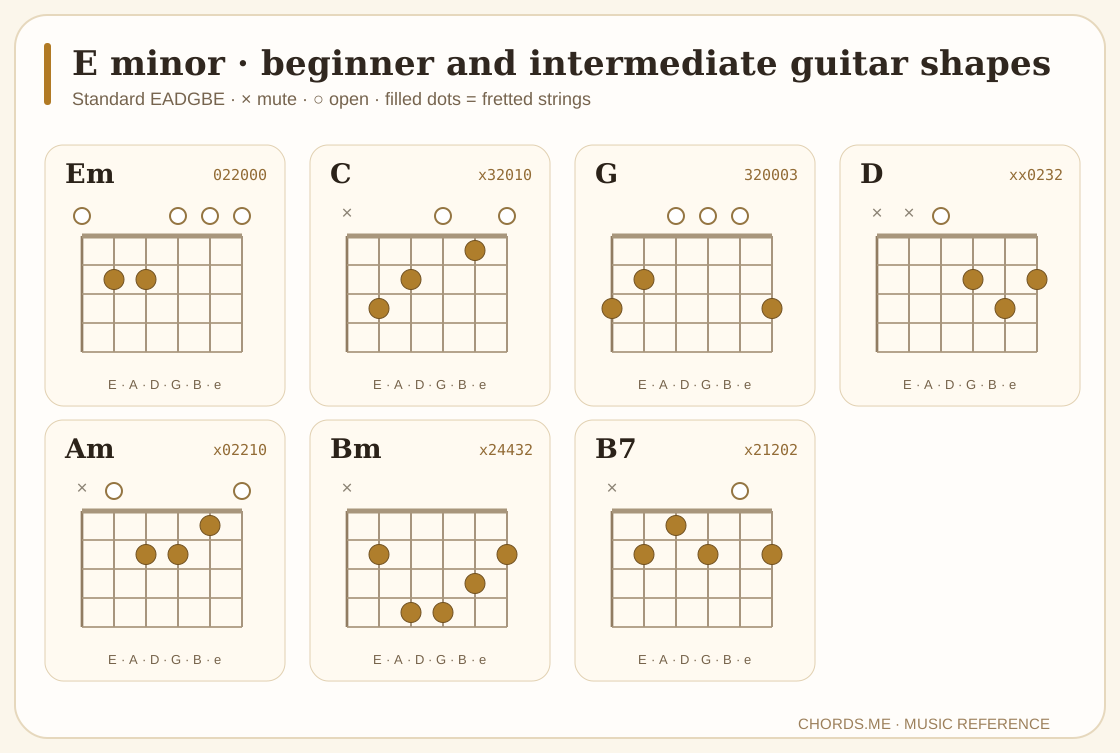
These shapes are written from the low E string to the high E string in standard EADGBE tuning. An x means do not play that string, and 0 means an open string.
| Chord | Shape |
|---|---|
| Em | 022000 |
| C | x32010 |
| G | 320003 |
| D | xx0232 |
| Am | x02210 |
| Bm | x24432 |
| B7 | x21202 |
For fingering suggestions, check the Guitar Chord Finder.
A strumming exercise in 4/4. Count “1 & 2 & 3 & 4 &” and play one chord per bar.
- Start with four down strums per bar, one on each beat.
- Add a more flowing pattern: down on 1, down on 2, up on the “&” after 2, rest on 3, up on the “&” after 3, down on 4, up on the “&” after 4.
Practice slowly with a metronome at a pace where you can change chords without stopping.
Chord-change advice. Bm is not an easy beginner chord. Its shape (x24432) asks your hand to cover several strings at once, so spend extra time on it instead of rushing. Practice each change as a pair, such as Am to Bm or B7 to Em, with a metronome and no strumming. Then add the strum.
B7 is easier to reach from Em because both chords leave the B string open. Keep that string ringing and let your hand find the rest of the shape.
How to Play These Progressions on Piano
The chords you need are:
- Em: E G B
- C: C E G
- G: G B D
- D: D F♯ A
- Am: A C E
- Bm: B D F♯
- B7: B D♯ F♯ A
A simple method is to play a root note in the left hand and a chord in the right hand. The Piano Chord Finder is a quick way to check any chord’s notes.
A smooth voice-leading example for Em – Am – B7 – Em:
| Chord | Left Hand | Right Hand |
|---|---|---|
| Em | E | G B E |
| Am | A | A C E |
| B7 | B | A B D♯ |
| Em | E | G B E |
Every note belongs to its chord. The B7 voicing leaves out the fifth (F♯), which is a common practical simplification. Between chords, each right-hand voice moves by a step or stays put:
- G → A, B → C, E stays (Em to Am).
- A stays, C → B, E → D♯ (Am to B7).
- A → G, B stays, D♯ → E (B7 to Em).
Bm vs B7: Why the Resolution Changes
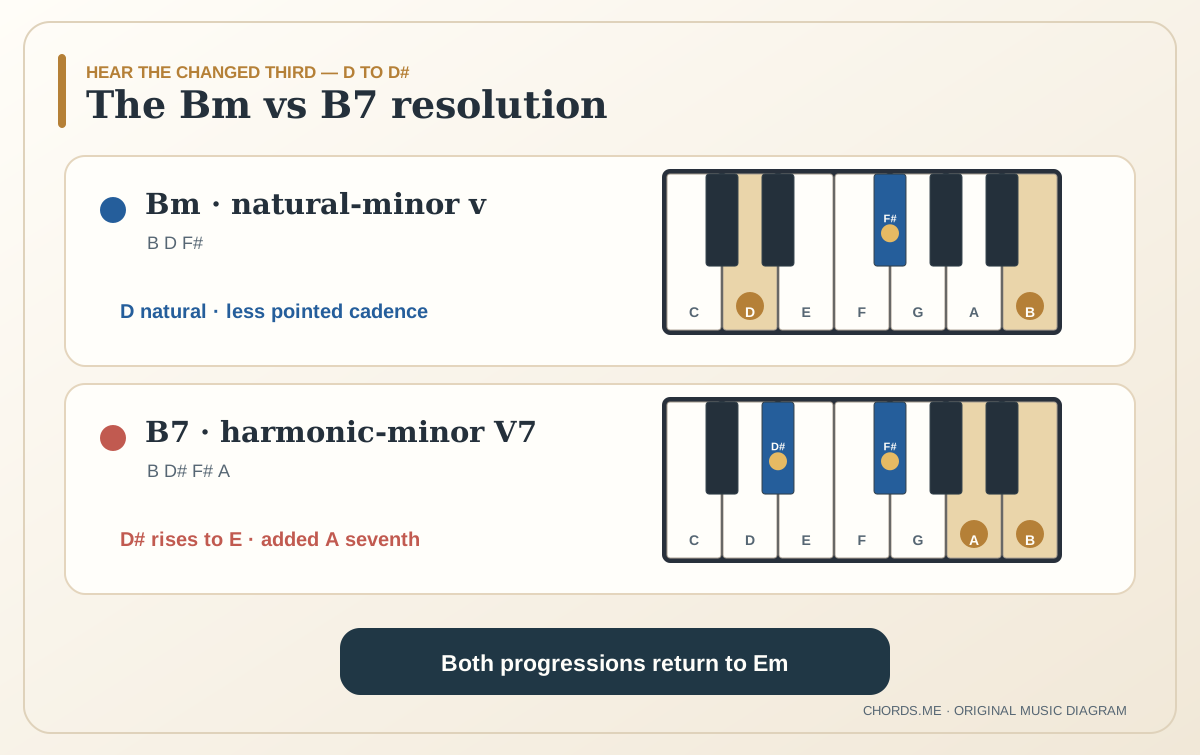
Compare these two progressions:
Em – Am – Bm – Em Em – Am – B7 – Em
The main color difference is D versus D♯, and B7 also adds an A as its seventh. Bm contains D natural, which sits a whole step below E. B7 contains D♯, which sits a half step below E. That half step creates a pull, so B7 feels like it wants to resolve and Bm feels more relaxed.
B7 also contains an A, which tends to fall toward G. That adds to the sense of motion, though D♯ to E is the main effect.
A songwriter might pick Bm for a gentle, modal sound or B7 when the music needs a firm arrival at Em.
A listening exercise for guitar:
- Play the D string alone at fret 1 (D♯), then fret 2 (E). That’s a half-step resolution.
- Play the open D string, then fret 2 (E). That’s a whole-step resolution.
- Play both progressions above at the same tempo with one chord per bar and compare how the last chord feels.
How Rhythm Changes a Progression
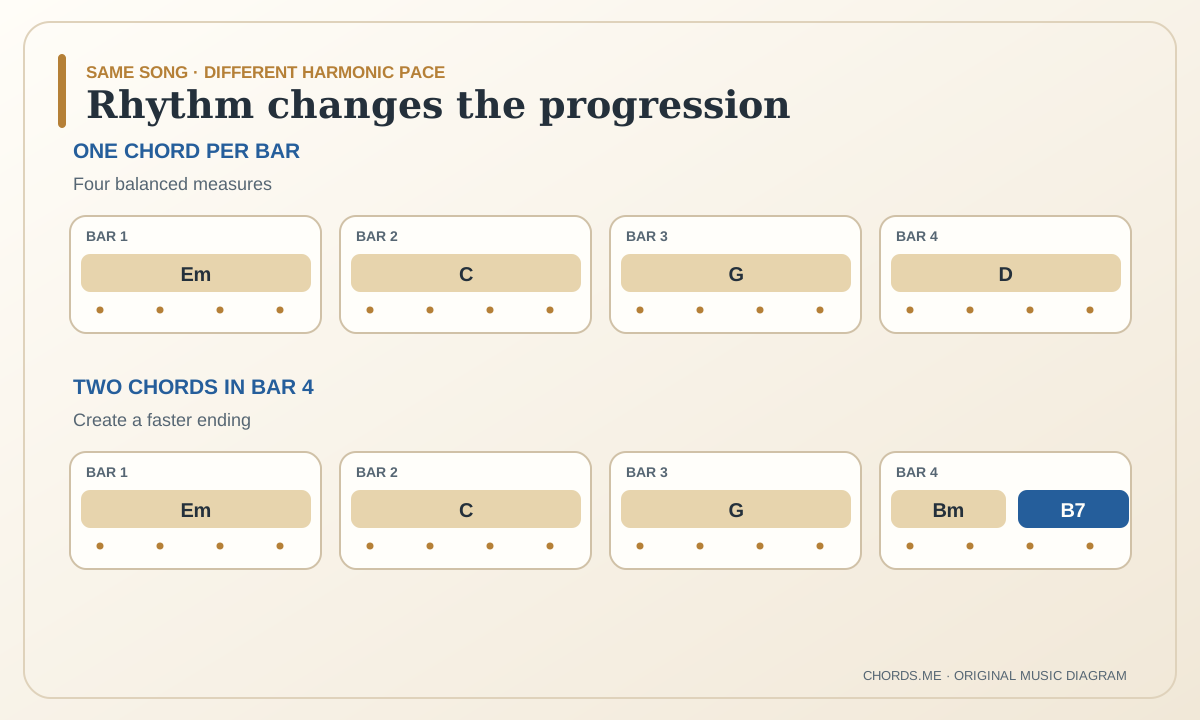
Chord order is only half the story. How long each chord lasts changes the feel, even when the notes stay the same.
Try Em – C – G – D in 4/4:
- One chord per bar: Em | C | G | D |. This is steady and spacious.
- Two beats per chord: Em C | G D |. The same harmony feels busier.
- Uneven lengths: Em | Em | C | D |. A long opening Em makes the home chord feel grounded.
You can also try a simple 6/8 pattern. Count “1-2-3-4-5-6” with the strong pulses on 1 and 4, so each bar feels like two big beats divided in three. This is different from 3/4, which has three beats per bar, each divided in two.
How to Write Your Own E Minor Chord Progression
Here is a simple method:
- Pick a tonal center. Start on Em and let the first chord feel like home.
- Choose a direction. Em to C feels lifting, and Em to Am feels darker.
- Decide where the tension goes. Use B7 if you want a strong return, or D if you want something looser.
- Set the duration. Short chords create motion and longer chords create stability.
- Close the loop. Make sure the last chord either leads back to Em or lands somewhere you chose on purpose.
A worked example: Start with Em. We want a reflective, mid-tempo feel, so we choose Em – C – Am – B7. In Roman numerals that is i – VI – iv – V7. We hold Em for two bars, C for one, Am for one, and B7 for two. The long B7 builds tension before the loop returns to Em.
For a basic melody, aim for chord tones on strong beats. Over Em, use G, B, or E. Over C, use E or G. Over Am, use A or C. Over B7, use D♯, F♯, or B, and avoid holding D natural against the D♯ in the chord. Resolving D♯ to E as the loop returns gives the phrase a satisfying end.
The Chord Progression Generator can help you test other combinations, and Chord to MIDI can help if you want to bring a progression into your recording software.
For a systematic five-step method, see how to tell what key a song is in.
E Minor vs G Major
E minor and G major share the same seven notes, so many of their chords overlap. Em – C – G – D is a clear example: in E minor it’s i – VI – III – VII, and in G major it’s vi – IV – I – V.
Several clues can tip the balance:
- Resolutions: A D♯ in B7 pointing to Em suggests E minor. A strong D to G motion suggests G major.
- Melody: If the tune keeps landing on E, it leans minor. If it keeps landing on G, it leans major.
- Emphasis: Which chord gets the longest duration or the strongest beat? That chord usually feels like home.
The first or last chord alone doesn’t settle it. Treat key as a matter of emphasis and context.
Common Mistakes
- Confusing the Em chord with the E minor key. Em is one chord, and E minor is a key with many chords. Playing Em doesn’t mean you’re in E minor.
- Thinking B7 is always wrong in E minor. B7 comes from harmonic minor and is a standard way to strengthen the return to Em.
- Assuming every progression beginning with Em is in E minor. Em – C – G – D can also be heard in G major.
- Ignoring chord duration and rhythm. The same chords can feel completely different depending on how long each one lasts.
- Mixing up Roman numeral qualities. Lowercase means minor, uppercase means major, and
°means diminished. WritingVorV7for B major or B7 andvfor Bm keeps them separate.
FAQs
What chords go with E minor? The most common choices are Em, C, G, D, Am, and Bm from the natural minor scale, plus B or B7 from harmonic minor.
What is an easy E minor chord progression? Em – C – D – Em uses open shapes that most beginners can reach quickly.
Can B7 be used in E minor? Yes. B7 is not in the natural minor scale, but it comes from harmonic minor and is widely used to strengthen the resolution to Em.
What is an E minor chord progression on guitar? It’s any sequence of guitar chords that treats Em as home, such as Em – Am – B7 – Em. The chart above gives seven options.
Is Em – C – G – D in E minor or G major? Either reading can work. If the music keeps returning to Em and emphasizes E, it leans toward E minor. If it emphasizes G, it leans toward G major.
Practical Takeaway
Start with one progression and loop it until it feels easy. Then change one thing at a time: the duration of a chord, one chord choice, or the melody note you land on. Try swapping Bm for B7 and listen for the change. Small changes like that teach you more about E minor chord progressions than memorizing a long list.