DADGAD Tuning Guide for Beginners
Learn DADGAD tuning notes, beginner chord shapes, drone sounds, and practical ways to start playing in this tuning.
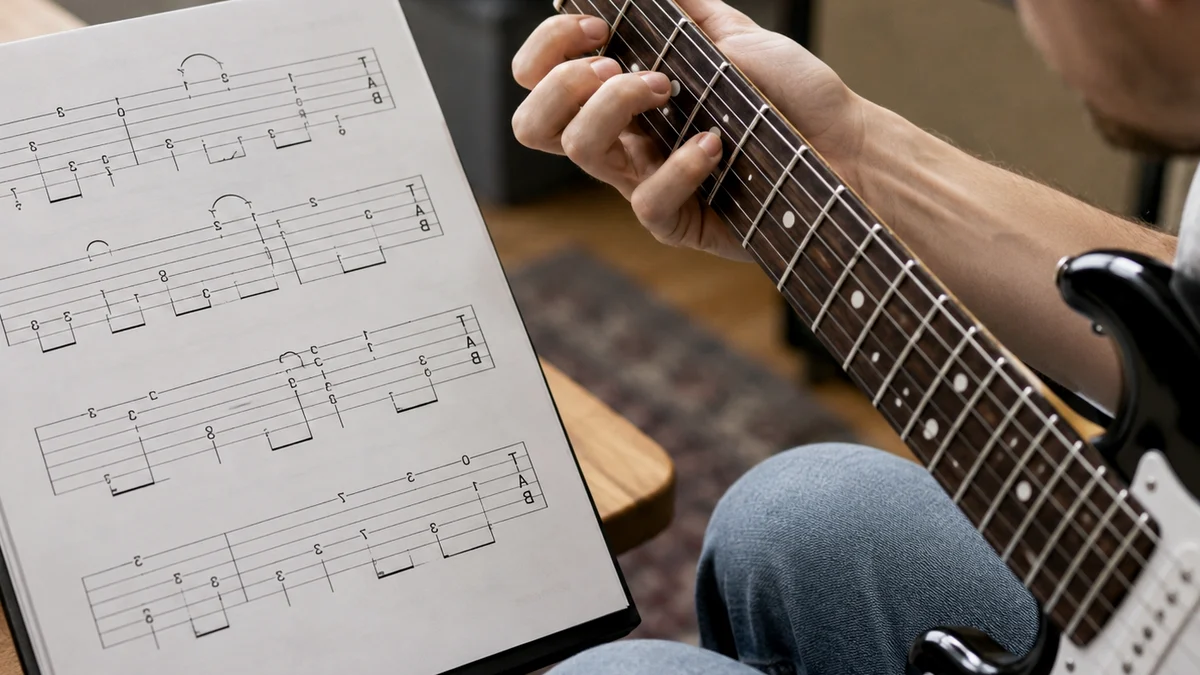
If you have spent any time listening to acoustic fingerstyle guitar, traditional Irish music, or even classic rock bands like Led Zeppelin, you have likely heard the mesmerizing, ringing sound of DADGAD tuning. This unique way of tuning your guitar offers a lush, resonant, and almost orchestral quality that is incredibly difficult to replicate in standard tuning.
For many guitarists, the idea of leaving the comfort zone of standard tuning can feel intimidating. You might worry that you will have to relearn the entire fretboard from scratch or that alternate tunings are only for advanced virtuosos. Fortunately, DADGAD is one of the most accessible, forgiving, and rewarding tunings a beginner can explore.

In this guide, you will learn exactly how to get your guitar into DADGAD tuning, the music theory behind its clear sound, why it is highly recommended for beginners, and how to start playing your very first chords and songs today.
What is DADGAD Tuning? DADGAD tuning is a popular alternate guitar tuning where the strings are tuned to the notes D, A, D, G, A, and D from the lowest string to the highest. It is widely classified as a modal tuning or suspended chord tuning because the open strings form a Dsus4 chord. Because this chord contains no major or minor third, it has an open, mysterious, and beautifully neutral sound that works exceptionally well for Celtic music, folk, and fingerstyle arrangements.
What is DADGAD Tuning?
To understand DADGAD, we first need to look at how it compares to the standard tuning you use every day. In standard tuning, your guitar is tuned to E, A, D, G, B, and E.
When you strum all six open strings in standard tuning, the resulting sound is discordant. Standard tuning is designed to make it easy to play a wide variety of chord shapes across different keys, but the open strings themselves do not form a clean, cohesive chord.
DADGAD changes this dynamic entirely. By lowering three of your strings by a whole step (two frets), you create a highly harmonious relationship between all six strings.
| String | Standard Tuning | DADGAD Tuning | Pitch Adjustment From Standard |
|---|---|---|---|
| 6 (Lowest) | E | D | Down 1 whole step (2 frets) |
| 5 | A | A | No change |
| 4 | D | D | No change |
| 3 | G | G | No change |
| 2 | B | A | Down 1 whole step (2 frets) |
| 1 (Highest) | E | D | Down 1 whole step (2 frets) |
The Power of the Modal Sound
In music theory, a standard major chord is made of three notes: the root, the third, and the fifth. The third is the note that tells our ears whether a chord is major (happy) or minor (sad).
If you look at the notes of DADGAD (D, A, G), you will notice we have the root note (D), the fifth (A), and the fourth (G). We do not have a third (which would be F# for D major, or F natural for D minor). Because the third is missing and replaced by the fourth, the open strings form a Dsus4 (D suspended fourth) chord.
This is why DADGAD is often referred to as a suspended chord tuning or a modal tuning guitar. Because there is no major or minor third, the open strings sound completely neutral. It is neither happy nor sad; it is an open canvas. This neutral quality allows you to play major or minor melodies over the top of the open strings without any harmonic clash, creating a rich, atmospheric, and modal sound.
How to Tune Your Guitar to DADGAD From Standard Tuning
If you are wondering how do you tune to DADGAD from standard, the process is straightforward. You only need to alter three of your six strings. The 5th, 4th, and 3rd strings remain exactly as they are in standard tuning.
To make this transition smooth, you can use the Chords.me online Guitar Tuner to help you visualize the pitch changes as you tune down. Here is the step-by-step process of how to tune guitar to DADGAD from standard:
Step 1: Lower the 6th String (Low E to D)
Pluck your low E string and slowly turn the tuning peg to lower the pitch. You want to drop it a whole step down to D. If you are tuning by ear, you can compare the pitch of this string to your open 4th (D) string. They should sound exactly one octave apart.
Step 2: Keep the 5th, 4th, and 3rd Strings the Same
Leave your A, D, and G strings alone. They are already in the correct pitch.
Step 3: Lower the 2nd String (B to A)
Pluck your B string and lower the pitch by a whole step down to A. To check this by ear, compare it to your open 5th (A) string. They should sound exactly one octave apart.
Step 4: Lower the 1st String (High E to D)
Pluck your high E string and lower the pitch by a whole step down to D. You can verify this pitch by comparing it to your open 4th (D) string, which will be exactly one octave lower, or your newly tuned 6th (D) string, which is two octaves lower.
Tuning Tips for Stability
Because you are lowering the tension on three of your strings, the neck of your guitar will adjust slightly to the relief in tension. This can sometimes cause the remaining strings to go slightly sharp. Once you have tuned all six strings to D-A-D-G-A-D, go back to the 6th string and double-check each one. It usually takes two or three quick passes to get the instrument completely stable in its new tuning.
Is DADGAD Good for Beginners?
When beginners first hear about alternate tunings, they often ask: is DADGAD good for beginners, and is DADGAD hard to learn?
The short answer is that DADGAD is incredibly beginner-friendly. In many ways, it is actually easier to make clear, musical sounds in DADGAD than it is in standard tuning. Here is why:
1. Simple One-Finger and Two-Finger Chords
In standard tuning, playing a clean G major or C major chord requires you to stretch your fingers across multiple frets and strings, which can be difficult for beginners who are still developing hand strength. In DADGAD, because the open strings are already harmonized, you can play gorgeous, complex-sounding chords using only one or two fingers.
2. The Magic of Drone Strings
One of the most appealing features of DADGAD is the ability to use drone strings. A drone is a continuous, unchanging note that rings out in the background while you play a melody on other strings. Because the open D and A strings sound so pleasant together, you can leave them completely open while you fret a simple melody on the 3rd or 1st string. Even if your fretting hand is only playing a single note, the surrounding open strings make your guitar sound strong, like two people are playing at once.
3. Lower String Tension
Tuning three of your strings down a whole step reduces the overall tension on the guitar neck. This makes the strings physically softer and easier to press down against the frets. If you are still building up your finger calluses, playing in DADGAD will feel much gentler on your fingertips than standard tuning.
What is DADGAD Tuning Used For?
Historically, what is DADGAD tuning used for? The tuning was popularized in the 1960s by the influential British folk guitarist Davey Graham. He inspired legendary players like Bert Jansch, John Renbourn, and Pierre Bensusan, who went on to make DADGAD the absolute standard for modern fingerstyle guitar.
Celtic Guitar Tuning
If you have ever listened to traditional Irish, Scottish, or Breton acoustic guitar, you have almost certainly heard DADGAD. It is often referred to as the definitive Celtic guitar tuning. Traditional Celtic music is highly modal and relies heavily on drones, mimicking instruments like the bagpipes, fiddle, and bouzouki. DADGAD allows the guitar to mimic these traditional instruments perfectly, providing a driving, rhythmic, and resonant accompaniment to jigs, reels, and airs.
Fingerstyle Tuning and Modern Folk
Beyond traditional music, DADGAD is a staple of modern fingerstyle tuning and contemporary folk. Fingerstyle guitarists love it because the layout of the strings makes it incredibly easy to play a moving bass line with the thumb while simultaneously playing a melody on the higher strings. The natural resonance of the open strings fills in the sonic gaps, creating a lush background wash that makes solo performances sound full and complete.
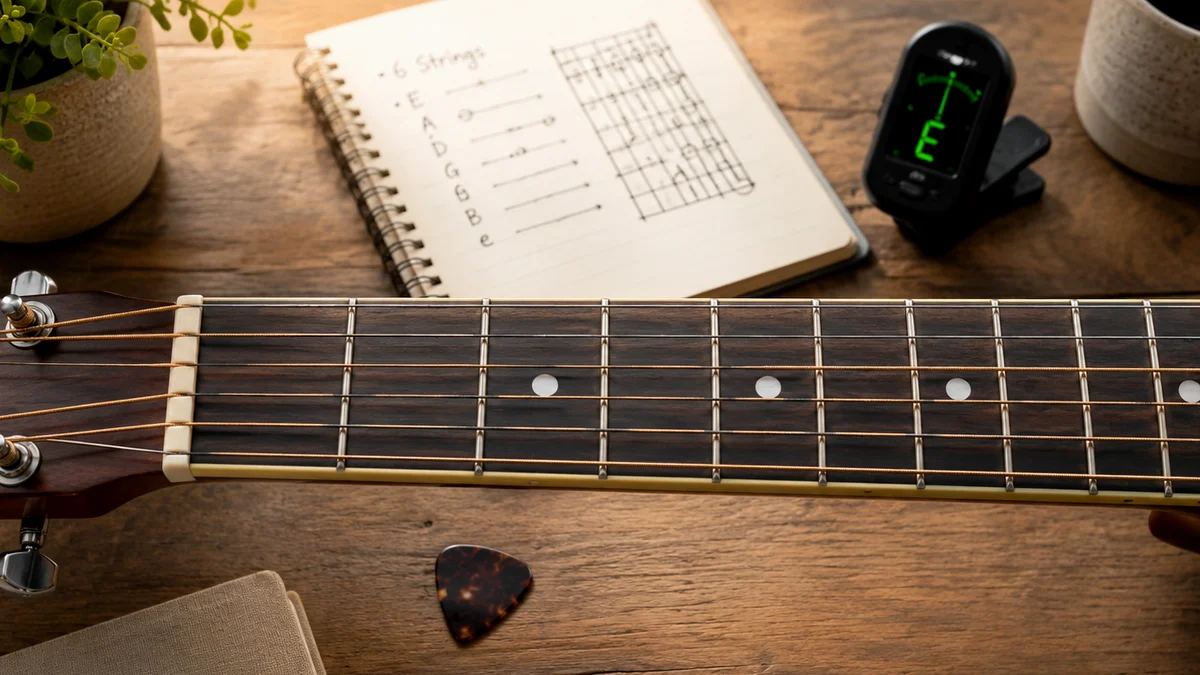
Essential DADGAD Chord Shapes for Beginners
To start playing in DADGAD, you do not need to memorize dozens of complex chord charts. Because of the way the strings are tuned, many chords can be played with minimal effort. Here are five essential, beginner-friendly chord shapes to get you started.
1. The Open D5 Chord (No Fingers)
The easiest chord in DADGAD requires absolutely no fingers on your fretting hand. Simply strum all six open strings.
D |---|---|---|---| (Open)
A |---|---|---|---| (Open)
G |---|---|---|---| (Open)
D |---|---|---|---| (Open)
A |---|---|---|---| (Open)
D |---|---|---|---| (Open)
This is your home base. It is a powerful, ringing D5 chord that serves as the perfect starting and ending point for your chord progressions.
2. The "Two-Finger" G Major Chord
To play a clear, ringing G major chord, you only need to fret two notes. Place your middle finger on the 5th fret of the 6th string, and your index finger on the 4th fret of the 3rd string. Let all the other strings ring open.
D |---|---|---|---|---| (Open)
A |---|---|---|---|---| (Open)
G |---|---|---|-(I)-|---| (4th fret)
D |---|---|---|---|---| (Open)
A |---|---|---|---|---| (Open)
D |---|---|---|---|-(M)-| (5th fret)
Notice how the open D and A strings blend with the fretted notes to create a highly atmospheric G major sound that is far more resonant than a standard G chord.
3. The One-Finger A7sus4 Chord
For an easy transition chord, simply place your index finger on the 2nd fret of the 3rd string. Strum all six strings.
D |---|---|---|---| (Open)
A |---|---|---|---| (Open)
G |---|-(I)-|---|---| (2nd fret)
D |---|---|---|---| (Open)
A |---|---|---|---| (Open)
D |---|---|---|---| (Open)
This chord has a clear, unresolved tension that naturally wants to resolve back to your open D5 chord.
4. The Celtic Bm7 Chord
To add a touch of melancholy to your playing, you can play a B minor 7th chord. Place your index finger on the 2nd fret of the 5th string, and your middle finger on the 2nd fret of the 3rd string. Keep the 6th string silent or lightly mute it with the tip of your index finger.
D |---|---|---|---| (Open)
A |---|---|---|---| (Open)
G |---|-(M)-|---|---| (2nd fret)
D |---|---|---|---| (Open)
A |---|-(I)-|---|---| (2nd fret)
D |---|---|---|---| (Muted or unplayed)
This chord is highly common in Celtic music and provides a wonderful minor contrast to the open D major sound.
5. The Simple D Major Chord
If you want a true D major chord (with the major third included), you only need to add one finger to your open D5. Place your index finger on the 1st fret of the 3rd string.
D |---|---|---|---| (Open)
A |---|---|---|---| (Open)
G |-(I)-|---|---|---| (1st fret)
D |---|---|---|---| (Open)
A |---|---|---|---| (Open)
D |---|---|---|---| (Open)
Fretting the 1st fret of the 3rd string changes the G note to an F#, which is the major third of the D scale. This instantly transforms the open, ambiguous sound of DADGAD into a bright, joyful D major chord.
What Songs Use DADGAD Tuning?
If you want to hear this tuning in action, there are several iconic tracks you should listen to. Exploring what songs use DADGAD tuning is a fantastic way to understand how professional guitarists utilize the unique properties of this layout.
"Kashmir" by Led Zeppelin
Perhaps the most famous rock song written in DADGAD, "Kashmir" uses the heavy, driving resonance of the low D string to create its legendary, hypnotic riff. Jimmy Page utilized the tuning to give the acoustic and electric guitars an exotic, orchestral weight that standard tuning simply could not achieve.
"Black Mountain Side" by Led Zeppelin
Another Jimmy Page masterpiece, this instrumental acoustic track is heavily influenced by traditional Irish folk. It showcases how DADGAD can be used to play rapid, sitar-like melodies over a constant low-end drone.
"Photograph" by Ed Sheeran
For a modern pop example, "Photograph" can be played beautifully using DADGAD-style fingerstyle arrangements. The open, ringing nature of the suspended chords fits the emotional, acoustic ballad style perfectly, allowing a single acoustic guitar to sound incredibly full behind the vocals.
"Drifting" by Andy McKee
While highly advanced, this modern fingerstyle piece utilizes DADGAD (and various percussive techniques) to create an entire band sound on a single acoustic guitar. It is a prime example of how the tuning allows for complex, multi-layered arrangements.
Common Mistakes Beginners Make in DADGAD
While DADGAD is highly accessible, there are a few common pitfalls that beginners encounter when first exploring alternate tunings. Being aware of these will save you time and frustration.
1. Trying to Play Standard Chord Shapes
The most common mistake is forgetting that your guitar is no longer in standard tuning. If you try to play a standard C major, G major, or E minor shape in DADGAD, it will sound incredibly dissonant and unpleasant. You must consciously remind yourself that the 6th, 2nd, and 1st strings have changed. Focus on learning the specific DADGAD shapes outlined above rather than relying on muscle memory from standard tuning.
2. Dealing with String Buzz
Because you are tuning three of your strings down a whole step, the physical tension on your guitar neck is reduced. If your guitar is set up with very low action (the height of the strings above the fretboard), this drop in tension can cause the strings to vibrate more widely, leading to fret buzz. To prevent this, try playing with a slightly lighter touch, or consider using a slightly heavier string gauge (such as medium strings instead of extra-lights) if you plan to keep your guitar in DADGAD for long periods.
3. Over-Strumming and Muddy Sound
Because DADGAD is so resonant and has so many sympathetic vibrations, strumming all six strings with a heavy hand can quickly result in a muddy, indistinct wall of sound. DADGAD thrives on space and dynamics. Try focusing your strumming on specific string groups, or use a light, delicate fingerstyle approach to let the individual notes sing out clearly.
Simple Exercises to Start Playing in DADGAD
To help your hands and ears get used to the unique feel of DADGAD, try these two simple exercises.
Exercise 1: The
Related Chords.me Guides
For the next step, read Open G Tuning Guide, Drop C Tuning Guide: Notes, Setup, and Common Mistakes, and Chromatic Tuner Guitar Guide: How to Tune Accurately as a Beginner before moving on. You can also test the same idea in another key and check each string with the guitar tuner while practicing this lesson.
Practice This With Chords.me
Use the Guitar Tuner to check each string slowly before practicing the example. Focus on clean notes and steady timing before increasing speed.
Frequently Asked Questions
What does DADGAD stand for?
DADGAD describes the note of each open string from lowest to highest: D, A, D, G, A, D.
Is DADGAD tuning hard for beginners?
DADGAD is not inherently hard, but it can be confusing at first because familiar chord shapes don't work the same way; beginners usually need to learn new shapes suited to the tuning.
What genre is DADGAD tuning associated with?
DADGAD is most associated with Celtic and folk fingerstyle guitar, though it is also used in some rock and world music.
About the Contributor
Chords.me Tuning & Setup Desk Tuning, strings, and setup contributor
A brand contributor profile for Chords.me tuning and setup content. This desk focuses on tuning accuracy, string choice, fret buzz, intonation, action, and maintenance topics for everyday players. Content is checked for practical clarity, beginner readability, and accurate links to relevant Chords.me tools.