Standard EADGBE Tuning Explained
Understand standard EADGBE guitar tuning, open string notes, frequencies, and why six-string guitars use this layout.

When you pick up a guitar for the first time, the array of strings, frets, and tuning pegs can feel a bit overwhelming. Before you can play your first chord or learn a favorite song, you have to tackle the most fundamental step: getting the instrument in tune. For the vast majority of guitar players worldwide, this means tuning to standard EADGBE.
Standard tuning is the default configuration for the modern six-string guitar. It dictates how chords are shaped, how scales are patterned across the fretboard, and how music is written for the instrument. Understanding standard EADGBE tuning is not just about memorizing a sequence of letters; it is about understanding the logical design of the guitar fretboard.
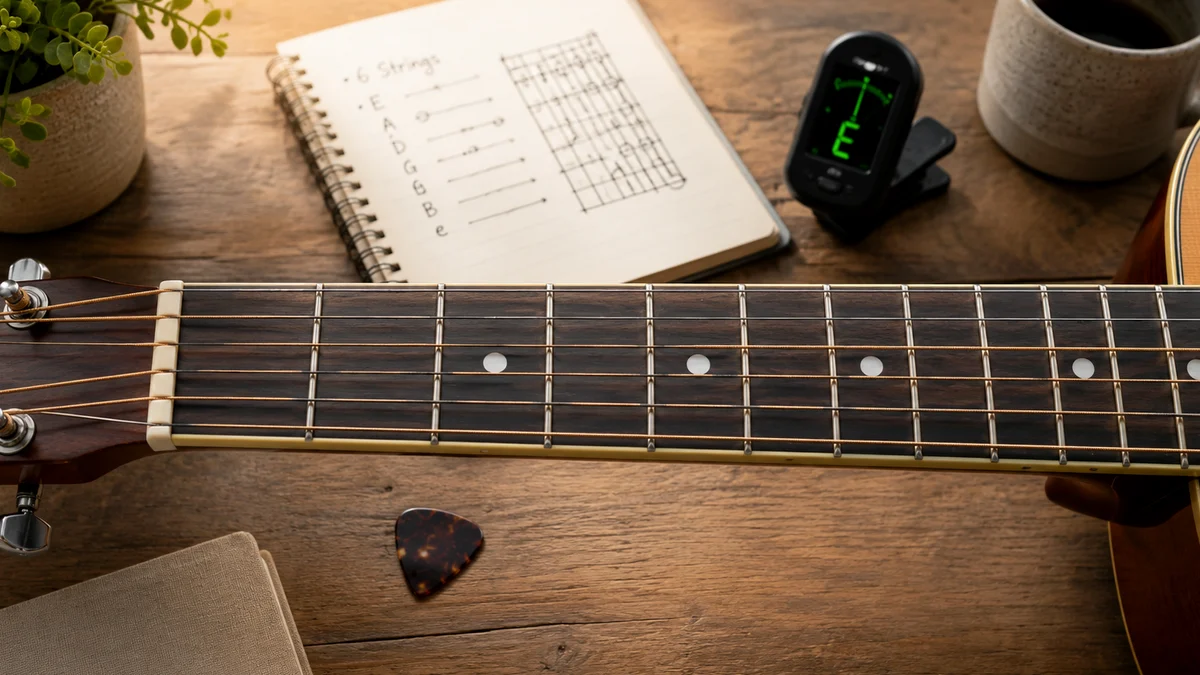
What Does EADGBE Stand For?
In standard guitar tuning, EADGBE represents the pitch names of the six open strings of the guitar, ordered from the thickest string (lowest pitch) to the thinnest string (highest pitch).
To tune your guitar to standard pitch, tune the strings in this specific sequence:
- 6th String (Thickest): Low E (E2, approximately 82.41 Hz)
- 5th String: A (A2, approximately 110.00 Hz)
- 4th String: D (D3, approximately 146.83 Hz)
- 3rd String: G (G3, approximately 196.00 Hz)
- 2nd String: B (B3, approximately 246.94 Hz)
- 1st String (Thinnest): High E (E4, approximately 329.63 Hz)
What is EADGBE Tuning
To understand standard tuning, let's look at how pitch naming and string order work. When we talk about open strings, we mean the pitches produced when you pluck a string without pressing down on any frets.
On a standard six-string guitar, the strings are numbered 1 through 6. This can feel a bit counterintuitive at first: the 1st string is the thinnest one (closest to the floor when you're holding the guitar in playing position), while the 6th string is the thickest one (closest to your chest).
We read standard tuning from low pitch to high pitch (6th string to 1st string). This low-E to high-E range provides a beautifully balanced frequency spectrum that sits perfectly in a musical mix, bridging the gap between bass instruments and higher-pitched melody instruments like the violin or flute.
The table below outlines the exact frequencies and scientific pitch notations for each open string in standard tuning, calibrated to the standard concert pitch of A440 (where the note A above middle C vibrates at exactly 440 Hz).
| String Number | Note Name | Octave (Scientific Pitch) | Frequency (Hz) | Physical Description |
|---|---|---|---|---|
| 6 | E | E2 | 82.41 Hz | Thickest string, lowest pitch |
| 5 | A | A2 | 110.00 Hz | Wound bass string |
| 4 | D | D3 | 146.83 Hz | Wound bass string |
| 3 | G | G3 | 196.00 Hz | Thinnest wound string (or thickest plain string) |
| 2 | B | B3 | 246.94 Hz | Plain steel treble string |
| 1 | E | E4 | 329.63 Hz | Thinnest string, highest pitch |
This also explains why a bass guitar and a standard guitar sound so different, even though they share note names. A standard four-string bass is tuned E-A-D-G, but those notes sit exactly one octave lower than the lowest four strings on your guitar.
Why Is the Guitar Tuned EADGBE?
A question I often get from beginners is: why do we use EADGBE instead of a simple alphabetical order (A-B-C-D-E-F) or a perfectly symmetrical pattern?
The answer comes down to a mix of music theory, ergonomics, and chord playability. This layout wasn't chosen at random; it evolved over centuries to make playing chords and scales as comfortable as possible for the human hand.
The Interval Pattern: Perfect Fourths and a Major Third
The relationship between adjacent strings determines how we play scales and chords. If you look closely at the musical intervals (the distance in pitch) between the open strings of a standard tuned guitar, you will find a highly specific pattern:
- From E to A is a perfect fourth (five semitones/frets).
- From A to D is a perfect fourth (five semitones/frets).
- From D to G is a perfect fourth (five semitones/frets).
- From G to B is a major third (four semitones/frets).
- From B to E is a perfect fourth (five semitones/frets).
This single major third interval between the 3rd and 2nd strings (G to B) is the practical way to the guitar's versatility.
Why Not Tune Entirely in Perfect Fourths?
If we tuned the guitar entirely in perfect fourths—which would result in E-A-D-G-C-F—the fretboard would be perfectly symmetrical. While this symmetry makes scale patterns identical across all six strings, it makes playing standard chord shapes incredibly difficult.
In an all-fourths tuning (E-A-D-G-C-F), a basic six-string major barre chord would require an awkward five-fret stretch. By dropping the 2nd string down by one semitone (from C to B) and the 1st string down accordingly (from F to E), we introduce that major third interval. This small shift aligns the open strings so you can play common major, minor, and dominant chords using compact, comfortable finger shapes.
Because of this, you can play a full six-string E major chord with just three fingers, or a G major chord using four. It also makes movable barre chords possible, letting you play any major or minor chord up and down the neck using the same basic hand shapes.
The History Behind Standard Guitar Tuning
Standard tuning didn't appear overnight. It’s the result of a long evolutionary process spanning several centuries and involving several of the guitar's ancestor instruments.
During the Renaissance and Baroque eras, instruments like the lute, vihuela, and early four- and five-course guitars used various tuning systems. Many were tuned primarily in fourths with a third in the middle. The lute, for example, often used G-C-F-A-D-G, which shares the exact same interval formula as our modern guitar, just pitched a bit higher.
As the instrument evolved from the five-course Baroque guitar to the modern six-string classical guitar in the late 18th and early 19th centuries, luthiers and musicians sought a standard layout that would maximize the instrument's volume, resonance, and playability.
Adding a lower sixth string tuned to E expanded the bass range of the instrument significantly. It matched the high E string two octaves lower, creating a pleasing symmetry where the lowest and highest strings share the same note name. This development was popularized by influential Spanish classical guitarists and luthiers, eventually cementing EADGBE as the universal standard for the six-string guitar.

Is EADGBE the Same for All Guitars
A common point of confusion is whether different styles of guitars require different tunings. The short answer is no—EADGBE is the default tuning for almost all standard six-string guitars, regardless of their design.
Whether you’re playing a nylon-string classical, a steel-string acoustic, or an electric guitar, standard tuning remains EADGBE. The scale length and string tension might differ, but the pitch relationships are identical. Once you learn a chord shape on an acoustic, you can play it exactly the same way on an electric.
However, there are variations depending on the type of instrument:
- Twelve-String Guitars: A twelve-string guitar is still tuned to standard EADGBE, but each of the six courses features a pair of strings. The lower four pairs (E, A, D, G) are tuned in octaves, while the top two pairs (B, E) are tuned in unison.
- Seven-String Guitars: Popular in heavy metal and jazz, seven-string guitars typically add a low B string below the 6th string, resulting in BEADGBE tuning.
- Eight-String Guitars: These instruments extend the range even further, usually adding a low F# string below the B, resulting in F#BEADGBE.
While standard tuning is the most common, guitarists also use "alternate tunings" to change the voice of the instrument. Examples include Drop D (where the 6th string is lowered to D) or Open G (where the strings are tuned to form a G major chord when played open). Despite these creative variations, standard EADGBE remains the foundational language of the instrument.
How to Memorize the EADGBE String Order
To tune quickly and navigate the fretboard with confidence, you'll want to memorize the open strings. The easiest way to do this is with a simple mnemonic device.
Here are a few popular phrases used by guitar teachers worldwide to help students remember the standard guitar tuning sequence:
- Eddie Ate Dynamite, Good Bye Eddie
- Every Amateur Does Get Better Eventually
- Every Acid Drink Gives Big Effects
- Elephants And Donkeys Grow Big Ears
If you prefer to memorize the strings from highest pitch to lowest pitch (1st string to 6th string), you can use this phrase:
- Every Beginner Gets Down And Exercises
Whichever phrase you choose, say it out loud while plucking the corresponding string. Linking the physical feel of the string with the visual cue and the spoken phrase will lock it into your memory in no time.
Practical Steps for Tuning Your Guitar to Standard Pitch
Now let's look at how to actually get your instrument in tune. Regular tuning is essential—wood is sensitive to changes in temperature and humidity, which causes strings to slip.
Using an Electronic Tuner
The most reliable way to tune is with a digital chromatic tuner. You can use a clip-on tuner on your headstock, a pedal, or an online tool like the Chords.me Guitar Tuner.
Here is how to use a tuner step-by-step:
- Turn on your tuner and make sure it's set to chromatic or standard guitar mode.
- Pluck the 6th string (low E) and let it ring. Don't pluck too hard, as striking the string too aggressively can temporarily sharpen the pitch.
- Look at the display. The tuner will show you the note it detects and tell you if you're flat (too low) or sharp (too high).
- Adjust the tuning peg. If you're flat, tighten the string to raise the pitch. If you're sharp, loosen it to lower the pitch.
- *Always tune up to the note.* If a string is too sharp, loosen it until it's flat, then tune up to the pitch. This keeps the string from slipping while you play.
- Repeat this process for the remaining strings (A, D, G, B, high E).
Once you've tuned all six, go back and double-check them. Adjusting the tension on one string slightly affects the neck, which can cause the other strings to drift.
Common Tuning Pitfalls to Avoid
Here are a few common hurdles to watch out for. Knowing these tips will save you from broken strings and plenty of frustration.
Tuning to the Wrong Octave
A digital tuner might tell you you're on 'E,' but you could be in the wrong octave. If the string feels loose and floppy, you're too low. If the tension feels dangerously tight, you're likely an octave too high and risk snapping the string.
Pay attention to how the strings feel. The low E should be firm but springy, while the high E should feel tight but not brittle. If something feels off, stop and compare the pitch to an audio reference or a dedicated guitar tuning app.
Over-Tightening and Snapping Strings
Breaking a string is a rite of passage, but it can be startling! This usually happens when you turn the wrong tuning peg by mistake.
Before you turn a peg, trace the string from the bridge all the way up to the headstock to make sure your hand is on the right one. Pluck the string continuously as you turn so you can hear the pitch change in real-time. If you're turning a peg and the pitch isn't changing, stop immediately—you're turning the wrong peg.
Tuning with Old Strings
If your strings are old, corroded, or dirty, they will struggle to hold a tune. Over time, metal loses its elasticity, causing strings to go flat quickly and sound dull. If your guitar won't stay in tune for more than a few minutes, it's likely time for a fresh set.
Summary of Standard Tuning
Standard EADGBE tuning is the starting point for your guitar practice. It offers the perfect balance of physical comfort, chord accessibility, and tonal range. By memorizing the open strings, understanding the interval logic, and using a reliable tuner, you'll build a solid foundation. Keep your guitar in tune, practice a little every day, and the fretboard will soon feel like home.
Related Chords.me Guides
For the next step, read Open G Tuning Guide, Drop C Tuning Guide: Notes, Setup, and Common Mistakes, and CAGED System Guitar Explained: Complete Beginner’s Guide to Fretboard Mast before moving on. You can also test the same idea in another key and check each string with the guitar tuner while practicing this lesson.
Practice This With Chords.me
Use the Guitar Tuner to check each string slowly before practicing the example. Focus on clean notes and steady timing before increasing speed.
Frequently Asked Questions
What do the letters EADGBE represent in guitar tuning?
EADGBE represents the musical notes of the six open strings on a guitar, from the thickest (lowest pitch) to the thinnest (highest pitch). Each letter corresponds to a specific note name that the string should be tuned to.
Why is standard guitar tuning called EADGBE?
It's called EADGBE because those are the specific musical notes the six strings are tuned to in standard configuration. The order is E (thickest string), A, D, G, B, and finally E (thinnest string).
What are the names of the 6 guitar strings?
The six guitar strings, from thickest to thinnest, are named E, A, D, G, B, and E in standard tuning. The thickest string is a low E, and the thinnest string is a high E.
Does every guitar use EADGBE tuning?
EADGBE is the most common standard tuning for six-string guitars, but it's not the only tuning. Many other tunings exist for different musical styles and sounds.
Is EADGBE tuning the same for electric and acoustic guitars?
Yes, EADGBE is the standard tuning for both electric and acoustic guitars. The tuning refers to the pitch of the open strings, regardless of the guitar's type or construction.
How are the guitar strings ordered in EADGBE tuning?
The strings are ordered from the thickest (lowest pitch) to the thinnest (highest pitch). This sequence is E (6th string), A (5th string), D (4th string), G (3rd string), B (2nd string), and E (1st string).
About the Contributor
Chords.me Tuning & Setup Desk Tuning, strings, and setup contributor
A brand contributor profile for Chords.me tuning and setup content. This desk focuses on tuning accuracy, string choice, fret buzz, intonation, action, and maintenance topics for everyday players. Content is checked for practical clarity, beginner readability, and accurate links to relevant Chords.me tools.