Chord Progressions in Every Key
Use common chord progressions in every key with Roman numerals, diatonic chords, and guitar-friendly examples.
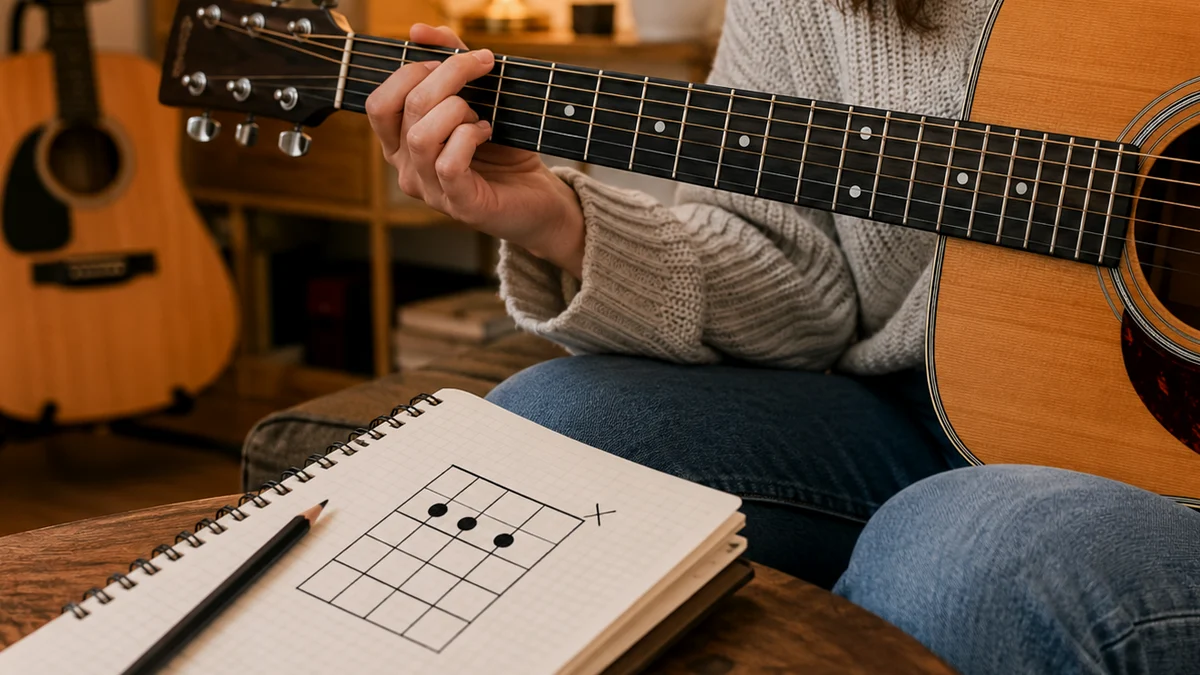
As a gigging guitarist and music practice guide, I see musicians struggle with transposition constantly. A vocalist asks to drop a song from G major to E major, and suddenly the rhythm section freezes. Understanding how chord progressions function across different keys is the practical way to playing by ear, writing songs effortlessly, and surviving any live jam session.
Before we map these patterns out across the fretboard and keyboard, let's establish a core definition that makes sense of the entire musical context.

What are Diatonic Chords? Diatonic chords are the seven chords built naturally using only the notes of a specific musical key. They follow a predictable pattern of major, minor, and diminished qualities based on the major scale, serving as the primary building blocks for almost all popular music.
Understanding Diatonic Chords: The Foundation of Every Key
To master chord progressions in every key, you must first understand how keys are constructed. Every major key contains seven distinct notes. If we build a three-note chord (a triad) on top of each of these notes using only the scale's existing notes, we get seven diatonic chords.
How do you find the diatonic chords of a key? You start with the major scale formula of whole steps (W) and half steps (H):
W - W - H - W - W - W - H
For example, in C major, this formula gives us the notes C, D, E, F, G, A, and B.
Once we have our scale notes, we stack thirds on top of each note to build our chords. This process reveals a universal pattern of chord qualities that applies to every single major key in existence:
- I (First chord): Major
- ii (Second chord): Minor
- iii (Third chord): Minor
- IV (Fourth chord): Major
- V (Fifth chord): Major
- vi (Sixth chord): Minor
- vii° (Seventh chord): Diminished
By using Roman numerals, we create a template. Capital letters represent major chords, lowercase letters represent minor chords, and the small circle indicates a diminished chord. This roman numeral analysis allows us to discuss a progression pattern without being tied to a single key. A "I-IV-V" progression behaves the same way in C major as it does in F# major; only the pitch shifts.
The Master Diatonic Chord Chart for All 12 Keys
To help you quickly identify what are the chords in every key, here is a complete chart mapping out the diatonic chords across all 12 major keys. This is your master reference when you need to find key-based chords on the fly.
| Key | I (Major) | ii (Minor) | iii (Minor) | IV (Major) | V (Major) | vi (Minor) | vii° (Diminished) |
|---|---|---|---|---|---|---|---|
| C | C | Dm | Em | F | G | Am | Bdim |
| G | G | Am | Bm | C | D | Em | F#dim |
| D | D | Em | F#m | G | A | Bm | C#dim |
| A | A | Bm | C#m | D | E | F#m | G#dim |
| E | E | F#m | G#m | A | B | C#m | D#dim |
| B / Cb | B | C#m | D#m | E | F# | G#m | A#dim |
| F# / Gb | F# | G#m | A#m | B | C# | D#m | E#dim |
| C# / Db | C# | D#m | E#m | F# | G# | A#m | B#dim |
| Ab | Ab | Bbm | Cm | Db | Eb | Fm | Gdim |
| Eb | Eb | Fm | Gm | Ab | Bb | Cm | Ddim |
| Bb | Bb | Cm | Dm | Eb | F | Gm | Adim |
| F | F | Gm | Am | Bb | C | Dm | Edim |
When studying this chart, notice how the relationships remain identical regardless of the starting note. The distance from the I chord to the IV chord is always a perfect fourth interval. The distance to the V chord is always a perfect fifth.
On the guitar, this geometric consistency is incredibly powerful. Once you learn a physical shape for a progression, you can slide it up and down the neck to play in different keys without changing your finger relationships.
What Is the Most Common Chord Progression in Every Key?
If you look at the history of Western popular music, one foundational movement stands out above all others. What is the most common chord progression in every key? The answer is the I-IV-V progression (and its modern four-chord cousin, the I-V-vi-IV progression).
The I-IV-V chord progression in every key represents Practical harmonic tension and release.
- The I chord represents home (the tonic). It feels stable and resolved.
- The IV chord (subdominant) introduces mild tension, moving away from home.
- The V chord (dominant) creates strong tension that pulls urgently back to the I chord.
Here is how the I-IV-V-vi progression maps across all 12 keys. This is Practical cheat sheet for popular chord progressions transposed to all keys.
| Key | I (Tonic) | IV (Subdominant) | V (Dominant) | vi (Relative Minor) |
|---|---|---|---|---|
| C | C | F | G | Am |
| G | G | C | D | Em |
| D | D | G | A | Bm |
| A | A | D | E | F#m |
| E | E | A | B | C#m |
| B | B | E | F# | G#m |
| F# | F# | B | C# | D#m |
| Db | Db | Gb | Ab | Bbm |
| Ab | Ab | Db | Eb | Fm |
| Eb | Eb | Ab | Bb | Cm |
| Bb | Bb | Eb | F | Gm |
| F | F | Bb | C | Dm |
Think about classic songs. "Wild Thing" by The Troggs is a straight I-IV-V-IV in A major (A - D - E - D). "La Bamba" uses the same movement in C major (C - F - G). If you want to sing "La Bamba" but find it too high for your vocal range, you can use a chord progression chart all keys to transpose it down to G major (G - C - D).
By understanding these relationships, you stop memorizing isolated chord shapes and start recognizing structural patterns. This is the difference between struggling to memorize a hundred songs and realizing that those hundred songs actually use the exact same three or four movements.
Popular Chord Progressions Transposed to All Keys
Beyond the standard three-chord rock progression, several other common chord progressions by key dominate modern music. Let's analyze three of the most influential patterns and see how they function across different musical environments.
The Sensitive Pop Progression (vi-IV-I-V)
This progression is the backbone of modern pop, rock, and punk. It starts on the emotional vi chord, giving it a melancholic feel, before resolving through the bright IV, I, and V chords. Think of "With or Without You" by U2 or "Let It Be" by The Beatles (which uses these same chords in a slightly different order).
- In C Major: Am - F - C - G
- In G Major: Em - C - G - D
- In D Major: Bm - G - D - A
- In A Major: F#m - D - A - E
If you are trying to write a song and feel stuck in C major, transposing this progression to E major (C#m - A - E - B) can instantly change the resonance of your instrument and inspire a completely different vocal melody.
The Jazz Standards Workhorse (ii-V-I)
If you play jazz, blues, or R&B, the ii-V-I progression is your daily bread. It is the primary vehicle used to establish a key center and navigate key changes. The minor ii chord leads smoothly into the dominant V chord, which resolves perfectly to the major I.
- In C Major: Dm7 - G7 - Cmaj7
- In G Major: Am7 - D7 - Gmaj7
- In F Major: Gm7 - C7 - Fmaj7
- In Bb Major: Cm7 - F7 - Bbmaj7
Notice how the tension builds step-by-step. The ii chord acts as a predominant preparation, the V7 contains the tritone tension that demands resolution, and the I major chord provides complete rest.
The Classic 1950s Doo-Wop Progression (I-vi-IV-V)
This progression defined an entire era of songwriting, heard in tracks like "Stand By Me" and "Earth Angel." It has a circular, nostalgic quality that can loop indefinitely without losing its charm.
- In C Major: C - Am - F - G
- In G Major: G - Em - C - D
- In E Major: E - C#m - A - B
When you need to shift these formulas on the fly during a rehearsal, using an online tool like the Chords.me chord transposer can save you from doing mental math under pressure. It allows you to instantly shift any chord sheet into a new key while maintaining the exact structural relationships of the original song.
Practical Tips for Transposing and Songwriting
Now that you have the charts and formulas, how do you apply this knowledge on your instrument? Here are several practical strategies I teach my private students to help them internalize chord progressions in every key.
Think in Numbers, Not Letters
When you look at a chord sheet for a song in G major (G - Em - C - D), don't just memorize the chords. Identify them as I - vi - IV - V. If you train your brain to hear the "vi" chord as the sad minor chord or the "V" chord as the tense dominant chord, your ears will start recognizing these relationships across different recordings.
On the guitar, this is particularly easy. The root note of your I chord on the low E string will always have the IV chord directly below it on the A string (at the same fret). The V chord will be two frets higher than the IV chord. The vi chord will be two frets higher than the I chord, but played as a minor shape.
Use a Capo to Keep Things Accessible
If you write a song in the key of Eb major, playing the diatonic chords (Eb, Fm, Gm, Ab, Bb, Cm) requires a lot of barre chords that can tire out your fretting hand. By placing a capo on the 3rd fret and playing in the key of C major shapes, you get the actual pitches of Eb major while using comfortable open chord shapes (C, Dm, Em, F, G, Am).
This allows you to keep the sonic character of open strings while matching the perfect key for your vocal range. It is a technique used by countless professional songwriters, from Bob Dylan to Ed Sheeran.
Experiment with Voice Leading
When moving from one chord to the next, try to keep common tones or move individual notes by only a step or half-step. For example, when moving from a G major chord to an Em chord, the notes G and B are shared between both chords. Keeping those notes stationary while only shifting the D note to an E note creates a smooth, professional transition.
This is especially important on the keyboard, where large jumps can sound jarring. Keep your hand movements small and let the inner voices of the chords slide smoothly into one another.
Watch Out for "Outside" Chords
While diatonic chords provide a safe, reliable palette, many of the best songs introduce non-diatonic chords to add color. A common example is using a major II chord (like playing an A major chord instead of an A minor chord in the key of G) to create a brighter, secondary dominant pull toward the V chord.
Another common variation is the flat-VII chord (bVII). In the key of C major, this is a Bb major chord. It adds a classic rock or mixolydian flavor to the progression, as heard in songs by artists like Lynyrd Skynyrd and Oasis.
Mastering chord progressions in every key is not about memorizing hundreds of individual chords. It is about recognizing the elegant, repeating geometric patterns that underpin all music. By using Roman numeral analysis and keeping a reliable diatonic chart handy, you can easily transpose your favorite songs, communicate clearly with other musicians, and find new creative options in your songwriting.
Related Chords.me Guides
For the next step, read How to Change a Song Key, Open G Tuning Guide, and Chromatic Tuner Guitar Guide: How to Tune Accurately as a Beginner before moving on. You can also test the same idea in another key and check each string with the guitar tuner while practicing this lesson.
Practice This With Chords.me
Use the Chord Transposer to test the idea in another key, then practice the same example slowly. Focus on clean notes and steady timing before increasing speed.
Frequently Asked Questions
What is the most common chord progression?
The most common chord progression in popular music is the I-V-vi-IV progression, heard in countless pop and rock songs.
How do you find the chords in a key?
You find the chords in a key by building a triad on each note of that key's major or minor scale, which gives you the standard set of chords that naturally belong to it.
What does I-IV-V mean in music?
I-IV-V refers to chords built on the 1st, 4th, and 5th notes of a key's scale, one of the most common and foundational chord progressions in music.
About the Contributor
Chords.me Tuning & Setup Desk Tuning, strings, and setup contributor
A brand contributor profile for Chords.me tuning and setup content. This desk focuses on tuning accuracy, string choice, fret buzz, intonation, action, and maintenance topics for everyday players. Content is checked for practical clarity, beginner readability, and accurate links to relevant Chords.me tools.