How to Transpose Guitar Chords: Practical Beginner Guide
How to Transpose Guitar Chords: clear guitar guide with practical examples and Chords.me tools.
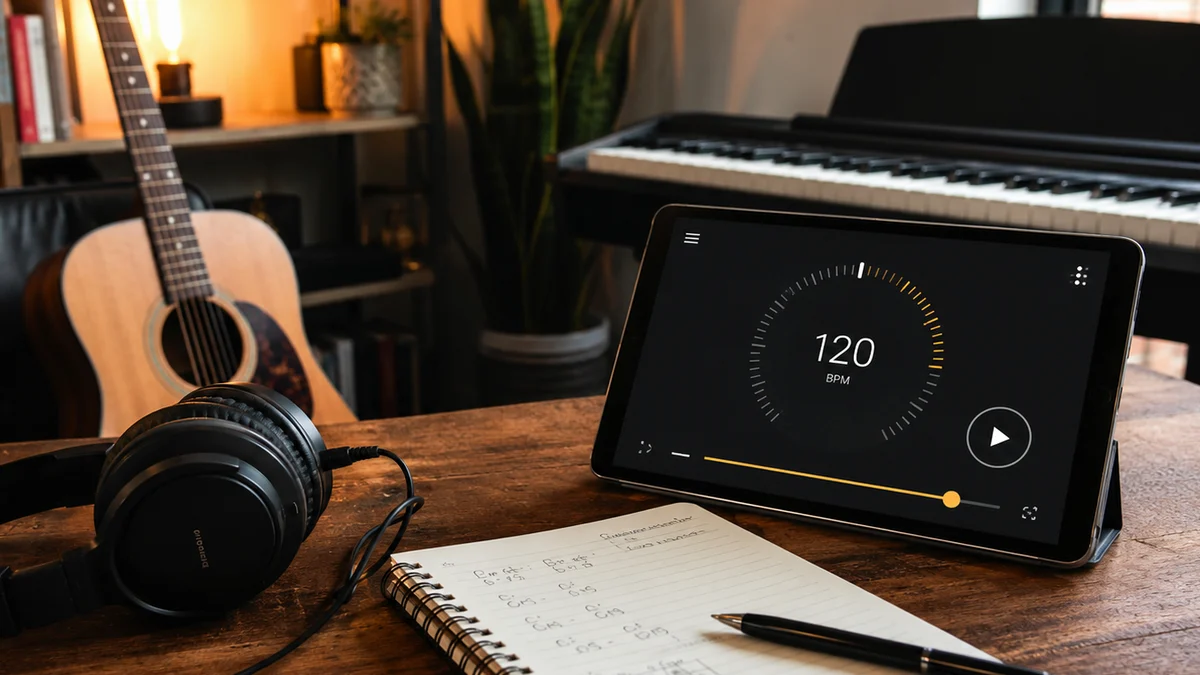
Imagine you are at a rehearsal or a soundcheck. The vocalist turns to you and asks to drop a song down a whole step because their voice is tired. If you only know how to play that song using open-position chords, panic might set in. You do not have a capo in your gig bag, or perhaps using one would push your guitar's pitch too high into a register that clashes with the arrangement.
Knowing how to transpose guitar chords on the fly is a fundamental skill that separates amateur bedroom players from adaptable, working musicians. It allows you to collaborate smoothly with other instrumentalists, accommodate any vocalist's natural range, and understand the fretboard on a much deeper level.
What is Transposition?
>
Transposition is the process of shifting a piece of music, a set of chords, or a melody up or down in pitch by a specific, uniform interval. When you transpose a song, the relationships between the chords remain identical, but the overall key changes. This accommodates a singer's vocal range or makes the chord shapes easier to play on the guitar.
Quick Steps: How to Transpose Chords Manually
- Identify the original key of the song and list the chords used in the progression.
- Determine the target key or the number of semitones (frets) you need to shift up or down.
- Locate each original chord root on the chromatic scale.
- Count the exact number of semitones forward or backward to find the new chord root.
- Keep the chord quality identical (e.g., minor chords must remain minor, dominant 7ths must remain dominant 7ths).
What Does It Mean to Transpose a Song?
To understand how to transpose guitar chords, you must first understand what it means to transpose a song conceptually. At its core, music is built on relative relationships. A standard major scale sounds like a major scale whether you start it on a low C or a high F#. The distance between the notes—the intervals—remains completely constant.
When we ask, "what does it mean to transpose a song," we are talking about moving the entire musical structure to a different starting point on the pitch spectrum. If you move one chord up by three semitones, you must move every other chord in that song up by exactly three semitones. If you fail to do this, the song will sound dissonant and out of tune because you have broken the internal relationships of the key.
How do you transpose guitar chords without losing the vibe of the original track? You do it by focusing entirely on the intervals between the chord roots. Transposition is essentially mathematical interval shifting applied to the fretboard. Once you Learn This mental shift, you can change guitar chords to a new key in a matter of seconds.
Understanding the Chromatic Scale and Semitones
Before you can perform manual chord transposition steps, you must memorize the musical alphabet in its entirety. This is known as the chromatic scale. The chromatic scale consists of twelve notes, each separated by a interval called a semitone. On the guitar fretboard, one semitone is exactly equal to one fret.
Here is the chromatic scale written out using sharps (#):
A - A# - B - C - C# - D - D# - E - F - F# - G - G#
And here is the same scale written using flats (b):
A - Bb - B - C - Db - D - Eb - E - F - Gb - G - Ab
Notice that there are no sharps or flats between B and C, or between E and F. This is one of the most common stumbling blocks for guitarists learning how transposition works. If you are shifting a chord up by one semitone from B, the new chord is C, not B#. If you are shifting down by one semitone from F, the new chord is E, not Fb.
Every step you take to the right on this scale represents moving up one fret on your guitar (one semitone). Every step to the left represents moving down one fret (one semitone). If you want to transpose chords to another key, you will use this scale as your primary map.
How to Transpose Guitar Chords to a Different Key Manually
To learn how to transpose guitar chords to a different key manually, let's break the process down into clear, repeatable steps. We will work through a practical example: transposing a common chord progression from the key of G major to the key of E major.
Step 1: Identify the Interval Shift
First, we need to calculate the distance between our original key (G) and our target key (E). Using our chromatic scale, let's count backward from G to E:
- Start at G
- Down 1 semitone: F#
- Down 2 semitones: F
- Down 3 semitones: E
The interval shift is exactly three semitones down (or three frets down on the guitar fingerboard).
Step 2: Shift Each Chord Root Note
Now, we must apply this exact same three-semitone downward shift to the root note of every chord in our progression.
- Original Chord: G
- Count down 3 semitones: G -> F# -> F -> E
- New Root: E
- Original Chord: E (from the Em chord)
- Count down 3 semitones: E -> D# -> D -> C#
- New Root: C#
- Original Chord: C
- Count down 3 semitones: C -> B -> Bb -> A
- New Root: A
- Original Chord: D
- Count down 3 semitones: D -> C# -> C -> B
- New Root: B
Step 3: Apply the Original Chord Qualities
A common mistake when learning how to transpose guitar chords is forgetting to preserve the chord quality. If a chord is minor, major, dominant seventh, or suspended in the original key, it must retain that exact quality in the new key.
- Our original G major chord becomes E major.
- Our original E minor (Em) chord becomes C# minor (C#m).
- Our original C major chord becomes A major.
- Our original D major chord becomes B major.
| Original Chord (Key of G) | Semitone Shift | New Chord (Key of E) | Chord Quality |
|---|---|---|---|
| G | Down 3 semitones | E | Major |
| Em | Down 3 semitones | C#m | Minor |
| C | Down 3 semitones | A | Major |
| D | Down 3 semitones | B | Major |
By following these chord transposition steps, you have successfully shifted the song into a key that might be much easier for a baritone vocalist to sing, while keeping the musical relationships completely intact.
The Nashville Number System: The Easiest Way to Transpose Chords for Singing
If you talk to professional session players in Nashville, they rarely use chord names like G, C, or D when discussing a song's structure. Instead, they use numbers. The Nashville number system is based on diatonic scale degrees, and it is arguably the easiest way to transpose chords for singing on the fly.
In any given musical key, there are seven notes in the scale. We can assign a Roman numeral to each note and its corresponding diatonic chord. For major keys, the pattern of chord qualities is always:
- I (Major)
- ii (Minor)
- iii (Minor)
- IV (Major)
- V (Major)
- vi (Minor)
- vii° (Diminished)
Let's look at how this applies to our original key of G Major:
| Scale Degree | I | ii | iii | IV | V | vi | vii° |
|---|---|---|---|---|---|---|---|
| Chords in G | G | Am | Bm | C | D | Em | F#dim |
Our original progression of G - Em - C - D translates to the numbers: I - vi - IV - V.
Once you think of a song as a series of numbers rather than a series of specific chords, transposition becomes instantaneous. If a singer wants to perform that same song in the key of C major, you do not need to count semitones. You simply look at the chords in the key of C Major and play the I - vi - IV - V chords.
| Scale Degree | I | ii | iii | IV | V | vi | vii° |
|---|---|---|---|---|---|---|---|
| Chords in C | C | Dm | Em | F | G | Am | Bdim |
Using this system, the I - vi - IV - V progression in the key of C is C - Am - F - G.
By memorizing the diatonic chords for the most common guitar keys (C, A, G, E, and D), you can transpose almost any popular song instantly without having to pause and calculate individual intervals.
How to Transpose Chords Without a Capo
Many guitarists rely heavily on a capo to change keys. If you want to play a song in Eb but only know open-position C chords, you can put a capo on the third fret and play your C shapes. But what happens if you forget your capo, or if you want to play a song that requires open strings that a capo would restrict?
Can I transpose chords without changing the capo? Yes. You can do this by using movable chord shapes, such as barre chords or shapes derived from the CAGED system.
Shifting Barre Chord Shapes
The easiest way to transpose chords without a capo is to transition from open chords to barre chords. Barre chords do not rely on open strings, meaning the entire chord shape can be slid up and down the fretboard.
For example, if you are playing an F major barre chord (with your index finger barring the 1st fret) and you need to transpose the song up a whole step (two semitones) to G major, you do not need to learn a new chord shape. You simply slide your entire hand up two frets so that your index finger bars the 3rd fret.
This physical interval shifting is the exact visual equivalent of moving notes along the chromatic scale.
Utilizing the CAGED System
If you want to avoid playing heavy, fatiguing barre chords all night, you can use the CAGED system to find alternative voicing options across the neck. The CAGED system teaches us that any major chord can be played using five basic open-chord shapes: C, A, G, E, and D.
If you need to transpose a song from a key that uses difficult open chords to a key that uses friendlier ones, you can use these shapes to find comfortable voicings. For instance, if a song is in the key of F# and features awkward chords like F#, B, and C#, you can transpose those chords to the key of G (G, C, D) and then tune your guitar down a half-step, or simply play the G shapes shifted down one fret using barre alternatives.
Handling Complex Chords: Slash Chords and Extensions
Once you move beyond basic major and minor triads, transposition can seem intimidating. How do you handle slash chords, suspended chords, or major 7ths?
The rule remains exactly the same: transpose the component parts individually while keeping the structural relationship intact.
Transposing Slash Chords
A slash chord (like C/B or G/B) indicates a specific chord played over a specific bass note. When transposing these, you must transpose both the chord to the left of the slash and the bass note to the right of the slash by the exact same interval.
Let's transpose G/B up a whole step (two semitones):
- Transpose the chord: G shifted up two semitones is A.
- Transpose the bass note: B shifted up two semitones is C# (B -> C -> C#).
- The new transposed chord is A/C#.
Transposing Chord Extensions
For extended chords like Cadd9, Asus4, or E7, simply isolate the root note, transpose it, and then reapply the extension.
- If you have a Cadd9 and you are transposing up a perfect fourth (five semitones):
- C shifted up five semitones is F (C -> C# -> D -> D# -> E -> F).
- Reapply the extension: the new chord is Fadd9.
- If you have an A7 and you are transposing down two semitones:
- A shifted down two semitones is G.
- Reapply the extension: the new chord is G7.
Common Pitfalls to Avoid When Transposing
Even experienced guitarists make mistakes when transposing chords manually. Keeping these common errors in mind will help you avoid sour notes during your next jam session.
1. Forgetting the "No Sharp/Flat" Rule
As mentioned earlier, the intervals between B and C, and E and F, are only a single semitone. If you are counting intervals and accidentally count B to C as a whole step (two semitones), every subsequent chord in your transposed chart will be incorrect. Always double-check your calculations around these two natural half-step boundaries.
2. Accidentally Changing Chord Qualities
It is incredibly easy to get so focused on finding the correct new root note that you forget to carry over the minor, major, or seventh quality of the original chord. If the original song has an Am7, and you transpose the root A down to a G, the new chord must be Gm7, not G major or G7.
3. Mixing Sharps and Flats
While A# and Bb sound identical on a standard guitar (they are enharmonically equivalent), writing them incorrectly on a chord sheet can confuse other musicians. If you are transposing a song into a key that uses flats (like F major), try to write all your transposed chords using flats rather than mixing sharps and flats arbitrarily. This keeps your chord sheets easy to read and theoretically consistent.
Streamlining the Process with a Chord Transposer
While understanding the manual process of transposition is vital for your growth as a musician, there are times when you need a fast, foolproof solution. If you have a five-page chord sheet with dozens of complex jazz chords, transposing it manually line-by-line can take hours and leaves a lot of room for human error.
This is where digital tools become incredibly valuable. Using an online Chord Transposer allows you to instantly shift the key of any song lyric sheet. You simply paste your text, select your starting key, and choose your target key. The tool automatically identifies the chord symbols and shifts them by the precise number of semitones required, keeping them perfectly aligned with the lyrics.
Using a digital tool is a fantastic way to double-check your manual calculations when you are first learning how to transpose guitar chords. You can write out your transposed version by hand, then run the original through the tool to see if your manual transposition matches the digital output.
Developing Your Transposition Ear
As you continue to practice transposing chords, you will start to notice that you rely less on paper calculations and more on your ears. You will begin to recognize the sonic "shapes" of chord progressions. A I - V - vi - IV progression has a highly distinct emotional character regardless of whether it is played in C major, G major, or Db major.
By practicing manual transposition regularly, you train your brain to hear music in terms of intervals and relationships rather than isolated chord shapes. This makes you a far more versatile guitarist, an empathetic accompanist, and a much more competent songwriter. The next time a vocalist asks you to change keys on stage, you will not have to reach for a capo—you will simply adjust your mental map of the fretboard and keep playing.
Related Chords.me Guides
For the next step, read How to Change a Song Key, Guitar Capo FAQs: Common Beginner Questions, and Chromatic Tuner Guitar Guide: How to Tune Accurately as a Beginner before moving on. You can also test the same idea in another key and compare capo positions while practicing this lesson.
Practice This With Chords.me
Use the Chord Transposer to test the idea in another key, then practice the same example slowly. Focus on clean notes and steady timing before increasing speed.
Frequently Asked Questions
What is the easiest way to transpose chords?
The easiest way to transpose chords is to count the number of semitones between the old key and the new key, then shift every chord in the song by that same number of semitones.
Does transposing change the capo position?
Yes, transposing a song's key changes which capo fret, if any, reproduces the original chord shapes, since the capo and key shift together.
Why would you transpose a song?
Songs are transposed to fit a singer's vocal range, to make chord shapes easier to play, or to match another instrument's key.
About the Contributor
Chords.me Tuning & Setup Desk Tuning, strings, and setup contributor
A brand contributor profile for Chords.me tuning and setup content. This desk focuses on tuning accuracy, string choice, fret buzz, intonation, action, and maintenance topics for everyday players. Content is checked for practical clarity, beginner readability, and accurate links to relevant Chords.me tools.