Semitones Explained for Guitar: Beginner Guide
Semitones Explained for Guitar: Understand what a semitone is and how it applies to guitar frets
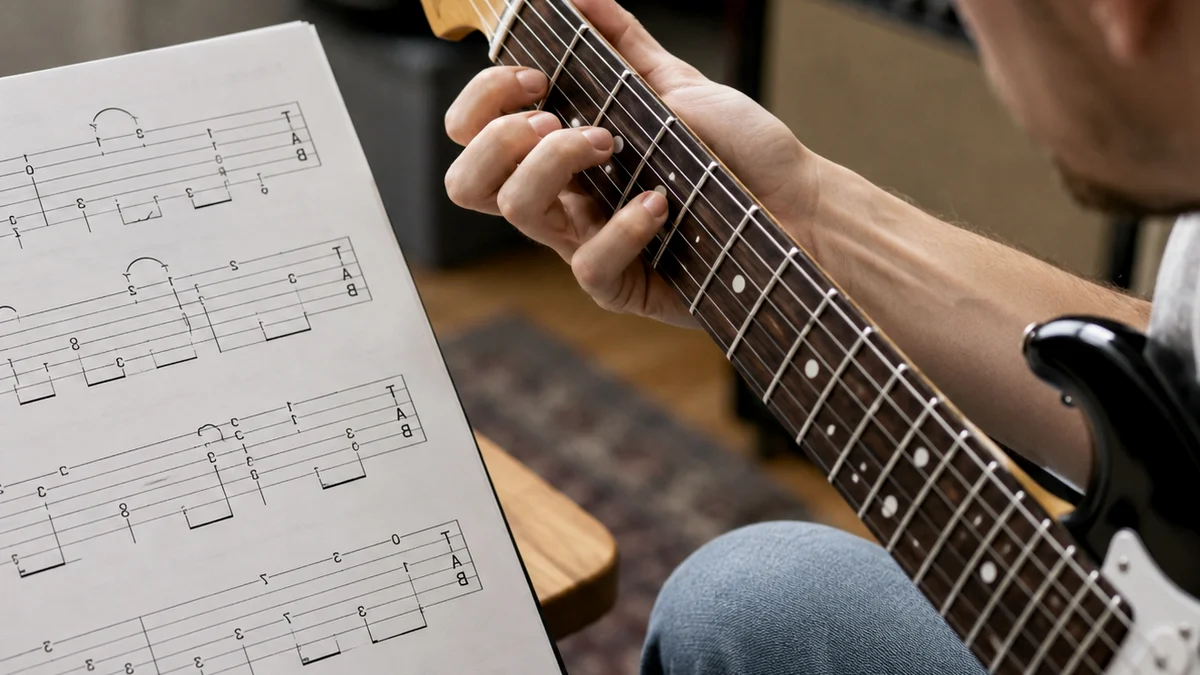
When you first pick up a guitar, the fretboard can look like a confusing maze of wood and metal wires. You might wonder how players navigate this space so effortlessly, jumping from note to note and chord to chord without getting lost. The practical way to understanding this grid lies in understanding the basic units of musical distance.
In Western music, the fundamental unit of distance between pitches is the semitone. For guitarists, this concept is incredibly practical because the instrument is physically designed around it. Once you grasp how semitones map to your fretboard, you can easily transpose songs, use a capo effectively, and build chords from scratch.

What Is a Semitone? A semitone (also known as a half step) is the smallest interval, or pitch distance, used in traditional Western music. On a standard guitar, one fret equals exactly one semitone. Moving your finger up or down by a single fret shifts the pitch of the string by one semitone.
What Is a Semitone in Music?
To understand how music works on the fretboard, we must first look at the concept of pitch. Pitch refers to how high or low a musical note sounds. When you pluck a string, it vibrates at a specific frequency. If you shorten the string, it vibrates faster, producing a higher pitch.
In the Western musical system, we divide an octave—the distance between one note and the next note with the same name, like A to A—into twelve equal parts. Each of these twelve parts is a semitone. Therefore, there are exactly twelve semitones in a single octave.
When you look at a piano keyboard, a semitone is the distance from any key to the very next key, whether it is white or black. On the guitar, we do not have black and white keys to help us visualize these relationships. Instead, we have frets.
Understanding the difference between a semitone and a whole tone is essential for any beginner. While a semitone is a half step, a whole tone (often called a whole step) is equal to two semitones. If you move two frets in either direction on your guitar, you have moved a whole tone.
Understanding Semitones on Guitar Frets
The design of the guitar makes music theory highly visual and tactile. Many beginners ask: why does one fret equal one semitone?
The answer lies in the physics of stringed instruments. When you press a string down behind a metal fret wire, you press the string against that wire. This temporarily shortens the vibrating portion of the string, which runs from the bridge of the guitar to the fret you are pressing.
Because the frets are placed at mathematically calculated intervals, shortening the string by one fret always raises the pitch by exactly one semitone. This answers the common question of how many semitones are between guitar frets: there is exactly one semitone of pitch distance between any two adjacent frets on the same string.
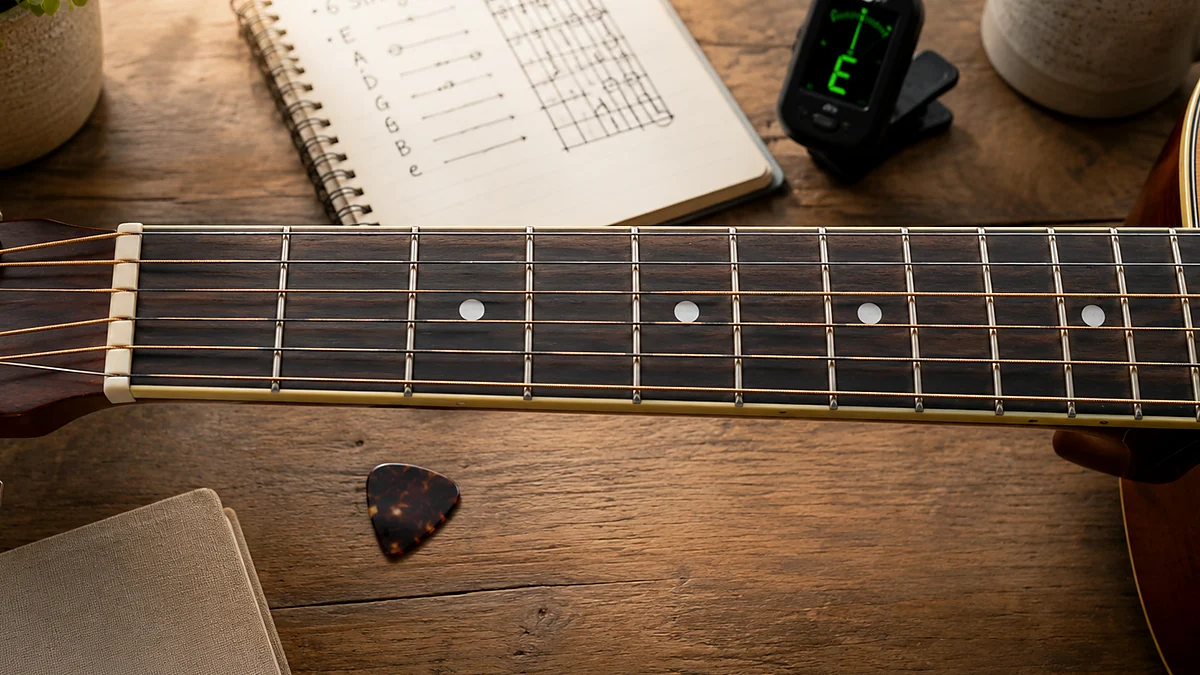
You might notice that the frets on your guitar get closer together as you move down the neck toward the body. This is because the physical distance required to change the pitch by a semitone decreases as the overall vibrating length of the string gets shorter. Even though the physical space between the frets shrinks, the musical interval—the semitone—remains exactly the same.
Half Step vs Whole Step: What Is the Difference?
In music theory, terms are often used interchangeably, which can confuse beginners. The terms "half step" and "semitone" mean the exact same thing. Similarly, "whole step" and "whole tone" are identical concepts.
To make this clear, let us look at how these intervals function as a semitone interval guitar players can easily visualize.
- Half Step (Semitone): The distance of one fret. If you place your index finger on the 3rd fret of the low E string (which is a G note) and slide it up to the 4th fret (G#), you have moved one half step.
- Whole Step (Whole Tone): The distance of two frets. If you start on the 3rd fret of the low E string (G) and move up to the 5th fret (A), you have moved one whole step.
This distinction is crucial when you begin learning scales. For example, the major scale is built using a specific pattern of whole steps (W) and half steps (H): W-W-H-W-W-W-H.
If you translate this pattern into frets on a single string, you get: 2 frets - 2 frets - 1 fret - 2 frets - 2 frets - 2 frets - 1 fret. By understanding this simple relationship, you can play a major scale starting on any note on any string, simply by counting frets.
Mapping Semitones Across a Single String
To see how semitones build the notes we play, let us map out a single string from the open position up to the 12th fret. We will use the low E string (the thickest string) as our example.
When you play the low E string without pressing any frets, you are playing an open E note. Pressing the 1st fret raises that pitch by one semitone to an F note. Pressing the 2nd fret raises it another semitone to F# (F sharp) or Gb (G flat).
This progression is called the chromatic scale, which is simply a scale made entirely of semitones. The table below shows how many semitones you are from the open string at each fret, along with the resulting note.
Fretboard Semitone Map (Low E String)
| Fret Number | Semitones from Open String | Resulting Note |
|---|---|---|
| 0 (Open) | 0 | E |
| 1 | 1 | F |
| 2 | 2 | F# / Gb |
| 3 | 3 | G |
| 4 | 4 | G# / Ab |
| 5 | 5 | A |
| 6 | 6 | A# / Bb |
| 7 | 7 | B |
| 8 | 8 | C |
| 9 | 9 | C# / Db |
| 10 | 10 | D |
| 11 | 11 | D# / Eb |
| 12 | 12 | E (Octave) |
As you look at this table, notice what happens at the 12th fret. You have moved up 12 semitones from the open string, and you arrive back at the note E. This is one octave higher than the open string.
You should also notice that there is no sharp or flat note between E and F (frets 0 and 1), nor is there one between B and C (frets 7 and 8). In Western music, these are natural half steps. Understanding that E to F and B to C are naturally only one semitone apart will prevent you from making common mistakes when naming notes on the neck.
How Semitones Relate to Capo Placement and Transposition
Once you understand that one fret equals one semitone, you can start applying this knowledge to practical playing situations. Two of the most common applications are using a capo and transposing songs into different keys.
How Semitones Relate to Capo Placement
A capo is a clamping device that you attach to the neck of your guitar. It acts as a temporary nut, shortening the playable length of all six strings simultaneously.
Every fret you move the capo up the neck raises the pitch of your open strings by exactly one semitone. For example:
- Placing a capo at the 1st fret raises the pitch of your guitar by 1 semitone.
- Placing a capo at the 2nd fret raises the pitch by 2 semitones (one whole step).
- Placing a capo at the 5th fret raises the pitch by 5 semitones.
If you are playing a song that uses the open chords G, C, and D, and you place a capo on the 2nd fret, you are shifting the pitch of those chords up by two semitones. Your G chord shape will now sound like an A major chord, your C shape will sound like a D major chord, and your D shape will sound like an E major chord.
If you need to change the musical key of a song quickly to match a singer's vocal range, calculating the shift in semitones is the easiest way to find your new capo position. For quick calculations, using a digital tool like the Chords.me Guitar Capo Calculator can save you time by instantly showing you where to place your capo and which chord shapes to use.
Transposing Chord Progressions
Transposition is the process of moving a piece of music up or down in pitch. We measure this movement in semitones.
Imagine you are playing a simple chord progression: C - Am - F - G.
If the vocalist finds this key slightly too low for their voice and asks you to raise the song by two semitones (one whole step), you can easily calculate the new chords by shifting each root note up by two frets:
- C moves up two semitones to D.
- Am moves up two semitones to Bm.
- F moves up two semitones to G.
- G moves up two semitones to A.
Your new chord progression is D - Bm - G - A. By thinking of the fretboard as a series of semitones, you can transpose any progression without needing to write out complex music theory charts.
Practical Exercises to Master Semitones on the Guitar
To turn this theoretical knowledge into muscle memory and ear training, you should practice applying these concepts directly on your instrument. Here are three simple exercises designed for beginners.
Exercise 1: The Chromatic Walk
This physical exercise builds finger strength and independence while reinforcing the feeling of moving in semitones.
- Start on the 1st fret of the low E string with your index finger. Play the note.
- Place your middle finger on the 2nd fret and play the note.
- Place your ring finger on the 3rd fret and play the note.
- Place your pinky finger on the 4th fret and play the note.
- Repeat this pattern on the A string, the D string, and so on, all the way across the fretboard.
As you play each note, say the interval out loud: "one semitone, one semitone, one semitone." This connects the physical sensation of moving one fret with the auditory experience of a half-step interval.
Exercise 2: Ear Training with Half Steps and Whole Steps
Developing an ear for intervals is one of the most valuable skills a musician can have.
- Play the 5th fret on your low E string (an A note). Listen closely to the pitch.
- Move up to the 6th fret (Bb) and play it. This is a semitone interval. Notice how tense and close the two notes sound to each other.
- Go back to the 5th fret, play it, and then jump to the 7th fret (B). This is a whole step interval. Notice how this interval sounds wider and more stable than the semitone.
- Close your eyes, hum the pitch of the first note, and try to sing the note a semitone higher before you play it.
Exercise 3: Single-String Scale Building
Building scales on a single string is an excellent way to break out of box patterns and understand the layout of the neck.
- Choose a starting note, such as the open low E string.
- Using the major scale formula (2-2-1-2-2-2-1 semitones), move up the string fret by fret.
- From open (0), move up 2 frets to the 2nd fret.
- Move up another 2 frets to the 4th fret.
- Move up 1 fret to the 5th fret.
- Continue this pattern until you reach the 12th fret.
By physically sliding up the neck to build this scale, you will visualize the structural gaps between notes far better than you would by staying in a single position.
Why Understanding Semitones Unlocks the Fretboard
Many beginner guitarists get stuck in a rut because they rely entirely on visual chord diagrams and scale boxes without understanding the underlying structure. They learn where to put their fingers, but they do not know why those patterns work.
When you understand that every fret is a semitone, you begin to see the relationships between different shapes. You realize that a major chord barre shape is not just a random pattern; it is a specific collection of intervals measured in semitones from the root note.
For example, a major triad consists of a root note, a major third (four semitones above the root), and a perfect fifth (seven semitones above the root). If you know where your root note is on the fretboard, you can count frets to find your third and fifth, allowing you to construct chords anywhere on the neck.
This knowledge also demystifies the tuning of the guitar. Standard guitar tuning is E-A-D-G-B-E. The distance between most adjacent strings is five semitones (a perfect fourth). The only exception is the distance between the G and B strings, which is four semitones (a major third). This is why the pattern for tuning your guitar using the 5th fret works for every string except the G string, where you must use the 4th fret.
By mastering the concept of the semitone, you shift from simply copying finger patterns to truly understanding the language of your instrument. This foundational knowledge will serve as the bedrock for your entire musical development, making every chord, scale, and song you learn in the future much easier to master.
Related Chords.me Guides
For the next step, read How to Change a Song Key, CAGED System Guitar Explained: Complete Beginner’s Guide to Fretboard Mast, and Blues Scale Guitar Guide: Beginner Practice Guide before moving on. You can also test the same idea in another key and compare capo positions while practicing this lesson.
Practice This With Chords.me
Use the Chord Transposer to test the idea in another key, then practice the same example slowly. Focus on clean notes and steady timing before increasing speed.
Frequently Asked Questions
Is one fret one semitone?
Yes, on a standard guitar each fret represents one semitone, so moving up or down one fret changes the pitch by a single semitone.
What is the difference between a semitone and a step?
A semitone is the smallest interval in standard Western music, equal to one fret on guitar, while a whole step equals two semitones, or two frets.
How many semitones are in an octave?
There are 12 semitones in an octave.
About the Contributor
Chords.me Tuning & Setup Desk Tuning, strings, and setup contributor
A brand contributor profile for Chords.me tuning and setup content. This desk focuses on tuning accuracy, string choice, fret buzz, intonation, action, and maintenance topics for everyday players. Content is checked for practical clarity, beginner readability, and accurate links to relevant Chords.me tools.