Open D Tuning Guide for Guitar
Learn Open D tuning notes, chord shapes, slide-guitar uses, and practical checks for keeping the guitar in tune.
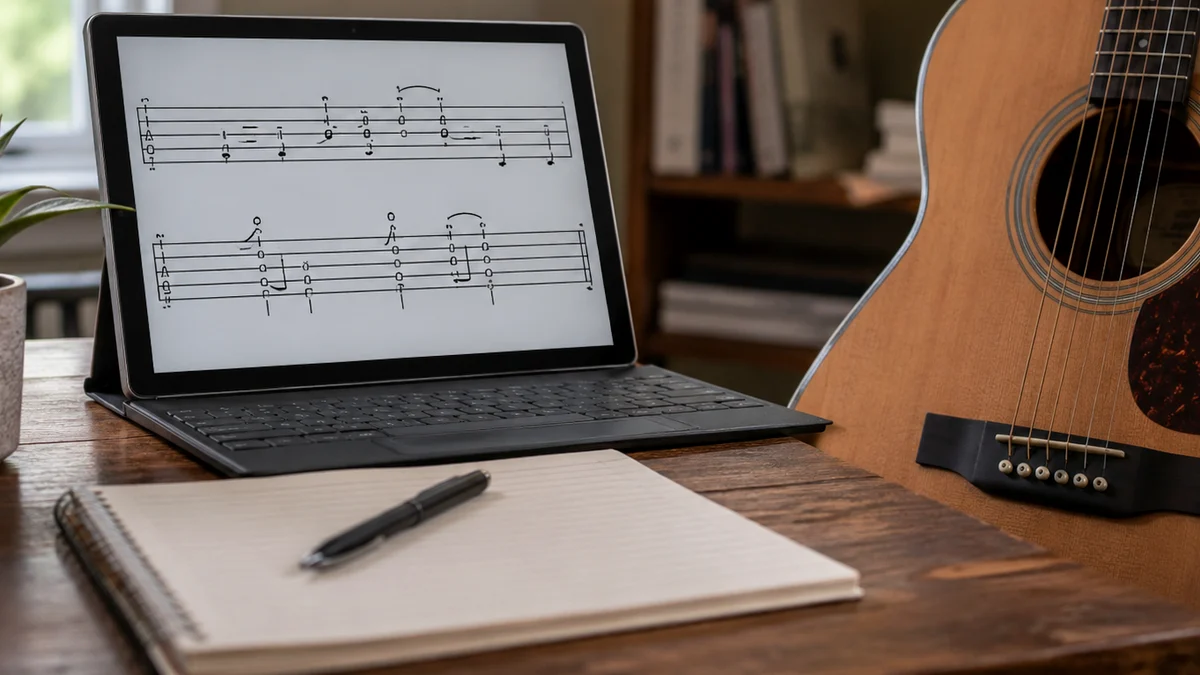
Few experiences on the acoustic or electric guitar match the feeling of striking all six strings open and hearing a strong, resonant chord ring out. In standard tuning, strumming open strings produces a dissonant, unresolved chord. By adjusting your guitar tuning notes to Open D, your entire instrument transforms into a single, clear D major chord.
This tuning has been a common choice of blues, folk, rock, and ambient music for over a century. It offers a warm, open, ringing quality that makes a single guitar sound like an entire ensemble.
If you want to break out of a repeated playing pattern, learn slide guitar, or explore rich acoustic textures, this guide will help you master Open D tuning step by step.
What is Open D Tuning
Open D tuning is an alternative guitar tuning where the six strings are adjusted so that strumming them without fretting any notes produces a D major chord.
The Musical Structure of Open D
To understand why this tuning sounds so harmonious, we must look at the structure of a D major chord. A standard D major triad consists of three notes: the root (D), the major third (F#), and the perfect fifth (A).
When you tune your guitar to Open D, you arrange these three notes across your six strings. The resulting layout is:
- 6th String: D (Root)
- 5th String: A (Fifth)
- 4th String: D (Root, one octave higher)
- 3rd String: F# (Major Third)
- 2nd String: A (Fifth, one octave higher)
- 1st String: D (Root, two octaves higher)
This specific arrangement stacks the intervals as Root - Fifth - Root - Third - Fifth - Root. By placing the lowest D on the bass string, you create a powerful, grounding drone. The major third (F#) sits right in the middle on the third string, giving the chord its bright, sweet, major character.
Is Open D Tuning Good for Beginners?
Yes, open d tuning for beginners is one of the most accessible and rewarding alternative tunings you can learn.
When you first start playing guitar, fretting clean chords can be frustrating. Standard shapes like C major, G major, and F major require finger strength, stretch, and precise placement. In Open D, you can play a full, rich major chord using just one finger barred across the fretboard.
Why Beginners Thrive with Open D
- Instant Gratification: You can play songs and experiment with harmony without fighting buzzy frets or painful finger stretches.
- Ear Training: Because the strings are tuned to a single key, you will naturally begin to hear how intervals relate to the root note. This builds a strong musical ear.
- Introduction to Slide Guitar: Open D is the premier tuning for bottleneck slide. Since all the notes of the chord line up horizontally across any given fret, a slide placed flat across the strings will sound perfectly in tune.
- Drone Techniques: You can leave the bass strings ringing open while fretting simple melodies on the higher strings. This creates a self-accompanied sound that makes beginner arrangements sound highly sophisticated.
While it is easy to get started, Open D also offers plenty of depth. As your skills grow, you can explore complex fingerpicking patterns, minor-key variations, and intricate slide work.
The Anatomy of Open D: String-by-String Breakdown
For tuning and setup context, compare this with DADGAD Tuning Guide for Beginners, Guitar Fretboard Notes Made Simple, and Guitar Tuning Complete Guide so the instrument stays easier to play and check.
For tuning and setup context, compare this with How Often Should You Change Guitar Strings so the instrument stays easier to play and check.
Before you turn your tuning pegs, let's look at how the pitch of each string changes from standard tuning. To tune guitar accurately, you need to know whether you are raising or lowering the pitch of each string.
In Open D, you will lower the pitch of four strings. Two strings will remain exactly the same as they are in standard tuning.
Here is a quick-reference table detailing the changes for each string:
| String Number | Standard Pitch | Target Open D Pitch | Pitch Change | Tuning Tip | Common Mistake |
|---|---|---|---|---|---|
| 6 (Thickest) | E | D | Down 1 whole step | Match pitch to the open 4th string (D) | Tuning down too far to C |
| 5 | A | A | No change | Keep at standard pitch | Accidentally turning this peg |
| 4 | D | D | No change | Keep at standard pitch | Accidentally turning this peg |
| 3 | G | F# | Down 1 half step | Listen carefully; this is a very small drop | Tuning down a whole step to F |
| 2 | B | A | Down 1 whole step | Match pitch to the open 5th string (A) | Tuning up to C instead of down to A |
| 1 (Thinnest) | E | D | Down 1 whole step | Match pitch to the open 4th or 6th string | Over-tightening and snapping the string |
As you can see, you never tune any string higher than standard tuning. This means your overall string tension will decrease, making the strings feel slightly looser and easier to press down.
How to Learn Open D Tuning Step by Step
To transition your guitar smoothly and safely, follow this step-by-step process. Using a reliable online guitar tuner is highly recommended to make sure your pitches are exact.
Step 1: Prepare Your Guitar
Place your guitar in playing position. If you tune your guitar while it is lying flat on a table, the gravity on the neck can alter the intonation slightly when you pick it up to play.
Step 2: Tune the 6th String (E to D)
Pluck your low E string. Slowly turn the tuning peg to lower the pitch. You are dropping this string down a whole step (two frets) to D.
- practice guide Tip: Pluck your open 4th string (which is already tuned to D) as a reference note. Lower your 6th string until it sounds exactly one octave lower than the 4th string.
Step 3: Verify the 5th and 4th Strings (A and D)
The 5th (A) and 4th (D) strings do not change. However, because you lowered the tension on the 6th string, the neck of your guitar may shift slightly. Double-check both strings with your guitar tuner to ensure they are still perfectly in tune.
Step 4: Tune the 3rd String (G to F#)
Pluck your G string. This string only drops by a half step (one fret) to F#. Because this is a very small adjustment, turn the tuning peg slowly.
- practice guide Tip: To check this note by ear, fret the 4th string at the 4th fret (which is an F#). The open 3rd string should match this pitch perfectly.
Step 5: Tune the 2nd String (B to A)
Pluck your B string. Lower the pitch by a whole step (two frets) to A.
- practice guide Tip: Use your open 5th string (A) as your reference note. Your newly tuned 2nd string should sound exactly one octave higher than the 5th string.
Step 6: Tune the 1st String (E to D)
Pluck your high E string. Lower the pitch by a whole step to D.
- practice guide Tip: This string should match your open 4th string (one octave lower) and your open 6th string (two octaves lower).
Step 7: Stretch and Fine-Tune
Because you have lowered the pitch of four strings, the overall string tension on the neck has dropped. Your guitar neck will adjust to this change, which can cause the strings to slip slightly out of tune.
Gently stretch each string by pulling it away from the fretboard, then use your online guitar tuner to fine-tune each string. Play a slow, full strum across all six strings. You should hear a clear, balanced, and resonant D major chord.

Essential Chords in Open D
Once your guitar is tuned, it is time to play. Because the interval relationships have changed, your standard chord shapes (like the common G, C, and Am shapes) will no longer work.
Let's look at how to build the most common chord types in Open D.
1. Major Chords (The One-Finger Bar)
Playing major chords in Open D is incredibly simple. Because the open strings form a D major chord, fretting all six strings at any given fret will produce a different major chord.
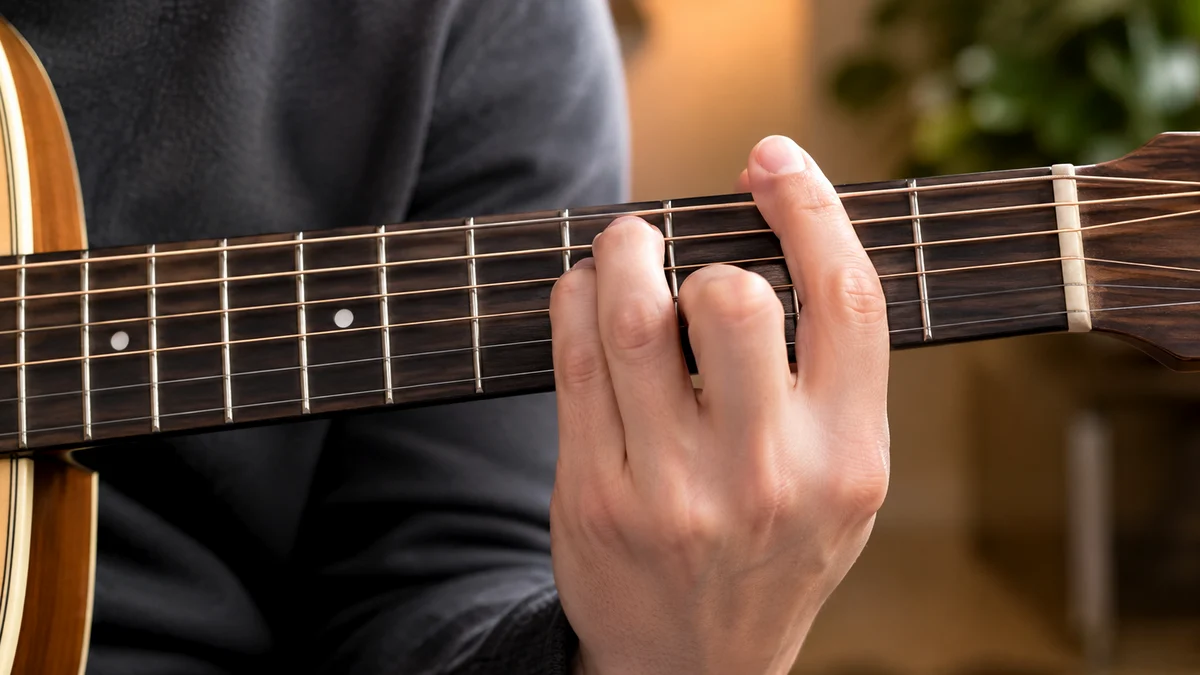
To play these, lay your index finger flat across all six strings at the desired fret. Make sure your finger is parallel to the fret wire and pressed firmly.
- D Major: Open strings (no fingers)
- E Major: Barred at the 2nd fret
- F Major: Barred at the 3rd fret
- G Major: Barred at the 5th fret
- A Major: Barred at the 7th fret
- B Major: Barred at the 9th fret
- C Major: Barred at the 10th fret
This simple layout allows you to play almost any basic pop, rock, or folk progression using just one finger sliding up and down the neck.
2. Minor Chords in Open D
Because Open D is naturally a major tuning, playing minor chords requires you to lower the major third (the F# on the 3rd string) by one half step to a minor third (F).
Here is the most common minor chord shape in Open D. We will use E minor as our example:
- 6th String: 2nd fret (E)
- 5th String: 2nd fret (B)
- 4th String: 2nd fret (E)
- 3rd String: 1st fret (G)
- 2nd String: 2nd fret (B)
- 1st String: 2nd fret (E)
To play this E minor sound, hold the 2nd fret on the 6th, 5th, 4th, 2nd, and 1st strings, while the 3rd string is fretted at the 1st fret. The important change is that the 3rd string moves one fret lower than the major-barre position, turning the G# color into G natural.
An easier way to play minor chords is to focus on the top four strings. For a simple D minor chord:
- 4th String: Open (D)
- 3rd String: 3rd fret (F)
- 2nd String: Open (A)
- 1st String: Open (D)
By fretting just the 3rd string at the 3rd fret, you change the open F# to an F natural, instantly turning your bright open D major into a melancholy D minor.
3. Dominant 7th Chords
Dominant 7th chords add tension and bluesy flavor to your playing. In Open D, a simple D7 sound comes from keeping the open D major notes and adding C natural, the flat seventh of D.
Here is a highly useful D7 shape:
- 6th String: Open (D)
- 5th String: Open (A)
- 4th String: Open (D)
- 3rd String: Open (F#)
- 2nd String: 3rd fret (C)
- 1st String: Open (D)
This shape is perfect for acoustic blues fingerpicking. It keeps the heavy, droning bass strings open while adding the C natural on the 2nd string for a clear D7 color.
Open D Tuning Mistakes Beginners Make
While playing in Open D is highly rewarding, transitioning to alternative tunings comes with a few common pitfalls. Understanding these open d tuning mistakes beginners make will save you time, frustration, and broken strings.
1. Tuning Up Instead of Down
This is the most dangerous mistake for your guitar. When tuning the 6th, 2nd, and 1st strings, you must always lower the pitch.
Some beginners mistakenly try to tune their 6th string up to a high D, or their 2nd string up to a high A. This puts immense tension on the neck and will almost certainly snap your strings or damage your bridge. Always double-check that your tuning pegs are turning counter-clockwise (loosening the string) when dropping down to Open D.
2. Misidentifying the F
The 3rd string transitions from G down to F#. This is a half-step drop, which is very small.
Many beginners spin the tuning peg too quickly and drop the string all the way down to F or even E. Because the pitch change is subtle, use a precise online guitar tuner and make micro-adjustments until the tuner displays a perfect F# (or Gb, which is the enharmonic equivalent).
3. Ignoring Intonation and String Buzz
Because Open D lowers the overall pitch of your strings, the physical string tension on your guitar neck decreases. This can cause two issues:
- String Buzz: Looser strings vibrate in a wider arc. If your guitar action is already very low, you may hear string buzz against the frets. To fix this, pluck with a slightly lighter touch or consider using slightly heavier gauge strings (like light-mediums) if you plan to keep your guitar in Open D permanently.
- Intonation Shifts: When string tension drops, the neck of the guitar bows backward slightly. This can throw off your intonation, meaning notes played high up on the neck may sound slightly sharp or flat. Always tune your strings, play for five minutes to let the wood settle, and then tune them a second time.
4. Forgetting the Key Center
When playing in standard tuning, your ear is trained to resolve to E or G. In Open D, your new home base is D.
Beginners often try to resolve their chord progressions to standard shapes, which creates musical confusion. Remember that in this tuning, your open strings are your Complete point of resolution. Every musical learning process you take across the fretboard should eventually lead back to that clear, open D chord.
Practical Song Examples & Musical Applications
To truly understand how to use open d tuning, it helps to look at how master musicians have applied it across different genres. Here are a few notable examples of Open D in action:
1. Folk and Singer-Songwriter Styles
- Joni Mitchell – "Big Yellow Taxi": Joni Mitchell was a pioneer of alternative tunings. In this track, she uses Open D to create bright, driving acoustic rhythms that would be impossible to play in standard tuning.
- Bob Dylan – "Simple Twist of Fate": This classic from Blood on the Tracks showcases the melancholic, rolling sound of Open D. Dylan uses simple fingerpicking patterns while letting the bass strings drone, creating a deeply emotional accompaniment for his vocals.
2. Blues and Slide Guitar
- Elmore James – "Dust My Broom": The definitive electric slide guitar anthem. James uses a slide barred across the high strings in Open D to create his signature screaming triplet intro.
- Traditional Blues Chugging: By placing a slide on your pinky finger, you can play rhythm parts with your index and middle fingers on the lower frets, then slide up to the 12th fret for a screaming, full-chord turnaround.
3. Rock and Alternative
- Mumford & Sons – "The Cave": This song utilizes the driving, percussive power of Open D. The lowered string tension allows for heavy, acoustic strumming that sounds strong in a live setting.
Pro Tips for Mastering Open D
As you become more comfortable with this tuning, use these professional tips to improve your playing and keep your instrument in top shape.
Use a Capo to Change Keys
One of the biggest secrets of open tunings is the power of the capo. If you love the fingerings and open chord shapes of Open D, but a song is in a different key (like E major or G major), you do not need to retune your entire guitar.
Simply place a capo on the fretboard:
- Capo at the 2nd Fret: Transposes your guitar to Open E tuning.
- Capo at the 5th Fret: Transposes your guitar to Open G tuning (using Open D shapes).
This allows you to keep all your easy, one-finger chord shapes while instantly matching the vocal range of any singer.
Explore the "Open D Minor" Variation
If you want to play dark, moody, or atmospheric music, you can convert Open D into Open D Minor (also known as DADFAD) with one simple adjustment.
Simply tune your 3rd string (F#) down another half step to F. Now, when you strum all six strings open, you get a haunting, cinematic D minor chord. This tuning is highly popular in modern fingerstyle guitar and Nordic folk music.
Keep an Eye on Your Nut Slots
If you transition between standard tuning and Open D frequently, your strings will slide back and forth through the slots in the guitar nut. Over time, this friction can wear down the slots or cause the strings to bind (get stuck), resulting in sudden jumps in pitch while tuning.
To prevent this, rub a tiny amount of graphite (from a standard wooden pencil) into the nut slots the next time you change your strings. The graphite acts as a dry lubricant, helping your strings slide smoothly and ensuring you can tune guitar accurately every single time.
Improve Your Playing with Practical Tools
Alternative tunings open up a completely new world of musical expression, but they also require a bit of mental adjustment. You don't have to memorize every new chord shape or fretboard calculation on your own.
Using practical online music tools can make your transition to Open D smooth. When you are ready to explore further, Chords.me offers a suite of essential tools designed for working guitarists:
- Online Guitar Tuner: Keep your instrument perfectly in pitch as you drop down to D-A-D-F#-A-D.
- Capo Calculator: Instantly figure out where to place your capo to play your favorite Open D shapes in different keys.
- Chord Transposer: Easily convert standard chord progressions into keys that work beautifully with your new open tuning.
By combining these digital tools with the physical techniques in this guide, you will quickly master the rich, resonant world of Open D tuning. Grab your guitar, turn down those pegs, and let those clear open chords ring out.
Related Chords.me Guides
For the next step, read Open G Tuning Guide, Chromatic Tuner Guitar Guide: How to Tune Accurately as a Beginner, and Drop C Tuning Guide: Notes, Setup, and Common Mistakes before moving on. You can also test the same idea in another key and check each string with the guitar tuner while practicing this lesson.
Practice This With Chords.me
Use the Guitar Tuner to check each string slowly before practicing the example. Focus on clean notes and steady timing before increasing speed.
Frequently Asked Questions
What is Open D Tuning?
Open D tuning is D-A-D-F#-A-D from the lowest string to the highest string. Strumming all six open strings gives you a D major chord, which makes one-finger major chords, drones, and slide-guitar ideas easier to explore.
Is open d tuning hard for beginners?
It can feel difficult at first, but it becomes manageable when you break it into small steps. Focus on clean notes, relaxed hands, and short practice sessions instead of trying to master everything in one day.
What should I practice first for open d tuning?
Start with the simplest version of the idea: one chord, one pattern, one short exercise, or one small section of the fretboard. Once that feels stable, add timing, transitions, or a second example.
What common mistakes should I avoid?
Avoid rushing, pressing harder than necessary, ignoring tuning, and practicing mistakes at full speed. Slow, accurate repetitions usually fix beginner problems faster than long unfocused practice sessions.
Which Chords.me tool helps with this topic?
The Guitar Tuner is the best supporting tool here because it helps with checking pitch, tuning stability, and practice accuracy. Use it before or during practice so the article’s examples translate into real playing more easily.
About the Contributor
Chords.me Tuning & Setup Desk Tuning, strings, and setup contributor
A brand contributor profile for Chords.me tuning and setup content. This desk focuses on tuning accuracy, string choice, fret buzz, intonation, action, and maintenance topics for everyday players. Content is checked for practical clarity, beginner readability, and accurate links to relevant Chords.me tools.