How to Find the Right Capo Position
Learn how to find the right capo position for a song by matching chord shapes, key changes, and vocal comfort.

Every singer-songwriter and acoustic guitarist eventually runs into the same wall. You find a song you love, print out the chord sheet, tune your guitar, and start to sing. Within two bars, you realize something is wrong. The low notes rumble in your chest like a failing engine, or the high notes force you into an uncomfortable, strained falsetto. The song is in the wrong key for your voice.
This is where the capo becomes your most valuable tool. A capo is not a crutch for beginners who want to avoid barre chords. It is a mechanical transposition device that allows you to shift the pitch of your open strings instantly. By clamping a capo onto your guitar neck, you can play the familiar, resonant open-chord shapes you already know while sounding in a completely different, vocally comfortable key.
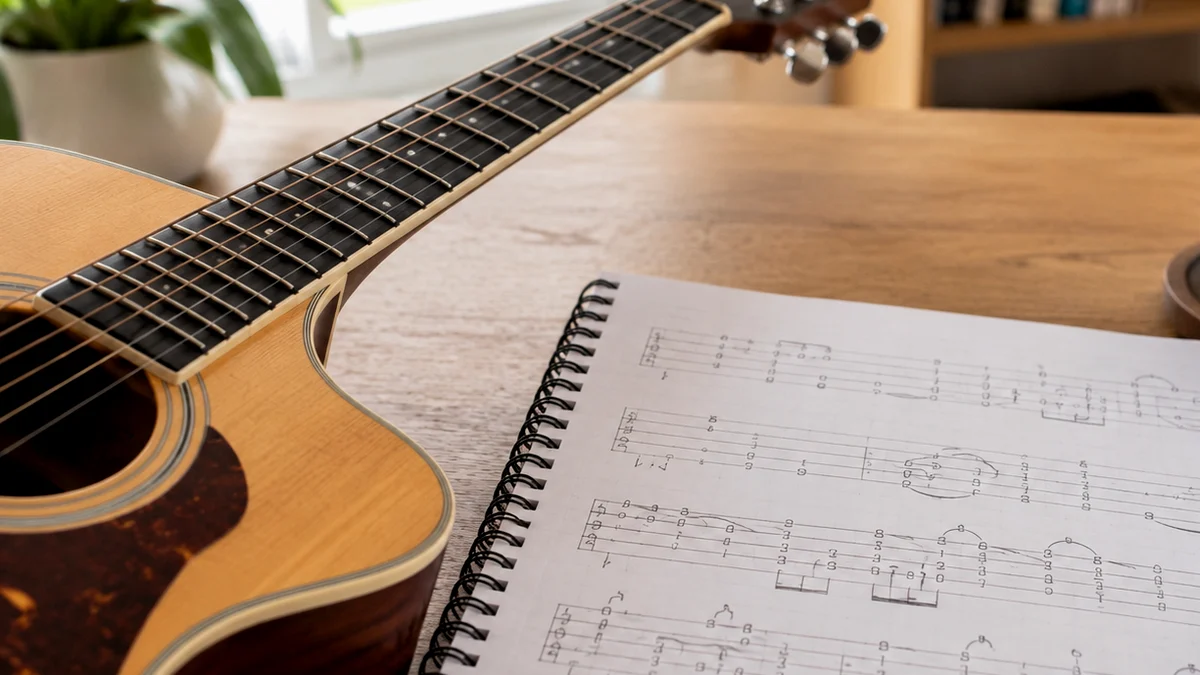
But how do you know what fret to put a capo on? Finding that sweet spot requires a mix of basic music theory, vocal awareness, and a systematic approach to transposition. This guide will walk you through the exact steps to locate the ideal capo fret for any song, match it to your vocal range, and use tools like a Guitar Capo Calculator to make the process effortless.
Step-by-Step: How to Calculate the Right Capo Position
If you need to quickly find the correct capo fret to match a specific target key, use this simple four-step process:
- Identify the Original Key: Determine the musical key of the song as it is written or recorded (e.g., Key of C).
- Find Your Target Key: Sing the melody without the guitar to find the key where your voice feels relaxed and resonant (e.g., Key of E).
- Count the Semitone Difference: Count the musical steps (semitones) upward from your original key to your target key using the chromatic scale (C → C# → D → D# → E = 4 semitones).
- Place the Capo: Clamp your capo on the fret that matches the number of semitones you counted. In this example, placing the capo on the 4th fret and playing the original C-shape chords will yield the key of E.
The Core Relationship Between Capo Position and Key Change
To understand how to calculate capo position, you must first understand what a capo actually does to your instrument.
When you place a capo on the fretboard, you are shortening the vibrating length of the strings. This raises the pitch of the open strings by one semitone (half-step) for every fret you move up.
- Open Strings (No Capo): Standard E-A-D-G-B-E tuning.
- Capo 1st Fret: Raises the pitch by one semitone (F-Bb-Eb-Ab-C-F).
- Capo 2nd Fret: Raises the pitch by two semitones/one whole step (F#-B-E-A-C#-F#).
- Capo 5th Fret: Raises the pitch by five semitones (A-D-G-C-E-A).
If you play a standard open G major chord without a capo, you are in the key of G. If you place the capo on the 2nd fret and play that exact same G chord shape, the actual sound coming out of your guitar is now an A major chord. You have transposed the song up a whole step without having to learn a single new chord shape.
This relationship is entirely governed by the chromatic scale. The chromatic scale consists of twelve notes, each separated by a half-step (one fret on the guitar):
Notice that there are no sharps or flats between B and C, or between E and F. Keeping this scale in mind is the key to mastering capo fret calculation.
How Do I Find the Right Capo Position for My Voice
When guitarists ask, "how do I find my capo position for a song," they are usually trying to solve a vocal comfort problem. Your voice has a specific range—a set of notes you can sing comfortably without straining. Songs written by other artists are tailored to their vocal ranges, which may be vastly different from yours.
To find the capo position for vocal range optimization, you need to experiment with shifting the key of the song until the vocal melody sits comfortably in your "tessitura"—the most aesthetically pleasing and physically comfortable part of your vocal range.
The Trial-and-Error Method
The most direct way to find your capo position for singing is the trial-and-error method.
- Start with the original chords: Play the song in its original key without a capo. Sing along. Note where the highest and lowest notes of the melody fall.
- Move up two frets: Place your capo on the 2nd fret. Play the same chord shapes. Sing the melody again. Does the high note feel easier to reach, or does it feel like you are straining?
- Continue shifting: If the song still feels too low, move the capo to the 3rd or 4th fret. If the high notes are starting to crack, you have gone too far.
- Try a different chord family: If moving the capo high up the neck (past the 5th or 6th fret) makes the guitar sound too thin or squeaky, you may need to drop the capo back down and use a different set of open chord shapes entirely.
Shifting Down by Going Up
It sounds counterintuitive, but you can actually use a capo to make a song lower for your voice.
Imagine a song is written in the key of D major, and the vocal melody is just slightly too high for you to sing comfortably. You want to drop the song down to the key of C major (two semitones lower).
Instead of trying to play difficult barre chords in the key of C, you can put your capo on the 5th fret and play G-shape chords. Because G transposed up 5 semitones is C, you are now playing in your lower target key of C while using highly resonant open chords.
How to Calculate What Fret to Put a Capo On
For capo work, keep Why a Capo Changes the Key and Easy Songs Using a Capo nearby so key changes and chord shapes stay clear.
If you want to move beyond trial and error, you can use a simple mathematical formula to calculate capo position. This is the professional way to handle transposition on the fly, especially when working with other musicians who might say, "Let's do this tune in Eb instead of C."
To perform a manual capo fret calculation, you need three pieces of information:
- Your Target Key (the key you want the song to sound in).
- Your Chord Shape Key (the open chord shapes you want to use).
- The Chromatic Scale.
The Capo Calculation Formula
The formula for finding your capo fret is:
Capo fret = Target key - chord-shape key
To calculate this, you simply count the number of semitones (frets) from your Chord Shape Key up to your Target Key.
Example 1: You want to play in Eb, but you want to use easy C-shape chords.
- Target Key: Eb
- Chord Shape Key: C
- Calculation: Count from C to Eb on the chromatic scale.
- C to C# (1 step)
- C# to D (2 steps)
- D to D# / Eb (3 steps)
- Result: Place your capo on the 3rd fret. When you play a C chord shape, it will sound as an Eb.
Example 2: You want to play in G#, but you want to use friendly G-shape chords.
- Target Key: G#
- Chord Shape Key: G
- Calculation: Count from G to G# on the chromatic scale.
- G to G# (1 step)
- Result: Place your capo on the 1st fret. When you play your G-shape chords, they will sound in the key of G#.
The Master Capo Transposition Table
To make matching capo to key even easier, you can refer to a transposition chart. The table below shows the actual sounding key (Target Key) you will hear when you play common open chord shapes with a capo placed on various frets.
| Open Chord Shape | Capo 1 | Capo 2 | Capo 3 | Capo 4 | Capo 5 | Capo 6 | Capo 7 |
|---|---|---|---|---|---|---|---|
| C | C# / Db | D | D# / Eb | E | F | F# / Gb | G |
| A | A# / Bb | B | C | C# / Db | D | D# / Eb | E |
| G | G# / Ab | A | A# / Bb | B | C | C# / Db | D |
| E | F | F# / Gb | G | G# / Ab | A | A# / Bb | B |
| D | D# / Eb | E | F | F# / Gb | G | G# / Ab | A |
How to Read This Table
Let's say you have a song written with chords in the key of E major (E, A, B7, C#m). You find these chords a bit difficult to play smoothly, or perhaps you want a brighter, more chime-like acoustic sound.
Look at the row for the C shape. Follow it across until you find E. You will see that the C shape becomes an E when the capo is placed on the 4th fret.
This means you can place your capo on the 4th fret, play the much easier chords from the C major family (C, F, G, Am), and the guitar will sound in the exact key of E major. You get the easy playability of the C family with the vocal pitch of the E family.
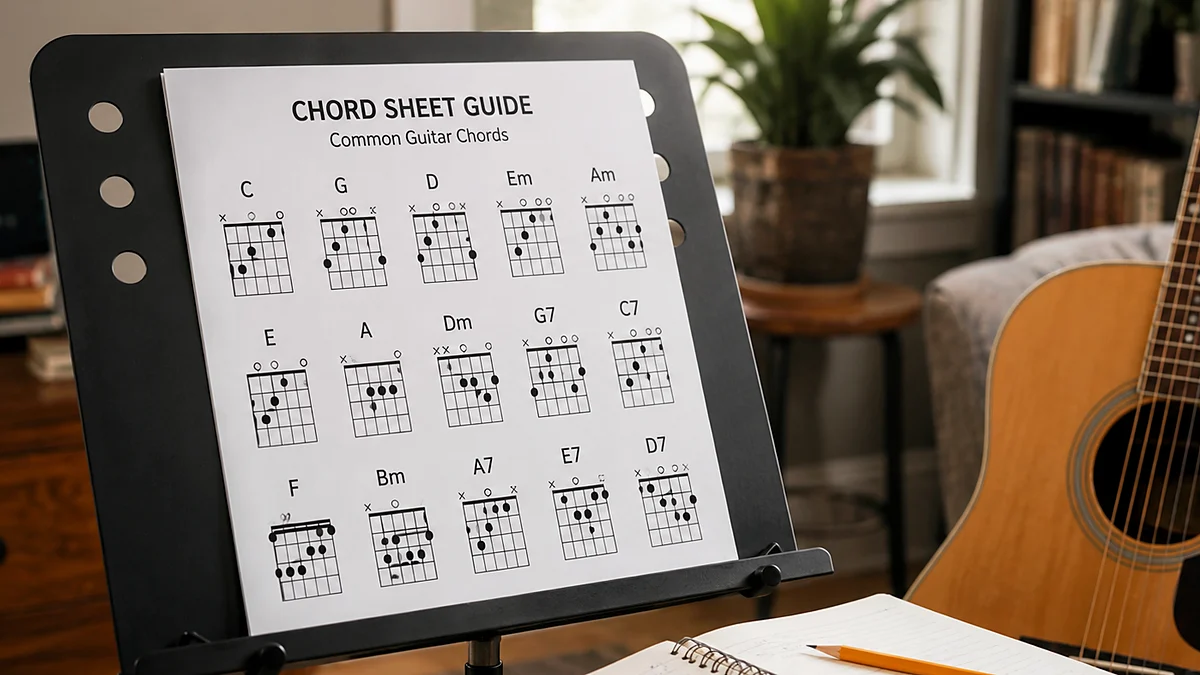
Matching Capo to Key: Choosing the Right Chord Family
When you are figuring out how to calculate what fret to put a capo on, you will often find that multiple capo positions can yield the same target key. Your choice depends on the specific tonal characteristics you want to achieve.
For example, if your target key is A major, you have several options:
- No Capo: Play standard open A-shape chords (A, D, E). This gives you deep, warm bass notes, but you are limited to the standard open voicings.
- Capo 2nd Fret (using G shapes): Play G-shape chords (G, C, D). This is a favorite configuration for acoustic guitarists. G-shape chords offer excellent fingerpicking patterns, suspended chord variations, and a highly resonant ring.
- Capo 5th Fret (using E shapes): Play E-shape chords (E, A, B). This moves the guitar further up the neck, giving it a tighter, brighter, almost mandolin-like quality that cuts beautifully through a dense band mix.
- Capo 7th Fret (using D shapes): Play D-shape chords (D, G, A). This position is very high on the neck. It is excellent for doubling another guitar player who is playing without a capo, creating a lush, wide stereo image.
When deciding which chord family to use with your capo, consider the vibe of the song. G and C shapes tend to feel more modern, folky, and fluid. E and A shapes feel more driving, traditional, and bluesy.
Using a Guitar Capo Calculator to Simplify the Process
While doing manual chromatic scale math is a great skill to have, it can be slow and prone to errors when you are in the middle of a rehearsal or songwriting session. This is where modern digital tools make life incredibly easy.
Instead of counting semitones on your fingers, you can use the interactive Guitar Capo Calculator on Chords.me.
CTA Box
Need to instantly transpose a song to fit your voice?
Try the free [Guitar Capo Calculator](https://www.chords.me/capo-calculator) on Chords.me.
Just input your current chords, select your target key,
And get the exact capo position and chord shapes instantly.
Using a capo position calculator for singing takes the guesswork out of live performance. You simply input the chord progression of the song in its original key, select the key you want to sing in, and the tool instantly tells you:
- What fret to place your capo on.
- The exact chord shapes you need to play.
- How those shapes translate to the actual sounding chords.
This is especially helpful for complex songs that contain minor, diminished, or extended chords (like maj7 or add9 chords) that are difficult to transpose in your head.
Common Mistakes When Finding and Using Capo Positions
Even after you calculate the correct capo fret, you might run into tuning or tone issues. Here are the most common mistakes guitarists make when using a capo, and how to fix them.
1. Clamping the Capo Directly on the Fret Wire
If you place your capo directly on top of the metal fret wire, you will deaden the strings, resulting in a dull, thudding sound with zero sustain. Conversely, if you place it too far back in the middle of the fret space, the strings will buzz because there isn't enough tension holding them down against the fret wire.
- The Fix: Place the capo just slightly behind the fret wire (about 2 to 3 millimeters back), parallel to the fret. This ensures maximum sustain and clarity without choking the notes.
2. Pulling the Strings Out of Tune
When you clamp a capo onto the neck, the spring or screw tension can pull the strings downward toward the fretboard too aggressively. This stretches the strings slightly, causing them to go sharp. If your guitar was perfectly in tune before you put the capo on, it might sound sour once the capo is clamped.
- The Fix: Use an adjustable-tension capo (like a screw-type or clutch-style capo) rather than a fixed-tension spring capo. Adjust the tension so it is just tight enough to eliminate string buzz, and no tighter. Always check your tuning with a clip-on tuner after you have put the capo on.
3. Ignoring the Guitar's Intonation Limits
As you move a capo higher up the neck (especially past the 7th fret), the physical intonation of your guitar can start to drift. The distance between the frets gets smaller, and the action (string height) typically gets higher. This can make chords sound slightly out of tune with themselves, even if the open strings are tuned perfectly.
- The Fix: Try to keep your capo placements between the 1st and 6th frets for optimal intonation and tone. If you must go higher, consider transposing the song to a different chord family that allows you to drop the capo back down to a lower fret.
4. Forgetting to Transpose the Bass Line or Lead Riffs
If you are playing in a band and you put a capo on the 3rd fret to play G-shape chords, you are sounding in Bb. If your bass player or keyboardist looks at your hands and plays a G note, it will sound horribly dissonant.
- The Fix: Remember that the capo only changes your instrument. You must communicate the actual sounding key (the Target Key) to the rest of the band. Tell your bass player, "The song is in Bb," even if you are thinking and playing in "G shapes."
Practical Examples: Putting It All Together
Let's look at a couple of real-world scenarios that working guitarists face every day to see how these concepts apply in practice.
Scenario A: The Soprano Singer and the Baritone Song
You want to cover a song originally sung by a deep-voiced male artist. The original song is in the key of G major, and it uses the chords G, Em, C, and D.
Because the original key is far too low for your higher vocal range, you want to raise the key to D major.
- Original Key: G
- Target Key: D
- Option 1 (No Capo): You could play the open chords D, Bm, G, and A. However, Bm is a barre chord that tires your hand out over a four-minute song.
- Option 2 (Using a Capo): You decide you want to keep using those comfortable, open C-shape chords (C, Am, F, G). Let's calculate the capo fret.
- Count from C (your chord shape) to D (your target key): C → C# (1) → D (2).
- Place the capo on the 2nd fret and play the C, Am, F, and G shapes.
- Now you are playing in the key of D with easy, flowing chord shapes, and the vocal melody is perfectly shifted into your comfortable upper register.
Scenario B: Adding Tonal Variety in a Duo
You are playing acoustic guitar alongside another guitarist in a duo. The song is in the key of C major, using C, Am, F, and G.
If both of you play the exact same open C chords in the same position, the guitars will fight for the same sonic space, resulting in a muddy, cluttered sound.
- Your Partner: Plays open C, Am, F, G chords with no capo.
- Your Strategy: You decide to use G-shape chords to create a brighter, complementary texture.
- Target Key: C
- Chord Shape Key: G
- Calculation: Count from G to C on the chromatic scale: G → G# (1) → A (2) → A# (3) → B (4) → C (5).
- Action: Put your capo on the 5th fret and play G, Em, C, and D shapes.
- The Result: Both guitars are playing in the key of C, but your guitar is sounding an octave higher with a completely different tonal footprint. The two guitars blend beautifully, sounding like a 12-string guitar or a polished studio production.
Finding the right capo position is a fundamental skill that bridges the gap between your guitar fretboard and your vocal range. By understanding the chromatic scale, learning how to count semitones between your chord shapes and your target keys, and utilizing tools like Chords.me Guitar Capo Calculator, you can make any song on earth comfortable to sing and beautiful to play. Keep a capo in your gig bag, experiment with different fret positions, and let your voice guide your hands to the perfect key.
Related Chords.me Guides
For the next step, read How to Change a Song Key, Guitar Capo FAQs: Common Beginner Questions, and Chromatic Tuner Guitar Guide: How to Tune Accurately as a Beginner before moving on. You can also test the same idea in another key and compare capo positions while practicing this lesson.
Practice This With Chords.me
Use the Guitar Capo Calculator to test the fret position, then compare the result with the Chord Transposer. Focus on clean notes and steady timing before increasing speed.
Frequently Asked Questions
How do I know what capo fret to use for my voice?
To find the right capo fret for your voice, try singing the song at a few different capo positions and pick the one where the melody sits comfortably without straining at the highest or lowest notes.
Can a capo help me sing a song more comfortably?
Yes, a capo can shift a song into a more comfortable vocal range without changing the chord shapes you already know.
Is there a calculator for capo position?
Yes, several free online capo calculators let you enter a song's original key and your target key to instantly find the right capo fret.
About the Contributor
Chords.me Tuning & Setup Desk Tuning, strings, and setup contributor
A brand contributor profile for Chords.me tuning and setup content. This desk focuses on tuning accuracy, string choice, fret buzz, intonation, action, and maintenance topics for everyday players. Content is checked for practical clarity, beginner readability, and accurate links to relevant Chords.me tools.