Guitar Practice Routine for Busy Beginners: A 15-Minute Blueprint
Guitar Practice Routine for Busy Beginners: A 15-Minute Blueprint: clear guitar guide with practical examples, common mistakes, and Chords.me practice tools.
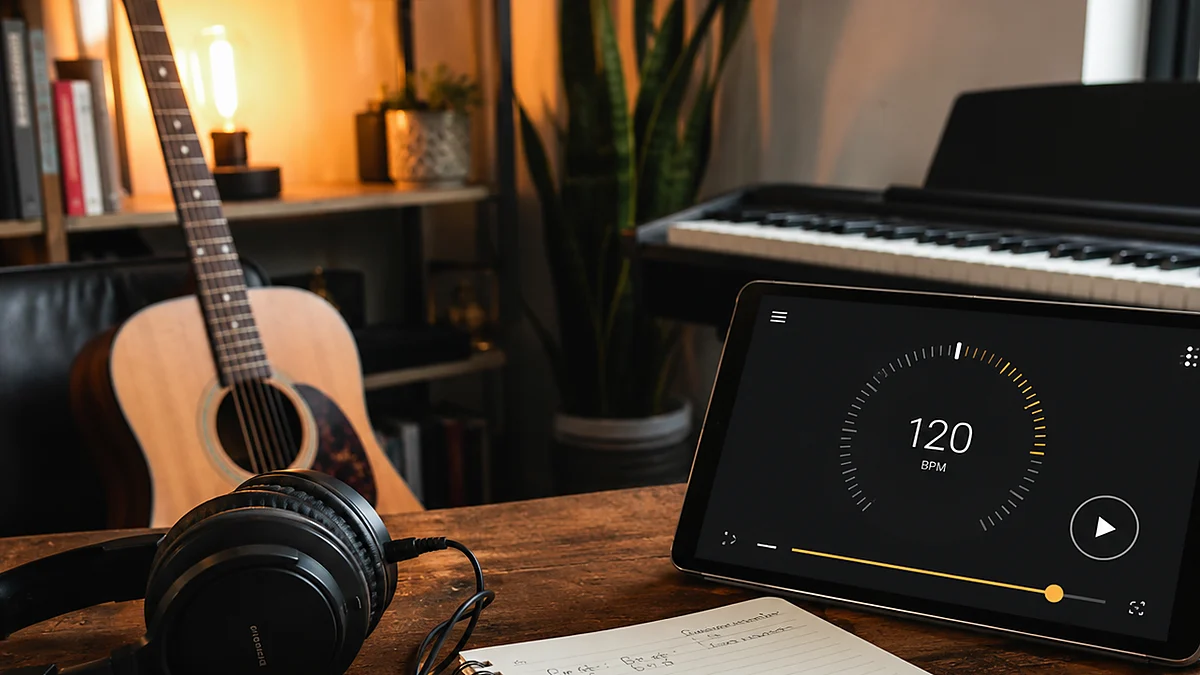
Learning to play the guitar is one of the most rewarding journeys you can undertake. However, the most common obstacle for new players is not a lack of talent, but a lack of time. Between work, family, and daily chores, finding a spare hour to practice can feel impossible.
The good news is that you do not need hours of free time every day to become a proficient guitarist. In fact, short, focused practice sessions are far more effective for building muscle memory than long, sporadic marathon sessions on the weekend. A structured 15-minute guitar practice routine can yield remarkable progress if you approach it with intention and consistency.

What Is a Guitar Practice Routine?
A guitar practice routine is a structured, repeatable sequence of exercises made to systematically improve your physical technique, theoretical understanding, and musicality. Instead of picking up the instrument and aimlessly playing things you already know, a routine targets specific areas of development within a set timeframe.
For those wondering, is guitar practice routine good for beginners? The answer is an absolute yes. Without a structured plan, beginners often default to noodling, which leads to frustration, slow progress, and bad habits. A focused routine keeps you accountable, saves time, and ensures that every minute you spend with the instrument directly contributes to your growth.
What is a Guitar Practice Routine?
To truly understand how to use a guitar practice routine, you must first understand what it is not. It is not a rigid, boring chore made to strip the joy out of music. Rather, it is a roadmap that removes decision fatigue. When you sit down with your guitar, you should not have to waste five minutes deciding what to play. You should know exactly what your fingers need to do the moment your instrument rests on your knee.
For a busy beginner, a practice routine must be highly concentrated. It focuses on the fundamental mechanics of playing: finger independence, chord shape recognition, clean transitions, and rhythmic accuracy. By dividing your limited time into distinct, goal-oriented blocks, you train your brain and muscles to adapt quickly.
Consistency is the engine of musical progress. Fifteen minutes of focused daily practice equals 105 minutes of high-quality training per week. This consistent daily stimulation signals to your brain that these movements are important, accelerating the development of myelin—the insulating layer that forms around nerves, allowing electrical impulses to transmit quickly and efficiently. This is the physiological basis of "muscle memory."
How to Learn Guitar Practice Routine Step by Step
If you want to know how to learn guitar practice routine step by step, the secret lies in breaking your session into four distinct, time-bound phases. This structure ensures you cover physical preparation, technical precision, practical application, and musical expression in a single quarter-hour block.
Here is how to execute a highly efficient 15-minute guitar practice routine.
Phase 1: The Warm-Up (2 Minutes)
Never skip the warm-up. Just as an athlete stretches before a race, a guitarist must prepare the small muscles in their hands, wrists, and forearms to prevent strain and injury.
Start with a simple physical stretch. Extend your fretting hand forward, gently pull your fingers back toward your body with your other hand, and hold for ten seconds. Shake out your hands.
Next, perform the classic "Spider Walk" exercise on the fingerboard.
- Place your index finger on the 5th fret of the low E string (6th string). Play the note.
- Place your middle finger on the 6th fret. Play the note.
- Place your ring finger on the 7th fret. Play the note.
- Place your pinky finger on the 8th fret. Play the note.
Focus entirely on tone and accuracy. Ensure each note rings out clearly without buzzing. Keep your thumb positioned behind the neck, roughly opposite your middle finger, to provide stable leverage. Do not rush; the goal here is physical preparation, not speed.
Phase 2: Core Technique and Accuracy (5 Minutes)
This segment is dedicated to building physical control, finger independence, and clean fretboard navigation. As a beginner, your primary technical hurdle is making your fingers move independently of one another.
For this phase, focus on alternate picking and fretboard accuracy. Use a simple four-note per string pattern, moving across all six strings from the low E to the high E, and then back up.
- The Down-Up Rule: Every time you strike a string, alternate your pick direction. If your first stroke is a downstroke, the next must be an upstroke. This is crucial for building efficient timing practice habits early on.
- Fret Proximity: Place your fingertips as close to the fret wire as possible without sitting directly on top of it. This minimizes the amount of pressure required to produce a clean tone, saving your fingers from unnecessary fatigue.
Keep your eyes on your fretting hand for the first few passes, then try to look away or focus on your picking hand. This builds spatial awareness on the instrument.
Phase 3: Chord Transitions and Song Application (5 Minutes)
Now that your hands are warm and your coordination is sharp, it is time to work on chords. For beginners, the greatest bottleneck in playing songs is the transition between chord shapes.
Choose two chords that you find challenging to switch between—for example, C major to G major, or G major to D major.
- The Hover Method: Form the first chord shape. Lift your fingers slightly off the strings (about half an inch), maintaining the shape of the chord in the air. Hold it for three seconds, then press your fingers back down simultaneously. Repeat this five times.
- The Common Finger Anchor: Identify if the two chords share a common note or finger position. For example, when moving from C major to A minor, your index and middle fingers do not need to leave the fretboard; they stay exactly where they are. Only your ring finger moves. Recognizing these "anchors" dramatically increases transition speed.
- The 1-Minute Change Club: Set a timer for one minute. Count how many times you can cleanly switch between the two chords. Do not sacrifice accuracy for speed. A transition only counts if every note in the chord rings out clearly. Write down your score and try to beat it during your next session.
Phase 4: Creative Play and Ear Training (3 Minutes)
The final phase of your guitar practice routine is made to keep the instrument fun and engaging. Use this time to apply what you have learned to real music, or to explore the fretboard creatively.
Play through a single verse or chorus of a song you love. If you only know two or three chords, find a song that uses those exact chords. Focus on maintaining a steady strumming pattern.
Alternatively, use this time for simple ear training. Hum a simple melody (like a nursery rhyme or a basic vocal line) and try to find those notes on a single string of your guitar. This connects your physical movements to your internal musical ear, which is the foundation of improvisation and songwriting.
The Busy Beginner's Practice Matrix
To keep your practice structured and balanced, use the table below to guide your weekly focus. You do not have to practice everything every day; instead, rotate your focus areas while keeping the structural time blocks the same.
| Skill | Practice Method | Time Needed | Common Mistake |
|---|---|---|---|
| Finger Independence | The Spider Walk (chromatic scales across strings) | 2 Minutes | Flying fingers (lifting unused fingers too far off the fretboard) |
| Chord Vocabulary | Chord shape memorization & muscle memory | 3 Minutes | Pressing too hard, causing hand fatigue and sharp notes |
| Chord Transitions | The 1-Minute Change Club (focusing on anchor fingers) | 5 Minutes | Pausing the strumming hand while waiting for the fretting hand |
| Timing & Rhythm | Metronome practice with basic quarter-note strumming | 3 Minutes | Speeding up during easy sections and slowing down during hard changes |
| Song Application | Playing a single verse or chorus of a beginner song | 2 Minutes | Trying to play the entire song at full speed before mastering the parts |

Timing and Rhythm: The practical way to Sounding Like a Pro
A guitarist who knows fifty chords but has poor timing will always sound worse than a guitarist who knows only three chords but plays them in perfect time. Rhythm is the glue that holds music together. Therefore, timing practice must be a core component of your daily guitar practice.
Metronome Practice
Many beginners find practicing with a metronome frustrating. However, the metronome is an honest mirror; it reveals exactly where your timing wavers.
When practicing your chord transitions or scale exercises, set your metronome to a slow, manageable tempo, such as 60 beats per minute (BPM).
- Play one strum or one note per click (quarter notes).
- Focus on landing your note exactly on top of the click, so that the sound of your guitar "hides" the sound of the metronome.
- Once you can play the exercise perfectly ten times in a row, increase the tempo by 5 BPM.
If you make a mistake, do not get frustrated. Simply slow the metronome down by 10 BPM and try again. Building accuracy at slow speeds is the quickest way to develop speed later.
Finding the Right Tempo
When you want to practice a specific song, you must first determine its tempo so you can set your metronome correctly. This is where modern digital tools become incredibly helpful.
If you are listening to a song on your phone or computer and want to know its exact speed, you can use Chords.me's Tap Tempo tool. Play the song, tap your spacebar or screen in time with the beat, and the tool will instantly calculate the BPM.
Once you know the song's original tempo (for example, 120 BPM), set your metronome to 60% of that speed (72 BPM) to practice the parts slowly. As your muscle memory develops and your accuracy improves, gradually increase the tempo until you can comfortably play along with the original track.
Guitar Practice Routine Mistakes Beginners Make
To get the most out of your 15-minute routine, you must avoid the common pitfalls that derail many self-taught players. Here are the most frequent guitar practice routine mistakes beginners make and how to fix them.
1. Practicing Too Fast
The brain learns physical movements through slow, deliberate repetition. If you practice a chord transition quickly and make a mistake, you are actually practicing the mistake. Your muscles do not know the difference between a correct movement and an incorrect one; they only remember what you repeat.
- The Fix: Slow down until it is impossible to make a mistake. If that means playing at 40 BPM, do it. Speed is a natural byproduct of accuracy, not effort.
2. Noodling Instead of Practicing
Noodling is the act of mindlessly playing things you can already do well. While noodling is fun and has its place in creative play, it does not contribute to technical improvement. If your practice session feels easy and comfortable, you are likely noodling, not practicing.
- The Fix: Keep a physical or digital timer next to you. When the timer is running, you must adhere strictly to your practice routine. Save the mindless playing for after your structured practice is complete.
3. Ignoring Poor Tone
Many beginners are so focused on placing their fingers on the correct frets that they ignore the actual sound coming out of the instrument. If your chords feature muted strings, buzzing frets, or dull notes, you are reinforcing poor hand posture.
- The Fix: Arpeggiate your chords. This means plucking each string of the chord individually rather than strumming them all at once. If a string sounds muted or buzzy, adjust your finger placement until it rings clear.
4. Inconsistent Practice Habits
Practicing for two hours on Sunday and then not touching the guitar until the following weekend is highly ineffective. Your brain will forget the physical pathways built during that long session, forcing you to start from scratch every week.
- The Fix: Commit to 15 minutes a day, five days a week. This is far more beneficial than a single weekly two-hour session.
How to Use Your Guitar Practice Routine Daily
To make your daily practice routine sustainable, you must eliminate the physical friction that prevents you from practicing. If your guitar is packed away in a gig bag in the back of your closet, you are far less likely to practice than if it is sitting on a stand in your living room.
Create a Dedicated Practice Space
Keep your guitar on a sturdy stand in a highly visible, easily accessible location. Keep your pick, tuner, and a notebook or tablet nearby. When you have a spare 15 minutes, you should be able to sit down, pick up the instrument, and begin playing immediately.
Track Your Progress
Keep a small notebook in your practice space. At the end of each session, write down:
- The tempo you reached on your technical exercises.
- Your score in the 1-Minute Change Club.
- Any specific trouble spots you encountered.
This physical record provides tangible proof of your progress. On days when you feel like you are not improving, looking back at your entries from two weeks prior will show you how far you have actually come.
Embrace the "Two-Minute Rule"
On days when you are absolutely exhausted and the thought of a 15-minute practice session feels overwhelming, commit to practicing for just two minutes. Tell yourself that you will do a quick physical warm-up and then put the guitar down.
In almost every case, once you have the guitar in your hands and have started playing, the initial resistance will fade, and you will end up completing your full 15-minute routine.
Maximizing your guitar learning
A structured, daily 15-minute practice routine is the most reliable path to guitar mastery for busy beginners. By focusing on deliberate, high-quality practice, prioritizing accuracy over speed, and utilizing practical tools like the Chords.me Tap Tempo finder to refine your rhythm, you will make steady, undeniable progress. Pick up your guitar, set your timer, and start building your lifelong musical foundation today.
Related Chords.me Guides
For the next step, read Beginner Guitar Lessons Roadmap: Your Step-by-Step Path to Playing Songs, Chords and Lyrics Formatting Guide, and Guitar Tabs Explained for Beginners: A Complete Step-by-Step Guide before moving on. You can also turn your chords and lyrics into a clean PDF and keep practice timing steady with the tap tempo tool while practicing this lesson.
Practice This With Chords.me
Use the Chord Transposer to test the idea in another key, then practice the same example slowly. Focus on clean notes and steady timing before increasing speed.
Frequently Asked Questions
What is Guitar Practice Routine for Busy Beginners?
Guitar Practice Routine for Busy Beginners is a guitar-learning topic that helps players build a clearer connection between technique, sound, and practice. For beginners, the most useful approach is to learn the basic idea first, then apply it slowly on a tuned guitar.
Is guitar practice routine for busy beginners hard for beginners?
It can feel difficult at first, but it becomes manageable when you break it into small steps. Focus on clean notes, relaxed hands, and short practice sessions instead of trying to master everything in one day.
What should I practice first for guitar practice routine for busy beginners?
Start with the simplest version of the idea: one chord, one pattern, one short exercise, or one small section of the fretboard. Once that feels stable, add timing, transitions, or a second example.
What common mistakes should I avoid?
Avoid rushing, pressing harder than necessary, ignoring tuning, and practicing mistakes at full speed. Slow, accurate repetitions usually fix beginner problems faster than long unfocused practice sessions.
Which Chords.me tool helps with this topic?
The Tap Tempo is the best supporting tool here because it helps with keeping rhythm steady and checking practice tempo. Use it before or during practice so the article’s examples translate into real playing more easily.
About the Contributor
Chords.me Beginner Lessons Desk Beginner guitar learning contributor
A brand contributor profile for Chords.me beginner lessons. This desk focuses on clear first-step explanations, practice order, common mistakes, and simple exercises players can test immediately. Content is checked for practical clarity, beginner readability, and accurate links to relevant Chords.me tools.