Half Step Down Guitar Tuning: Beginner Guide
Learn half step down guitar tuning, the note names, when to use it, and how to tune safely from standard tuning.
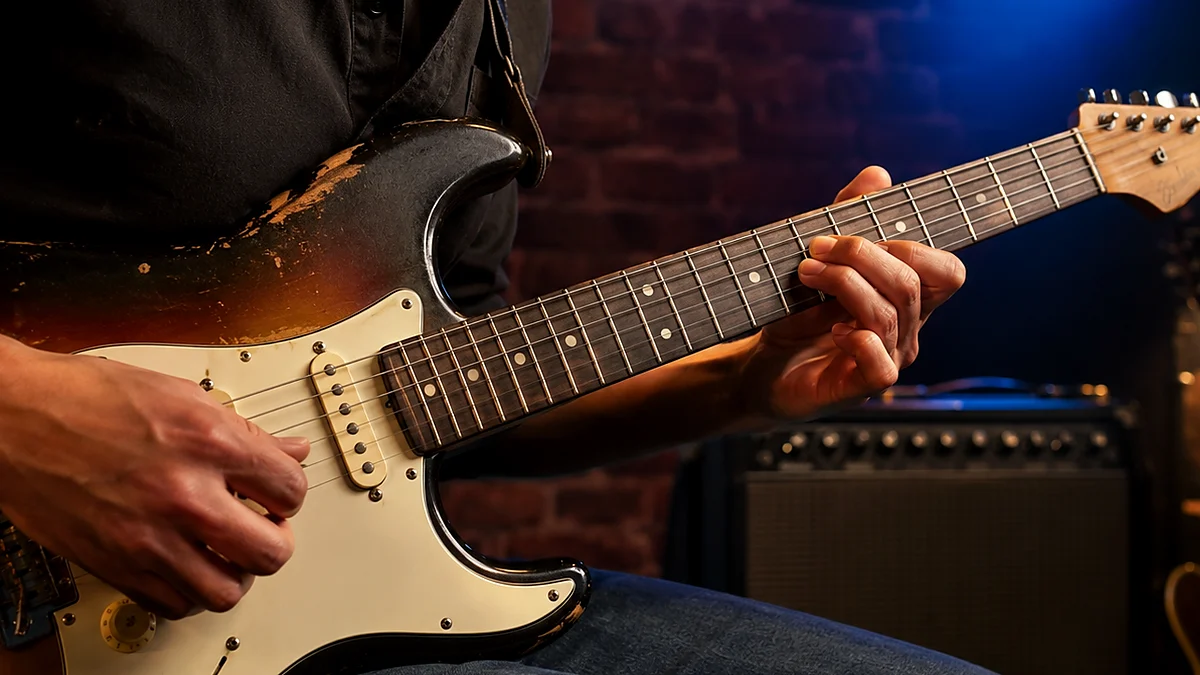
If you have ever tried to play along with your favorite classic rock, grunge, or blues records and noticed your guitar sounded slightly higher in pitch than the recording, you have likely run into half step down guitar tuning. This tuning is one of the most popular alternative setups in modern music history.
By lowering the pitch of all six strings by a single semitone, you get a warmer, heavier tone and make your instrument significantly easier to play. For singers who play guitar, it can also be the practical way to reaching notes that previously felt just out of reach.

In this guide, you will learn the mechanics of half step down tuning, why so many players rely on it, and exactly how to set up your own guitar for this classic sound.
What is Half Step Down Tuning?
Half step down tuning is an alternative guitar tuning where every string is tuned down by exactly one semitone (a half step) from standard tuning. This means your guitar retains the exact same intervals between strings as standard tuning, but the overall pitch of the entire instrument is lower.
Because the intervals remain identical, all of your open chord shapes, scale patterns, and fretboard relationships stay exactly the same. An open G chord shape is still played the same way, though it will sound as a Gb (G flat) chord. This makes the transition from standard tuning smooth for players of any skill level.
This tuning is also widely known as Eb standard tuning (E-flat standard) or D# standard tuning (D-sharp standard). Both names refer to the exact same pitch configuration, as Eb and D# are enharmonically identical notes.
Standard vs. Half Step Down: The Note Comparison
To understand how this alteration changes your instrument, it helps to compare the note names and physical frequencies of standard tuning side-by-side with Eb tuning.
| String | Standard Note | Half Step Down Note (Flat) | Half Step Down Note (Sharp) | Frequency (Hz) - Standard | Frequency (Hz) - Half Step Down |
|---|---|---|---|---|---|
| 6 (Low) | E | Eb | D# | 82.41 | 77.78 |
| 5 | A | Ab | G# | 110.00 | 103.83 |
| 4 | D | Db | C# | 146.83 | 138.59 |
| 3 | G | Gb | F# | 196.00 | 185.00 |
| 2 | B | Bb | A# | 246.94 | 233.08 |
| 1 (High) | E | Eb | D# | 329.63 | 311.13 |
As you can see from the table, the half step down tuning note names are lowered by a single fret's distance. The low E string becomes Eb (or D#), the A string becomes Ab (or G#), and so on, all the way up to the high E string, which becomes Eb.
Why Do Guitarists Tune Half Step Down?
If standard tuning works so well, why do guitarists tune half step down in the first place? There are three primary reasons why musicians make this adjustment: vocal comfort, physical playability, and tonal characteristics.
1. Accommodating Vocal Ranges
The primary reason many touring bands adopt Eb standard tuning is to assist their lead vocalist. Singing night after night on a grueling tour takes a strong toll on a singer's vocal cords. By lowering the pitch of the songs by a half step, the singer does not have to strain as hard to hit the high notes in their repertoire.
For example, a high Bb that might cause vocal fatigue over a two-hour show becomes an A natural when the band tunes down a half step. This subtle shift can extend a singer's vocal longevity and make live performances sound much more consistent.
2. Lower String Tension
When you are detuning strings, you are physically reducing the tension pulling across the guitar neck. Lower string tension makes the strings feel looser and more flexible under your fingers.
For lead guitarists, this tension drop makes wide string bends and vibrato significantly easier to execute. Blues players who prefer a highly expressive, vocal-like bending style often use this tuning specifically for the physical relief it offers to their fingers.
3. Warmer, Darker Tonal Qualities
Guitars tuned down a half step exhibit a distinct acoustic resonance. The lower string tension allows the strings to vibrate with a wider physical arc, which often translates to a thicker, warmer, and more bass-heavy tone.
In heavy rock and metal genres, this slight drop in pitch adds an aggressive growl to low-end riffs without losing the clarity of standard chord voicings. In acoustic music, it gives the guitar a woody, deep resonance that sits beautifully beneath a solo singer-songwriter's voice.
How to Tune Guitar Half Step Down from Standard
There are several reliable methods to transition your instrument from standard tuning to Eb. Whether you have access to digital tools or must rely on your ears, you can easily achieve an accurate tune.
Method 1: Using a Chromatic Tuner
Using a dedicated chromatic tuner is the most precise way to tune your guitar. A chromatic tuner detects any of the twelve semitones in western music, rather than just the six notes of standard guitar tuning.
- Turn on your chromatic tuner or open the online Chords.me Guitar Tuner on your phone or computer.
- Pluck your low E string (6th string).
- Slowly turn the tuning peg clockwise (loosening the string) to lower the pitch.
- Watch the tuner display until it reads Eb (E-flat) or D# (D-sharp). Ensure the needle is centered perfectly.
- Repeat this process for the remaining strings, tuning them to Ab (G#), Db (C#), Gb (F#), Bb (A#), and Eb (D#).
- Because the overall tension on the neck has dropped, the first few strings you tuned may have slipped slightly. Double-check and fine-tune all six strings a second time.
Method 2: The Capo Method
If you only have a basic non-chromatic tuner that only recognizes standard EADGBE notes, you can use a capo to trick the tuner.
- Place your capo firmly on the first fret of your guitar.
- Clamp it down so that all six strings ring out clearly.
- Turn on your standard guitar tuner.
- With the capo on the first fret, tune your guitar as if you were tuning to standard EADGBE. The tuner will guide you to E, A, D, G, B, and E.
- Once all strings are perfectly in tune with the capo on, remove the capo.
- Because the first fret of an Eb-tuned guitar is standard E, removing the capo leaves the open strings tuned exactly one half step down to Eb standard.
Method 3: Tuning to Itself (The Fret Method)
If you do not have a tuner or a capo, you can tune the guitar to itself, provided you can reference at least one correct pitch (like a keyboard or another instrument already in Eb).
- Lower your 6th string until it matches the pitch of an Eb reference note.
- Place your finger on the 5th fret of the newly tuned 6th string (Eb). This note is now Ab.
- Pluck the open 5th string and compare it to the fretted 6th string. Adjust the 5th string tuning peg until the pitches match perfectly.
- Place your finger on the 5th fret of the 5th string (Ab). This note is Db. Match the open 4th string to this pitch.
- Place your finger on the 5th fret of the 4th string (Db). This note is Gb. Match the open 3rd string to this pitch.
- Place your finger on the 4th fret of the 3rd string (Gb). This note is Bb. Match the open 2nd string to this pitch.
- Place your finger on the 5th fret of the 2nd string (Bb). This note is Eb. Match the open 1st string to this pitch.

Does Half Step Down Tuning Need Heavier Strings?
A common question among players learning how to tune guitar half step down from standard is whether they need to change their string gauge. The answer depends on your personal preference for string tension and how your specific instrument reacts to detuning.
When you lower the pitch of your strings, you reduce the physical tension on the neck. This can make your strings feel loose or "floppy." If you currently play with very light strings, such as a.009–.042 set, tuning down a half step might cause the strings to buzz against the frets because they lack the tension to pull away from the neck.
Choosing the Right Gauge
If you plan to keep your guitar in Eb standard tuning permanently, it is highly recommended to move up one string gauge size. This compensates for the loss of tension and restores the physical feel you are accustomed to in standard tuning.
- If you use .009s in standard, try .010s for Eb tuning.
- If you use .010s in standard, try .011s for Eb tuning.
- If you use .011s in standard, try .012s for Eb tuning.
By increasing the thickness of the wire, you add mass. This extra mass requires more tension to bring the string up to pitch, effectively canceling out the floppiness caused by detuning.
Instrument Setup Adjustments
Your guitar is a finely balanced machine. The metal strings pull the neck forward, while the wooden neck (reinforced by an internal steel truss rod) pulls backward. When you lower the string tension by tuning down, the truss rod may pull the neck backward too much, causing a slight back-bow.
If you experience fret buzz after tuning down, you may need to make a minor truss rod adjustment. Loosening the truss rod slightly (turning it counterclockwise) will allow the neck to bow forward a fraction of a millimeter, restoring the proper action. Additionally, you should check your guitar's intonation at the bridge to ensure notes remain perfectly in tune all the way up the fretboard.
Famous Artists and Genres Using Eb Standard Tuning
Eb standard tuning is not a rare specialty setup; it has been a common choice of popular music for over half a century. Many of the most iconic guitar tones in history were recorded in this tuning.
Blues and Classic Rock
The legendary Jimi Hendrix was one of the earliest pioneers of half step down tuning. He frequently tuned his Stratocasters down to Eb. This allowed him to sing comfortably over his heavy, psychedelic blues arrangements and made his strong string bends much easier on his fingers.
Following in Hendrix's footsteps, Stevie Ray Vaughan adopted Eb tuning as his default setup. Vaughan was famous for using incredibly heavy string sets (often starting with a.013 on the high E string). Tuning down a half step was the only way he could physically bend those thick strings while maintaining his aggressive, high-energy playing style.
Hard Rock and Metal
In the late 1980s and early 1990s, hard rock bands embraced Eb standard tuning to create a heavier, more menacing sonic footprint. Slash of Guns N' Roses recorded almost all of his iconic riffs and solos in Eb, including "Sweet Child O' Mine" and "Welcome to the Jungle." The tuning gave his Gibson Les Paul a thicker, darker midrange growl.
Heavy metal pioneers like Slayer used Eb tuning on their early albums to make their thrash metal riffs sound deeper and more aggressive. Metallica has also relied on Eb standard for their live performances for decades, helping vocalist James Hetfield preserve his voice during long world tours.
Grunge and Alternative Rock
The Seattle grunge scene of the 1990s embraced the dark, moody textures of detuned guitars. Alice in Chains guitarist Jerry Cantrell used Eb tuning to craft the heavy, sludgy riffs that defined the band's signature sound.
Pop-punk icons Green Day recorded their breakthrough album Dookie entirely in half step down tuning, which gave Billie Joe Armstrong's simple power chord progressions a punchier, thicker wall of sound. Alternative rock bands like Weezer and The Smashing Pumpkins also utilized Eb tuning extensively to create their strong, fuzzy guitar tracks.
Common Mistakes When Detuning Strings
While tuning down a half step is relatively straightforward, beginners often run into a few common pitfalls that can hurt their tuning stability and overall sound.
1. Tuning Down to the Note
When tuning any stringed instrument, you should always tune up to the target pitch rather than down to it. If you are tuning down from standard, do not simply stop turning the peg when you hit Eb.
If you tune down to a note, slack can get trapped in the string winding around the tuning post or behind the nut. The moment you strike the string hard or bend a note, that slack will release, and the string will immediately go flat.
Instead, tune slightly below your target Eb pitch, and then tune upward until the tuner needle centers. This locks the string tension evenly across the entire length of the instrument.
2. Ignoring String Binding at the Nut
If you decide to switch to heavier strings to compensate for the lower tension of Eb tuning, the thicker strings might bind or stick in the slots of your guitar's nut. This prevents the string from sliding smoothly through the slot when you tune or bend notes, leading to sudden jumps in pitch.
To prevent this, you can lubricate your nut slots. Applying a tiny amount of graphite (from a mechanical pencil) or a dedicated guitar lubricant to the slots when you change strings will keep them sliding freely.
3. Forgetting to Stretch Your Strings
Whenever you change your tuning or install a new set of strings, you must stretch them thoroughly. After tuning all strings to Eb, gently pull each string away from the fretboard along its entire length.
You will notice the pitch drops significantly after stretching. Tune back up to pitch and repeat the process until the strings hold their pitch perfectly after being pulled. This ensures excellent tuning stability during your practice sessions or live gigs.
Half Step Down vs. Standard Tuning: Which is Right for You
Choosing between half step down vs standard tuning ultimately comes down to your musical goals, your vocal range, and the physical feel you prefer.
Standard tuning is the universal language of the guitar. It is the default for instructional books, online chord sheets, and the vast majority of music education resources. If you are a absolute beginner learning your basic open chords, staying in standard tuning makes it easy to follow along with lessons without having to transpose notes in your head.
However, if you find yourself struggling to sing along with your playing, or if your fingers hurt from trying to execute wide bends on stiff strings, switching to Eb standard tuning can make a world of difference. It offers a forgiving physical feel, a rich, warm resonance, and opens the door to playing along with some of the greatest rock, blues, and metal songs ever recorded.
Experimenting with both setups is the best way to find your personal preference. Keep a tuner handy, pay attention to how your guitar's neck reacts to the tension changes, and enjoy the deep, resonant tones that only a half step down tuning can provide.
Related Chords.me Guides
For the next step, read Chromatic Tuner Guitar Guide: How to Tune Accurately as a Beginner, Blues Scale Guitar Guide: Beginner Practice Guide, and Major Scale Guitar Guide: Beginner Practice Guide before moving on. You can also test the same idea in another key and check each string with the guitar tuner while practicing this lesson.
Practice This With Chords.me
Use the Guitar Tuner to check each string slowly before practicing the example. Focus on clean notes and steady timing before increasing speed.
Frequently Asked Questions
What is the point of tuning half a step down?
Tuning half a step down (Eb standard) lowers every string by one semitone, which reduces string tension for easier bends and a slightly deeper tone, and matches recordings by artists who tune this way.
Is Eb tuning the same as half step down?
Yes. Eb tuning and half-step-down tuning are the same thing: every string is lowered one semitone from standard EADGBE to EbAbDbGbBbEb.
Do I need different strings for half step down tuning?
No special strings are required for half step down tuning, though slightly heavier gauge strings can help maintain comfortable tension since every string is a semitone looser.
About the Contributor
Chords.me Tuning & Setup Desk Tuning, strings, and setup contributor
A brand contributor profile for Chords.me tuning and setup content. This desk focuses on tuning accuracy, string choice, fret buzz, intonation, action, and maintenance topics for everyday players. Content is checked for practical clarity, beginner readability, and accurate links to relevant Chords.me tools.