Baritone vs Tenor Ukulele: Tuning & Chords
Compare tenor GCEA and baritone DGBE ukulele tuning, size, chord shapes, sound, and comfort. See how to play the same song on both.
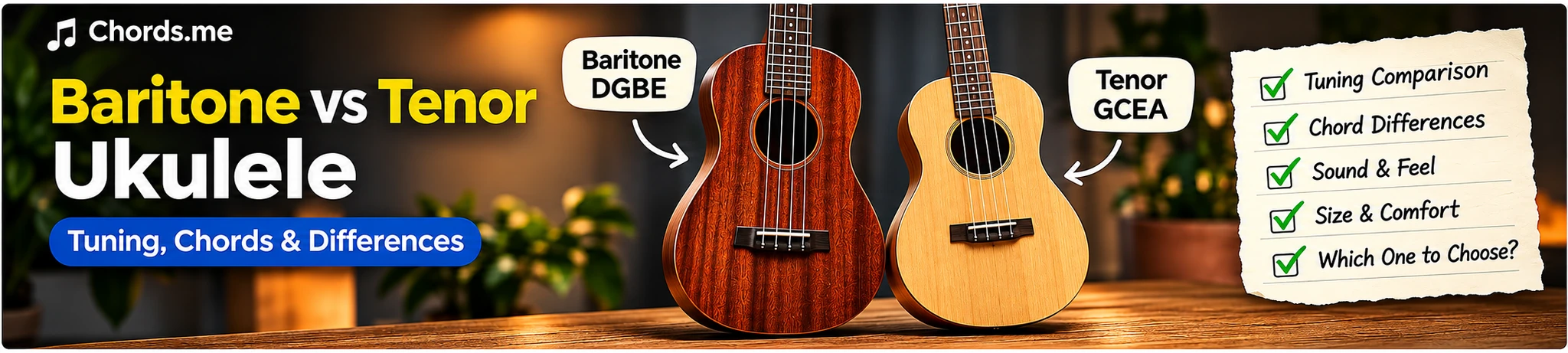
The main difference between a baritone ukulele and a tenor ukulele is tuning. Tenor ukuleles are usually tuned GCEA, while baritone ukuleles are usually tuned DGBE. Baritones are typically larger and sit in a lower register. Because the strings are tuned differently, the same fret pattern produces a different chord on each instrument.
Which one suits you depends on the sound you want, whether you already play guitar, and which lessons and chord charts you plan to use. This guide covers the tuning, chord, sound, and comfort differences so you can decide.
Baritone vs Tenor Ukulele: Quick Comparison
| Tenor ukulele | Baritone ukulele | |
|---|---|---|
| Typical tuning (4th to 1st string) | G – C – E – A (GCEA) | D – G – B – E (DGBE) |
| Tuning layout | Usually reentrant high-G; low-G is a common variation | Linear, low to high |
| Scale length | Roughly 16.5–17.5 inches, varying by maker | Roughly 19–21 inches, varying by maker |
| Physical size | Larger than soprano and concert; compact overall | Larger body and longer neck than a tenor |
| General sound | Often bright, with classic ukulele character | Often lower and warmer, with a more guitar-like feel |
| Chord-chart compatibility | Matches most standard ukulele charts and lessons | Needs DGBE charts, or the chords transposed |
| Learning resources | Very widely available | Fewer, but growing |
| For existing guitarists | Requires learning a new tuning system | Top four strings match a guitar’s top four |
| Common playing preferences | Strumming, fingerstyle, and traditional ukulele repertoire | Folk, singer-songwriter accompaniment, and guitar-style playing |
Dimensions and tone vary between brands and models, so treat these numbers as typical ranges rather than universal rules.
Real instrument photo: tenor and baritone ukuleles photographed by FolsomNatural.jpg), licensed CC BY 2.0. Used without alterations.
The Biggest Difference: GCEA vs DGBE Tuning
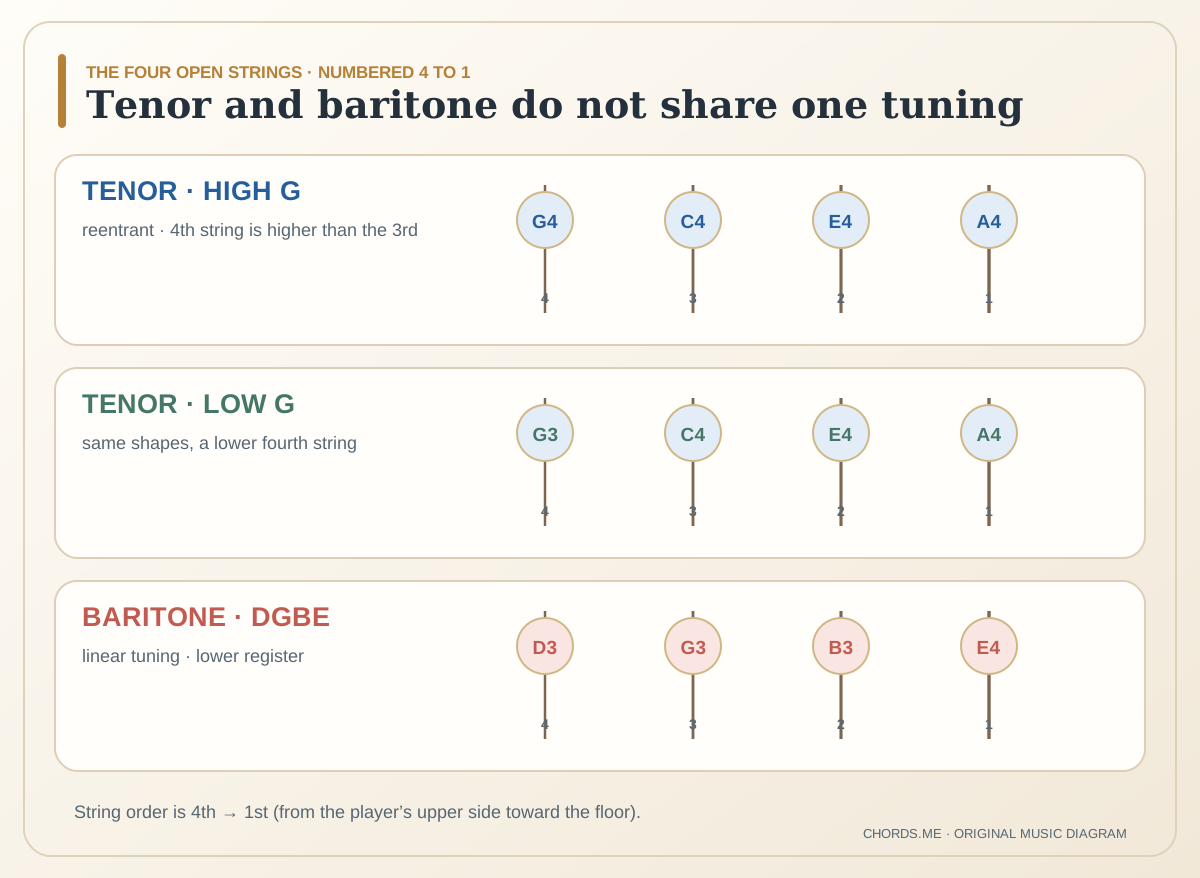
Tuning is where almost every other difference comes from.
Tenor (standard high-G), 4th string to 1st string:
- 4th string: G4
- 3rd string: C4
- 2nd string: E4
- 1st string: A4
This is reentrant tuning. The 4th string (G4) is higher than the 3rd string (C4), so the pitches don’t climb steadily from the thickest string to the thinnest. That tucked-in G is a big part of the traditional ukulele sound.
Many tenor players use low-G instead: G3 – C4 – E4 – A4. The 4th string drops an octave, so the tuning becomes linear. The note names stay the same, which means standard GCEA chord names and fret patterns still apply. Only the voicing and the available low notes change.
Baritone (standard), 4th string to 1st string:
- 4th string: D3
- 3rd string: G3
- 2nd string: B3
- 1st string: E4
This tuning is linear. Each string is higher than the last. These four notes match the highest four strings of a standard six-string guitar.
Why tuning changes the chord name
A chord is determined by the notes your fingers produce, not by the shape they make. If the open strings are different notes, the same shape lands on different notes.
Try this: play the open strings and one fretted note.
- On a tenor, 0003 plays G – C – E – C, which spells C major.
- On a baritone, 0003 plays D – G – B – G, which spells G major.
The finger pattern is identical, and the chord is not.
Relative to the usual GCEA chord system, the same patterns on DGBE give chords whose roots are a perfect fourth lower. C becomes G, F becomes C, and so on. Because high-G tuning is reentrant, that doesn’t mean every individual string moves by exactly the same interval in the same register. It’s the chord names that follow the pattern.
Do Tenor and Baritone Ukuleles Use the Same Chords?
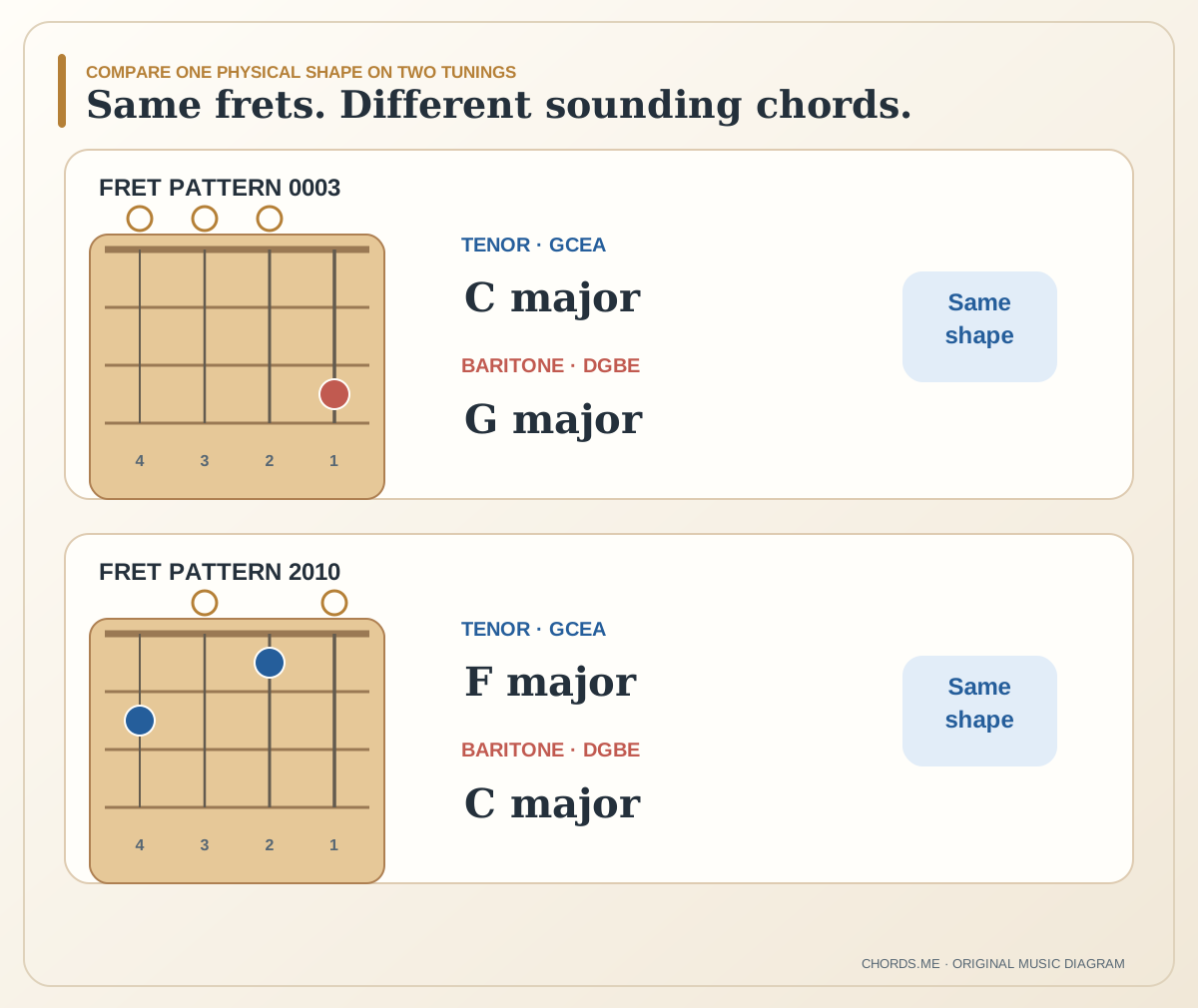
Both instruments can play many of the same musical chords, but they generally use different fret patterns to get the same sounding chord.
Fret patterns below are written from the 4th string to the 1st string, and 0 means open.
| Fret pattern | Tenor GCEA result | Baritone DGBE result |
|---|---|---|
| 0003 | C major | G major |
| 2010 | F major | C major |
| 0232 | G major | D major |
| 2000 | A minor | E minor |
Three ideas are easy to mix up:
- Same fret shape. The fingers sit in the same places on the fretboard.
- Same chord name. The chord is called the same thing, such as “G major.”
- Same sounding notes. The pitches you actually hear are identical.
Tenor and baritone can share a chord name without sharing a fret shape. Even then, the sounding notes won’t match exactly, because the instruments sit in different registers and use different voicings.
A quick exercise: the 0003 pattern
- Tune your instrument carefully and confirm which tuning you’re using.
- Strum all four open strings, then place one finger on the 3rd fret of the 1st string (the thinnest string).
- On a tenor, you’ve just played C major. On a baritone, you’ve just played G major.
- Now play 2010 on either instrument and notice that the shape is different but still easy to hold. Tenor gives F major. Baritone gives C major.
This is the clearest way to feel why a GCEA chart can’t be read directly on a DGBE instrument.
Playing the Same Song on Both Instruments
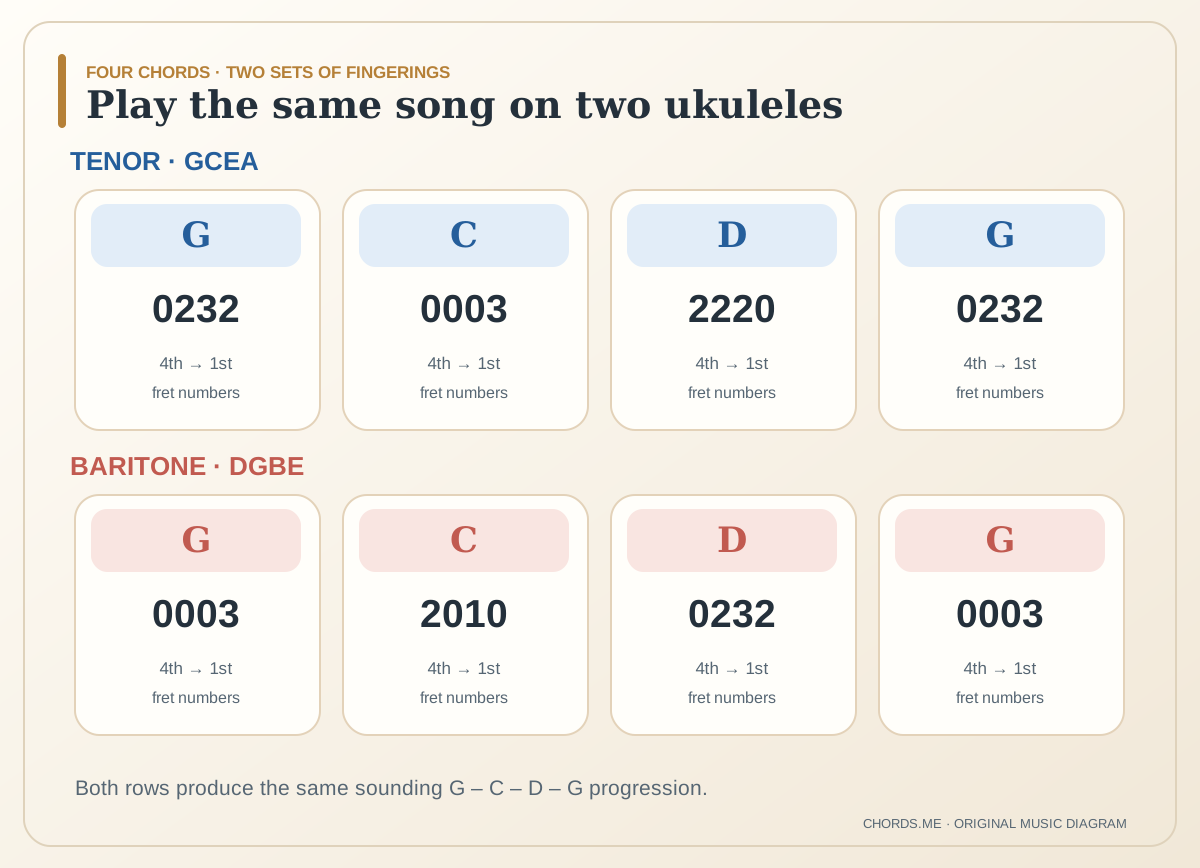
Here’s a simple progression in the key of G: G – C – D – G. A tenor player and a baritone player can both play it in the same key, using different fingerings.
Tenor GCEA
| Chord | Fret pattern |
|---|---|
| G | 0232 |
| C | 0003 |
| D | 2220 |
| G | 0232 |
Baritone DGBE
| Chord | Fret pattern |
|---|---|
| G | 0003 |
| C | 2010 |
| D | 0232 |
| G | 0003 |
How to practice it
- Strum each chord for four beats at a slow tempo.
- Move through all four chords, then repeat.
- Say the chord name out loud as you change, so your brain connects the name to the sound and not just the fingering.
- Once it feels steady, try a simple down-down-up-up-down-up strum.
Why the song stays in the same key
Notice that both players are playing G, C, D, G. They are playing the same chords by name, so the song is in the same key on both instruments. Only the fingerings differ.
Changing an instrument’s tuning does not automatically change a song’s key. Tuning only changes which fret patterns produce which chords. As long as you play the right chords by name, the key stays put.
To see what goes wrong when you ignore this, take the tenor fingerings (0232, 0003, 2220, 0232) and play them on a baritone. The result is D – G – A – D. That’s a perfectly good progression, but it’s in the key of D, a fourth lower than the song you meant to play. If you’re singing along, that shift matters.
Two players with different instruments can also play the same progression together. The chord names match, even though the voicings and registers differ.
How Do They Sound Different?
Sound is partly objective and partly personal, so it helps to separate the two.
General tendencies:
- Tenor ukuleles often keep the bright, recognizable ukulele character, especially in high-G tuning.
- High-G tuning contributes to the reentrant sound. The tucked-in 4th string adds a sparkly, compact quality to strummed chords and fingerpicked patterns.
- Low-G tenors have a lower available note range, which can add warmth and make melody-and-bass playing easier, while keeping tenor scale length and construction.
- Standard baritones sit in a lower register and are often described as warmer and more guitar-like.
What also affects tone:
- Body construction and tonewood
- String material and gauge
- Playing technique, such as fingerstyle versus strumming
- Instrument quality and setup
- Amplification, if any
No size is universally better, louder, more professional, or more musical. Both are legitimate instruments with their own character, and the best one is the one whose sound you want to play.
Size, Scale Length, and Playing Comfort

A tenor is larger than the soprano and concert ukuleles, but still compact. A baritone is larger again, with a longer scale length and typically a bigger body. Exact measurements vary by brand and model, so check the specifications of any instrument you’re considering.
Here’s how size affects practical playing:
- Fret spacing. A longer scale length means frets sit farther apart. That can make stretches slightly harder for some hands, while giving others more room to place fingers cleanly.
- Hand reach. Players with smaller hands may find a tenor easier for chord changes. Players with larger hands may feel cramped on short frets and prefer a baritone’s spacing.
- Weight and portability. Baritones are generally a bit bulkier. That barely matters at home, but it’s worth noticing if you travel or play outdoors.
- Strumming vs fingerpicking. Both work on either instrument. Some players like the extra spacing of a longer neck for fingerstyle, while others prefer the tighter reach of a tenor.
- Personal fit. Comfort depends on your body, posture, and playing style.
A bigger fretboard doesn’t automatically make an instrument easier for everyone. If you can try both in person, spend a few minutes forming chords and changing between them.
Is Baritone Ukulele Easier for Guitar Players?
For many guitarists, a baritone feels familiar. Standard DGBE tuning matches the top four strings of a six-string guitar, so many guitar chord shapes carry over directly.
A simple example is the open G chord. On a guitar, an open G shape often uses 3-2-0-0-0-3. Take just the top four strings and you get 0003, which is G major on a baritone.
The same works for open C (2010 on the top four strings), open D (0232), and E minor (2000).
There are limits, though:
- Shapes that use the fifth or sixth strings don’t transfer unchanged. A guitar chord that relies on a low bass note has no equivalent on four strings.
- Omitting bass strings can remove important chord tones. Some guitar voicings depend on the lowest strings, so the four-string version may sound thinner or less complete.
- Some arrangements need alternate voicings. Moving a song from guitar to baritone sometimes means finding a different four-string way to play a chord.
A baritone ukulele is also not literally a guitar with two strings removed. Its scale length, construction, strings, and playing feel are different. Guitar knowledge gives you a head start, but it doesn’t mean every guitar chord works perfectly.
Is Tenor or Baritone Better for Beginners?
There’s no simple universal winner. The better choice depends on what you want to do.
Reasons a tenor can be convenient for beginners:
- Most beginner ukulele lessons, songbooks, and chord charts assume GCEA tuning.
- If you join a ukulele group, standard chord charts will probably match your instrument.
- Tenor size is a comfortable middle ground for many hands.
- If you’ve heard the classic ukulele sound and love it, a tenor delivers it.
Reasons a baritone can be a sensible first instrument:
- You specifically want the lower DGBE register and warmer sound.
- You already know guitar, or plan to move to guitar later, and want a smaller step.
- You prefer baritone-specific repertoire or accompanying singers in lower keys.
- You’re comfortable using baritone chord charts from the start.
The main trade-off is resources. Because so much beginner material is written for GCEA, a baritone player sometimes needs to translate chords or look specifically for DGBE material. That isn’t hard, but it’s an extra step.
If you’re unsure, think about the first ten songs you want to play and the lessons you’d like to follow. Choose the instrument that makes those easiest, or the one whose sound you can’t stop thinking about.
Can You Tune a Tenor Like a Baritone?
In theory, tuning is just pitch, so it’s tempting to retune one instrument to match another. In practice, it isn’t that simple.
Whether an instrument can safely handle GCEA, low-G GCEA, or DGBE depends on:
- String gauge and material. Strings are designed for particular pitches and tensions.
- String tension. Tuning ordinary strings far below or above their intended pitch can leave them floppy or put excess stress on the instrument.
- Scale length. A shorter scale length changes how much tension a string carries at a given pitch.
- The instrument’s specifications. Some bridges, nuts, and necks are built with particular tunings and string sets in mind.
Do not force ordinary strings into a significantly different tuning. If you want a major change, such as playing a tenor in DGBE, check that a compatible string set exists for your instrument, look at the maker’s guidance, or ask a qualified instrument technician.
Even then, a retuned tenor is not the same as a true baritone. Scale length and construction still affect sound and feel. Some models may handle a change well and others may not, so a conversion isn’t guaranteed to be safe or practical.
Moving between high-G and low-G on a tenor is a much more common change, and string sets for it are widely available. Just remember that low-G tenor tuning is not baritone tuning.
Want more exact shapes? Start with the baritone DGBE chart or the interactive ukulele chord finder.
How to Read the Right Ukulele Chord Chart
A chord chart is only useful if it matches your tuning. A diagram built for GCEA will show the wrong chord on a DGBE instrument, and vice versa.
Here’s a simple workflow:
- Confirm your instrument’s string notes. Check them with a tuner, from the 4th string to the 1st.
- Select GCEA or DGBE accordingly. Choose a chart written for your tuning.
- Look up the intended sounding chord. Find the chord name the song calls for.
- Check the finger pattern. Read the fret numbers from the 4th string to the 1st.
- Play and listen. Strum the chord, and compare it with the song or with a recording to make sure it sounds right.
If you play baritone, the Baritone Ukulele Chord Chart gives you 12 practical DGBE chord diagrams and a printable chart. For other chords, the Ukulele Chord Finder supports standard gCEA, low-G GCEA, baritone DGBE, and D tuning, so you can look up shapes for the tuning you’re actually using. You can also open it directly in baritone mode.
Which Should You Choose?
Consider a tenor if:
- You want the common GCEA ukulele tuning.
- You plan to follow standard ukulele lessons and chord charts.
- You prefer the sound and feel of a tenor.
- You want to play alongside other ukulele players, such as in a group or class, without translating chords.
Consider a baritone if:
- You want the lower DGBE register.
- You already understand the upper four strings of a guitar.
- You prefer baritone-specific chords and playing styles.
- You’re happy to use DGBE charts and resources from the beginning.
Neither choice locks you in. Many players eventually own both. If you can, hold and strum each one before deciding, and pay attention to which sound and feel you reach for again.
Common Mistakes When Switching Between Them
1. Using a GCEA chart on a DGBE instrument. This is the most common error. It produces chords a perfect fourth off from what you intended. Fix: check the tuning on the chart before you start, and use a baritone chart or the baritone mode in the chord finder.
2. Assuming the same finger pattern always means the same chord. A shape like 0003 is C major on tenor and G major on baritone. Fix: learn chords by name and sound, not only by finger pattern.
3. Confusing low-G tenor with baritone tuning. Low-G changes the 4th string to G3 but keeps GCEA. Baritone is DGBE. Fix: check all four string notes, not just the lowest one.
4. Assuming all guitar chord shapes transfer perfectly. Shapes that rely on the fifth or sixth strings don’t carry over unchanged. Fix: use the four-string shapes that match your top strings, and look up alternative voicings when needed.
5. Changing tuning too far without suitable strings. Retuning an instrument well outside its intended range can strain it and hurt tone. Fix: use a compatible string set and check the maker’s guidance, or consult a technician.
A sixth habit is worth watching too: assuming bigger always means easier. A longer scale length changes spacing and reach, and whether that helps depends on your hands and playing style.
Frequently Asked Questions
Is baritone ukulele bigger than tenor?
Generally, yes. Baritones typically have a longer scale length and a larger body than tenors, though exact sizes vary by brand and model.
Is a baritone ukulele tuned like a guitar?
Partly. Standard baritone tuning, DGBE, matches the top four strings of a standard guitar, but the instrument has only four strings and different construction.
Can I use tenor ukulele chords on a baritone?
Not directly. The same fret patterns produce different chords, with roots a perfect fourth lower on baritone. You can still play the same chords by name, but you’ll need the DGBE fingerings.
Does low-G tuning turn a tenor into a baritone?
No. Low-G tenor tuning is G3 – C4 – E4 – A4. It keeps the GCEA pitch names and only changes the register of the 4th string. A baritone uses DGBE tuning and has a longer scale length.
Is baritone ukulele good for beginners?
It can be, especially for someone who wants the lower sound or already knows guitar. The main drawback is that many beginner resources assume GCEA, so you may need to look for DGBE material specifically.
Can a tenor and baritone play the same song together?
Yes. If both players use the same chord names, such as G – C – D – G, they’ll play in the same key even though their fingerings differ. The voicings and registers will sound different, which can add variety.
The Takeaway
A tenor and a baritone are both good instruments, and they differ mainly in tuning, register, and size. Pick a tenor if you want the standard GCEA sound and easy access to lessons and charts. Pick a baritone if you want the lower DGBE sound or are coming from guitar. Whichever you play, use a chart written for your tuning and learn chords by name and sound, not just by finger shape. That habit will let you move between instruments, and between keys, with confidence.