Guitar Tuning Frequencies (440Hz)
Guitar Tuning Frequencies (440Hz): Understand the reference pitch standard (A440) used in guitar tuning
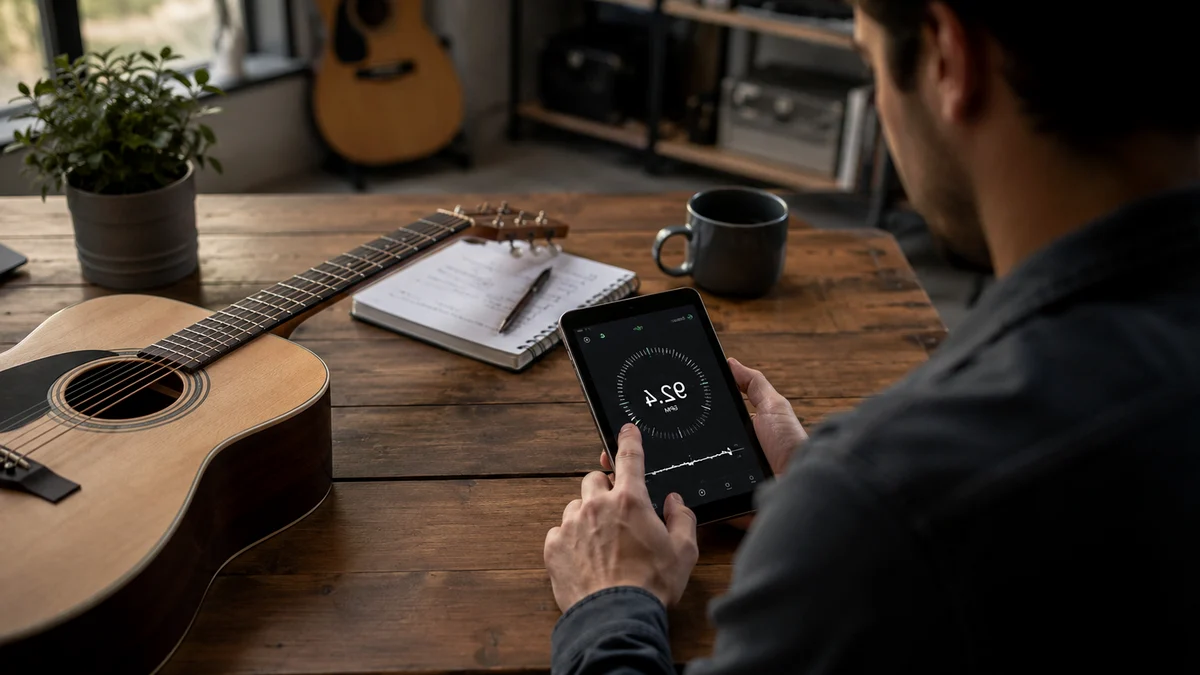
When you pluck a string on your guitar, you are initiating a physical event governed by the laws of acoustics. Most guitarists learn to tune their instrument by focusing on letter names: E, A, D, G, B, and E. However, behind these letters lies a precise world of physics measured in Hertz (Hz).
Understanding guitar tuning frequencies (440Hz) and how they define your instrument's voice is crucial for developing your ear, maintaining your gear, and collaborating with other musicians. Whether you are adjusting your truss rod, setting up your intonation, or simply trying to get in tune with a piano, knowing the mathematical foundation of your fretboard changes how you approach the instrument.
What is the A440 Tuning Standard
To understand how a guitar is tuned, you must first understand the concept of a reference pitch. A reference pitch is a starting point—an acoustic anchor that all other notes are measured against.
What is A440? A440 (or 440 Hz) is the globally accepted standard tuning pitch for Western music. It establishes that the note A above middle C (A4) vibrates at exactly 440 cycles per second (Hertz). All other musical notes on the guitar are tuned in relation to this reference frequency.
This system is known as the A440 tuning standard or concert pitch tuning. When you calibrate an electronic tuner, you will usually see "440Hz" displayed on the screen. This means the tuner is calculating all notes based on the mathematical intervals of the 12-tone equal temperament scale, starting from A4 = 440Hz.
It is important to note a common point of confusion for guitarists: the open A string (the 5th string) on a guitar is not actually 440Hz. The open A string is tuned to A2, which vibrates at 110Hz. This is exactly two octaves below the A4 reference pitch. Because octaves operate on a 2:1 mathematical ratio, doubling 110Hz gives you 220Hz (A3), and doubling that gives you 440Hz (A4).
Guitar String Frequency Chart: Standard Tuning Hz Values
To understand what frequency is each guitar string tuned to, we must look at standard tuning (E-A-D-G-B-E) through the lens of Scientific Pitch Notation (SPN). This system assigns a letter name and a number to each note, indicating its exact octave on a keyboard.
The table below outlines the open string Hz values for a six-string guitar in standard tuning, calibrated to the A440 concert pitch.
Guitar String Frequency Chart
| String Number | Note Name | Scientific Pitch | Frequency (Hz) | Octave Range |
|---|---|---|---|---|
| 1 (Thinnest) | E | E4 | 329.63 Hz | 4th Octave |
| 2 | B | B3 | 246.94 Hz | 3rd Octave |
| 3 | G | G3 | 196.00 Hz | 3rd Octave |
| 4 | D | D3 | 146.83 Hz | 3rd Octave |
| 5 | A | A2 | 110.00 Hz | 2nd Octave |
| 6 (Thickest) | E | E2 | 82.41 Hz | 2nd Octave |
Analyzing the Open String Frequencies
Looking at these specific numbers reveals several practical insights about the guitar's acoustic profile:
- What is the frequency of the low E string? The lowest note in standard guitar tuning is E2, which vibrates at 82.41 Hz. This low frequency requires a thicker string with more mass to vibrate slowly enough to produce such a deep pitch at a playable tension.
- The Octave Relationship: Notice the relationship between the low E string (E2 at 82.41 Hz) and the high E string (E4 at 329.63 Hz). If you multiply 82.41 by four (representing a two-octave jump), you get 329.64 Hz. The slight discrepancy is due to the rounding of decimal points in equal temperament calculations, but acoustically, they represent a perfect multi-octave relationship.
- The Middle Register: The middle strings (D3 at 146.83 Hz, G3 at 196.00 Hz, and B3 at 246.94 Hz) sit comfortably in the human vocal range. This is why the guitar blends so naturally with singer-songwriters; the instrument's primary frequencies occupy the same acoustic space as the human voice.
Why is 440Hz the Standard Tuning Pitch?
If you have ever wondered why is A tuned to 440Hz, you have to look at both history and physics. Before the mid-20th century, there was no global agreement on pitch.
In the 18th and 19th centuries, tuning varied wildly from country to country, city to city, and even church to church. Organ pipes in one cathedral might be tuned to an A of 380Hz, while an opera house down the street tuned to 480Hz. This made it incredibly difficult for traveling musicians to perform without transposing or ruining their instruments by over-tensioning the strings.
The Rise of Pitch Inflation
During the Classical and Romantic eras, a phenomenon known as "pitch inflation" occurred. Orchestras discovered that if they tuned slightly higher than their competitors, their instruments sounded brighter, more brilliant, and more exciting to the audience.
To stand out, orchestras continually raised their reference pitch. However, this caused strong problems. Singers strained their vocal cords trying to reach notes that were suddenly much higher than composers intended. Wind instrument makers struggled to build instruments that could adapt to these shifting standards.
The Path to Standardization
To stop pitch inflation, several attempts at standardization were made:
- The French Diapason Normal (1859): France passed a law setting the standard pitch of A at 435Hz. This was a popular standard across Europe for several decades.
- The London Conference (1939): An international conference recommended that A440 be adopted as the official standard. This frequency was chosen as a compromise between various European and American standards.
- The ISO Standard (1955): The International Organization for Standardization formally adopted A440 as ISO 16. This solidified 440Hz as the global reference pitch for broadcasting, instrument manufacturing, and musical performance.
Today, almost every digital tuner, synthesizer, and virtual instrument is calibrated to A440 by default. When you use the online guitar tuner on Chords.me, it relies on this exact standard to help you keep your instrument in perfect pitch with the rest of the musical world.
Understanding Hertz and Audio Frequency in Guitar Acoustics
To truly Practice instrument, it helps to understand what these numbers actually mean. The term Hertz (Hz) is a unit of frequency defined as one cycle per second. It is named after Heinrich Hertz, the German physicist who proved the existence of electromagnetic waves.
When you pluck your low E string, the string physically moves back and forth 82.41 times every second. This physical movement pushes and pulls the surrounding air molecules, creating a pressure wave that travels to your ear. Your eardrum vibrates at that exact same frequency, and your brain interprets those physical vibrations as the musical note E.
Fundamental Frequencies vs. Harmonics
When a guitar string vibrates, it does not just vibrate at one single frequency. If it did, it would sound like a sterile, lifeless test tone from a laboratory generator.
Instead, a plucked string vibrates in multiple ways simultaneously:
- The Fundamental Frequency: This is the lowest and loudest frequency produced by the string. It determines the actual pitch you hear (e.g., 110Hz for the open A string).
- Overtones and Harmonics: The string also vibrates in halves, thirds, fourths, and smaller fractions of its total length. These fractional vibrations produce higher pitches called harmonics or overtones. For example, when you play an open A string (110Hz), the string also quietly produces frequencies at 220Hz, 330Hz, 440Hz, 550Hz, and beyond.
The unique blend of these harmonics is what gives the acoustic or electric guitar its distinctive timbre. A wood choice, pickup design, pick material, and string alloy all influence which harmonics are emphasized, but the underlying fundamental frequencies remain tied to the physics of standard tuning.
The 432Hz vs. 440Hz Debate: Is 432Hz Better for Guitar?
In recent years, an internet-driven debate has emerged regarding whether A440 is the "correct" standard. Many online articles and videos claim that tuning to A432 (where A4 is calibrated to 432Hz instead of 440Hz) is superior, healthier, or more natural.
But is 432Hz better than 440Hz for guitar, or is this simply a myth? Let's examine the facts.
The Claims Behind 432Hz
Proponents of 432Hz tuning often claim that:
- 432Hz is mathematically aligned with the "Schumann resonances" or the geometry of the universe.
- It is more relaxing, healing, and resonant with the human body.
- It was the "original" tuning standard used by classical masters like Mozart and Verdi.
The Scientific and Historical Reality
When we analyze these claims objectively, they fall apart under historical and scientific scrutiny:
- No Historical Monolith: There was never a single "ancient" standard of 432Hz. As historical tuning forks prove, past composers used whatever pitch was available locally. Mozart's tuning fork from Vienna was measured at roughly 421.6Hz, while Verdi actually advocated for 435Hz, only occasionally mentioning 432Hz as a theoretical ideal for vocal preservation.
- The Physics of the Guitar: Tuning your guitar to 432Hz drops the pitch of every note by about 31.8 cents (roughly a third of a semitone). While there is no magical healing property to this frequency, it does have a physical impact on your instrument. Lowering the pitch reduces the overall tension of the strings.
- Tonal Differences: Because of the reduced tension, strings vibrate with a wider physical arc. This can make the guitar feel slightly looser under your fingers, which some players prefer for bending strings. The lower tension also softens the high-end transients, giving the guitar a slightly darker, warmer tone.
If you prefer the warmer sound of lower tension, tuning to 432Hz is a valid artistic choice. However, doing so makes it incredibly difficult to play with other musicians. If you jam with a keyboardist, they cannot easily retune their physical piano to match your 432Hz setup. For general collaborative play, sticking to the A440 standard is highly recommended.
How Reference Pitch Affects Your Guitar Setup
Every time you change the tuning frequency of your guitar, you alter the physical forces acting upon the instrument. A standard set of light-gauge electric guitar strings (.010 to.046) tuned to A440 exerts roughly 100 to 110 pounds of tension on the neck.
If you alter your tuning standard or drop to alternative frequencies, you must understand how this tension shift impacts your guitar's geometry.
Changing the Reference Pitch
If you decide to experiment with 432Hz or other historical pitches (like the Baroque standard of A415), the overall tension on your neck will drop. This can cause the truss rod inside your guitar neck to pull the neck slightly backward, resulting in flatter action and potential fret buzz.
Conversely, if you raise your reference pitch above 440Hz (some modern European orchestras tune to A442 or A443), the tension increases. This can pull the neck forward, raising your action and making the guitar harder to play.
Alternative Tunings and Frequencies
Many guitarists use alternative tunings to achieve different tonal colors. When you drop your tuning, you are changing the fundamental frequencies of your strings.
For example, in Eb Standard Tuning (where every string is tuned down a half-step), your frequencies shift downward:
- Eb2: 77.78 Hz
- Ab2: 103.83 Hz
- Db3: 138.59 Hz
- Gb3: 185.00 Hz
- Bb3: 233.08 Hz
- Eb4: 311.13 Hz
In Drop D Tuning, only the 6th string is altered, dropping from E2 (82.41 Hz) to D2 (73.42 Hz). This deep frequency provides a heavy, resonant bass response popular in rock and metal music. Because of the lower tension on that single string, players often use a thicker string gauge for the 6th string to prevent it from sounding muddy or rattling against the frets.
Practical Tips for Precision Tuning
Understanding the science of frequencies is only half the battle; you also need to apply this knowledge when tuning your instrument. Here are some practical tips to ensure your guitar remains perfectly calibrated to the A440 standard:
- Tune Up, Never Down: When tuning a string, always approach the target frequency from below. If a string is sharp, tune it flat first, then slowly tension it up to the correct Hz value. This prevents the string from getting caught in the nut slots, which can cause it to slip out of tune the moment you bend a note.
- Account for Temperature and Humidity: Wood is highly sensitive to environmental changes. Cold temperatures cause wood to contract, which increases string tension and raises your frequencies. Warm, humid environments cause wood to expand, lowering your pitch. Always let your guitar acclimate to a room for 15 minutes before performing a final tune.
- Use Quality Tools: Clip-on piezo tuners and pedal tuners are great for noisy stages, but for precise setups and intonation work, a high-resolution digital tuner is essential. The guitar tuner tool on Chords.me offers the precision needed to ensure your fundamental frequencies are perfectly aligned with concert pitch.
- Check Your Intonation: A guitar can be perfectly in tune on the open strings but completely out of tune as you play higher up the neck. To check this, pluck the open string and note its frequency. Then, gently press the string at the 12th fret and pluck it again. The frequency at the 12th fret should be exactly double the open string frequency (one octave higher). If it is sharp or flat, your saddle needs to be adjusted.
By grounding your guitar playing in the physical reality of acoustic frequencies, you demystify the fretboard. Whether you are performing standard maintenance, collaborating in an ensemble, or exploring alternative sounds and textures, keeping these numbers in mind ensures your instrument always sounds its best.
Related Chords.me Guides
For the next step, read Open G Tuning Guide, Chromatic Tuner Guitar Guide: How to Tune Accurately as a Beginner, and Drop C Tuning Guide: Notes, Setup, and Common Mistakes before moving on. You can also test the same idea in another key and check each string with the guitar tuner while practicing this lesson.
Practice This With Chords.me
Use the Guitar Tuner to check each string slowly before practicing the example. Focus on clean notes and steady timing before increasing speed.
Frequently Asked Questions
Why is 440Hz the standard for tuning?
440Hz became the international standard pitch for the note A4 in 1955, giving orchestras and instrument makers worldwide a common reference point.
What frequency is the low E string?
The low E string (6th string) in standard tuning is E2, which vibrates at approximately 82.41 Hz.
Is 432Hz tuning noticeably different?
The difference between 440Hz and 432Hz tuning is subtle, roughly a third of a semitone lower, and most listeners cannot reliably tell them apart without a direct comparison.
About the Contributor
Chords.me Tuning & Setup Desk Tuning, strings, and setup contributor
A brand contributor profile for Chords.me tuning and setup content. This desk focuses on tuning accuracy, string choice, fret buzz, intonation, action, and maintenance topics for everyday players. Content is checked for practical clarity, beginner readability, and accurate links to relevant Chords.me tools.